
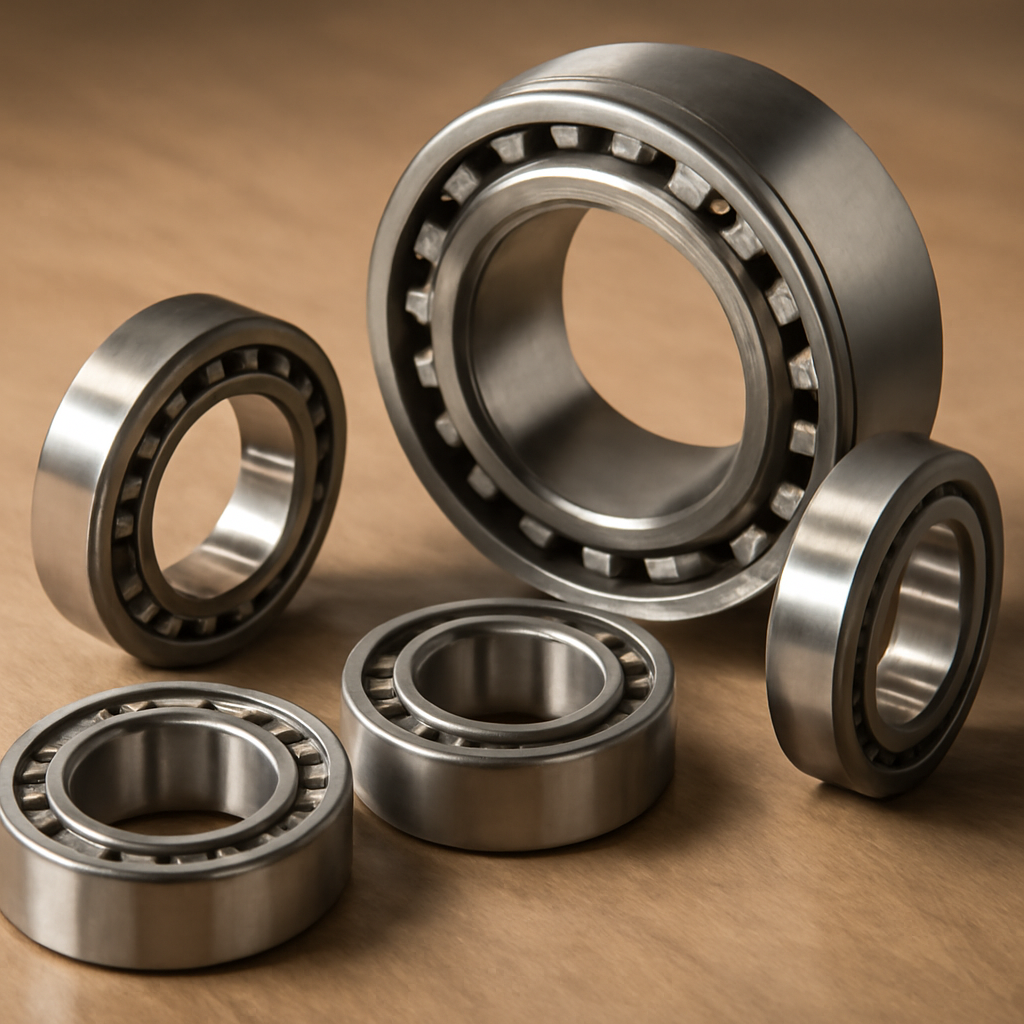
Cylindrical roller bearings are the workhorse where high radial load capacity matters and the application can isolate axial loads in a separate bearing. They are everywhere in electric motors, gearboxes, machine tool spindles, and rolling mill applications.
The standard types
- NU type: outer ring with two integral flanges, inner ring without flanges. Allows axial displacement of the shaft relative to the housing — the floating-bearing arrangement of choice.
- N type: mirror image (flanges on inner ring). Same axial-displacement function.
- NJ type: outer ring with two flanges, inner ring with one flange. Carries small axial loads in one direction.
- NUP type: outer ring with two flanges, inner ring with one integral and one loose flange. Carries small axial loads in both directions.
- NN type: double-row cylindrical roller bearings for very high radial-load spindle applications.
Where they fit
Electric motor traction bearings (the non-drive end), gearbox intermediate shafts, machine tool spindles (NN double-row for high-precision), rolling mill backup roll bearings (four-row cylindrical), and large industrial fans and blowers.
Designation decoder example
NU 2206 ECP: NU type (cylindrical roller, displaceable), series 22 (medium width, heavy load), bore code 06 = 30 mm bore, E = improved internal design with higher load capacity, C = normal clearance, P = glass-fibre-reinforced polyamide cage.
Selection guidance
- Always pair a cylindrical roller bearing with a fixing bearing on the other shaft end to handle axial loads.
- For high-speed applications, choose the E-design with optimised internal geometry.
- Verify the cage choice — polyamide for moderate temperatures, brass for higher temperatures or shock loads.
- Check the clearance class against the expected operating temperature and shaft fit.
The NU vs NJ vs NUP arrangement decisions in depth
The flange configuration on cylindrical roller bearings (NU, NJ, NUP) determines axial guidance capability. Understanding when each is appropriate prevents application mistakes:
- NU type: floating bearing function. Used at one shaft end with a fixed bearing (typically deep groove or tapered roller) at the other end. Accommodates thermal expansion of the shaft.
- NJ type: provides axial location in one direction. Used where modest axial load in one direction must be carried by the cylindrical roller bearing itself.
- NUP type: provides axial location in both directions. Used as a fixed bearing position carrying small bidirectional axial loads.
- NU + HJ (with separate flange ring): combines NU floating function with optional retrofitted axial location ring for service flexibility.
Design for high-speed cylindrical roller applications
Cylindrical roller bearings designed for high-speed operation incorporate specific engineering features: optimised cage design (typically machined brass or one-piece polyamide), modified raceway geometry (logarithmic profile to reduce edge stress), tighter manufacturing tolerances (P5 or P4 precision classes), and specialised lubrication systems (oil mist or oil-air rather than grease).
For machine tool spindle applications, the NN double-row cylindrical roller is the typical workhorse. The double-row construction provides exceptional radial load capacity in a compact axial envelope while maintaining the high-speed capability required for machine tool spindles. Specialised NN-spec bearings from SKF, FAG, NSK, NTN dominate this segment.
Cylindrical roller bearing materials and heat treatment
Standard cylindrical roller bearings use 100Cr6 (52100) through-hardened bearing steel. For high-temperature applications, S0 (stabilised to 150 °C) or S1 (stabilised to 200 °C) heat treatments extend the operating temperature envelope without sacrificing fatigue life. For very high-temperature applications (300 °C+), specialty case-carburised steels are used.
For corrosion-prone applications (food, beverage, chemical), stainless steel variants are available. The stainless cylindrical roller range carries higher cost than standard equivalents but eliminates corrosion-driven failures in aggressive environments. For European food and beverage processors, the stainless cylindrical roller is increasingly the default specification on critical positions.
The role of cylindrical rollers in heavy industrial duty
Beyond standard industrial applications, cylindrical roller bearings appear in heavy industrial duty positions: rolling mill backup roll bearings (four-row cylindrical configurations), large mining gearboxes, power generation turbines, paper and pulp machinery, and cement processing equipment. Each application has specialised bearing specifications developed over decades of operational experience.
For heavy industrial customers, the cylindrical roller bearing is often the most critical bearing in the assembly. The combination of high radial load capacity, ability to handle thermal expansion via the floating configuration, and proven reliability across industries makes the cylindrical roller a workhorse specification.
Modern manufacturing innovations
The major bearing manufacturers continue to invest in cylindrical roller bearing technology. Recent developments include: optimised logarithmic roller profile geometry for reduced edge stress, improved cage materials for high-speed operation, integrated condition monitoring sensors on selected industrial sizes, and advanced surface treatments for micropitting resistance.
For the next decade, the cylindrical roller bearing remains a foundational industrial product. The incremental innovations extend its operational envelope while preserving the simple, reliable design that has made it ubiquitous across European industry.
Cross-reference notes for cylindrical roller bearings
FAG, SKF, NSK, NTN cylindrical roller bearings cross-reference dimensionally on standard catalogue ranges. The enhanced ranges (X-life, Explorer, HP) have proprietary internal geometry that delivers the enhanced calculated life — cross-substitution with standard equivalents loses the enhanced life characteristics. For engineering-class applications, the cross-reference should preserve the enhanced specification rather than dropping to standard equivalents.
The 2026 application engineering ecosystem
Modern bearing application engineering goes beyond catalogue selection. The major manufacturers provide structured application engineering services: bearing selection consultation, calculated bearing life analysis, lubrication system design, failure mode analysis, and integrated condition monitoring programmes. For OEM equipment designers and major industrial customers, engaging these services during equipment design pays back through extended service life and reduced operational risk.
The European authorised distribution network typically provides the first layer of application engineering — sufficient for standard catalogue selection and common application questions. Manufacturer engineering centres provide deeper consultation for complex applications, specialty environments, or new equipment design. The escalation path from distribution to manufacturer is well-established and worth using for non-routine applications.
Quality assurance and traceability
For critical applications, bearing manufacturer quality assurance and product traceability matter as much as the bearing specification. Modern bearing manufacturers maintain detailed batch records, material certification documentation, and dimensional inspection records. For aerospace, medical, and food applications subject to regulatory traceability requirements, this documentation is itself a strategic asset that supports customer compliance.
For routine industrial applications, traceability is less critical but still valuable. When unusual failures occur, batch traceability supports root-cause analysis. When supplier substitution is required, traceability documentation supports engineering equivalence verification.
The strategic supplier relationship
Beyond transactional bearing supply, the strategic supplier relationship delivers value across multi-year horizons. Engineering consultation on new equipment designs, training programmes for maintenance teams, condition monitoring platform integration, and access to roadmap information for procurement planning all flow from strategic supplier relationships. For European industrial customers, building this relationship with one or two preferred manufacturers — while maintaining qualified alternatives for supply resilience — is a sound procurement strategy.
Looking ahead to 2027-2030
The next 3-5 years will see continued bearing industry evolution: smart bearing technology becoming standard rather than premium, condition monitoring platforms maturing across all major manufacturers, supplier consolidation effects flowing through to procurement choices, and end-user expectations evolving toward integrated reliability solutions rather than component supply. For European industrial customers, positioning the procurement strategy for this evolution — qualifying smart bearing platforms, building condition monitoring capability, and maintaining supplier substitution agility — is the strategic foundation for the coming decade.
Practical procurement guidance for 2026
For European industrial procurement teams operating in 2026, the practical guidance distils to a few key principles. First, build multi-supplier qualification across critical SKUs — supplier substitution agility is the most valuable procurement capability through the consolidation period. Second, lock pricing on framework agreements where leverage exists — bearing list prices continue upward trajectory through H2 2026 on most ranges. Third, invest in condition monitoring capability — the technology is mature and the ROI is documented. Fourth, build cross-reference databases that support informed substitution decisions during supply disruptions.
The cumulative effect of these procurement disciplines compounds across years. Organisations that build the capability now position themselves to outperform through the industry transition; those that delay will be implementing in 2028 against competitors who already have the foundation in place. The strategic window is open through 2026; the practical actions are well-defined.
The H2 2026 market context
Looking ahead to H2 2026, the European bearing market enters the period with several specific dynamics worth tracking. Industrial production indicators point toward moderate recovery; raw material costs remain elevated but stable; supply chain rebalancing continues as Schaeffler Yinchuan capacity reaches steady-state output. The NSK + NTN antitrust filings expected in Q3 2026 will be the most-watched ongoing story; SKF Automotive spin-off mechanics provide additional industry restructuring context.
For distributors and end-users operating in this environment, the practical posture is active engagement with supplier strategic developments combined with disciplined operational execution. Framework agreement negotiations during H2 2026 should incorporate the consolidation context; inventory positioning should reflect the lead-time normalisation; condition monitoring deployments should accelerate while implementation capacity is available. The window for proactive positioning ahead of the 2027 industry structure is narrow but real.
Related guides
- Cylindrical Roller Bearings: Features and Industrial Applications
- How to Choose the Right Bearing Based on Load and Speed
- How to Read FAG Bearing Designations
Need help choosing the right bearing? Our technical team can support you with selection, cross-references and lead-times.