
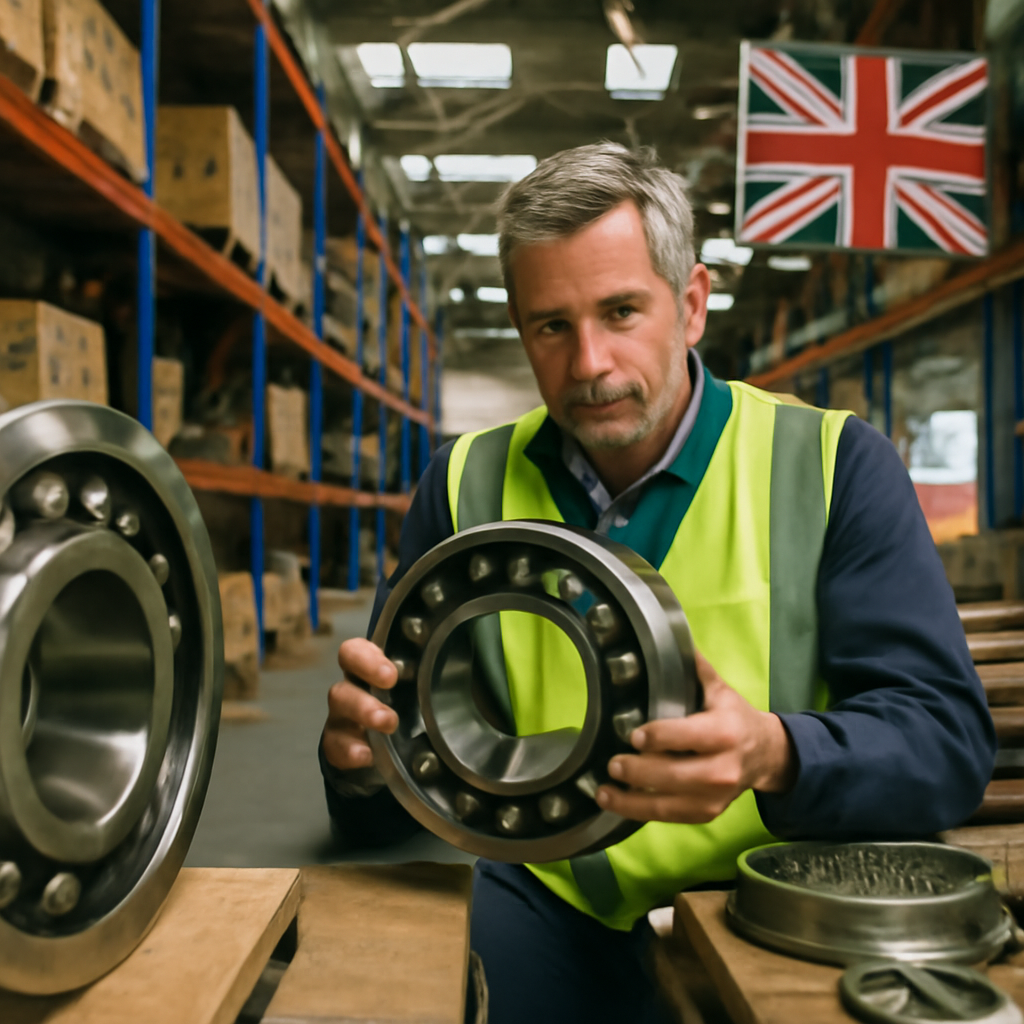
Six years after Brexit, the UK industrial bearings market has settled into its own distinct dynamics. Trade flows that used to move seamlessly between EU manufacturers and UK distributors now involve customs procedures, certificates of origin, and dual-stock strategies. For UK industrial buyers and European distributors serving them, the 2026 reality is shaped by both the lingering Brexit settlement and the global bearing industry transition. Here is the practical snapshot.
1. The supply chain structure in 2026
- Most major bearing manufacturers maintain UK warehousing or distribution partnerships.
- UK distributors operate larger safety stocks than equivalent EU peers — typically 20-30% deeper.
- Continental-to-UK shipping involves customs declarations and slightly longer transit times.
- UK-EU free trade agreement provisions cover most bearing trade but documentation burden remains.
2. The pricing picture
UK bearing list prices broadly track EU prices, with a modest premium reflecting smaller market size, customs friction, and currency dynamics. The sterling-euro exchange rate continues to drive period-to-period variability.
3. Distinctive UK market features
- Strong aerospace bearing demand: UK aerospace industry remains a significant niche.
- Rail industry investment: HS2 and broader rail upgrade programmes drive specialty bearing demand.
- Offshore wind: UK offshore wind capacity is among the largest in Europe and uses large wind-grade bearings.
- Mature manufacturing aftermarket: long-established industrial base means significant aftermarket bearing demand.
4. Where UK distributors compete
- Speed of response to UK industrial customers.
- Local technical support.
- Stock depth on critical industrial references.
- Cross-border capability for UK customers with EU operations.
5. The supply-chain practical considerations
- Origin documentation for bearings shipped EU-to-UK affects duty treatment.
- UKCA marking (where applicable) has implications for some product categories.
- VAT treatment for B2B cross-border has settled into routine but requires attention.
- Currency hedging is a practical issue for large UK end-users buying from EU.
6. The 2026 trends specific to UK
- EV bearing demand growing on the back of UK EV market expansion.
- Wind energy bearing demand strong, driven by offshore wind project pipeline.
- Rail bearing demand driven by HS2 and broader rail investment.
- Aerospace bearing demand recovering as commercial aviation returns to growth.
7. The cross-border opportunity
For European distributors with UK presence (or partnership), the post-Brexit settlement has stabilised. The cross-border opportunity centres on:
- Continental-to-UK supply with established customs processes.
- UK-to-Ireland trade under specific Northern Ireland Protocol arrangements.
- Specialty product categories where EU manufacturers offer breadth UK suppliers cannot match.
8. The watch list
- UK industrial demand trajectory through H2 2026.
- Sterling-euro exchange rate moves.
- Possible UK trade defence measures on steel.
- UK domestic bearing manufacturing investment signals.
Conclusion
The UK industrial bearings market is a distinct sub-market with its own dynamics, premium and discount factors, and demand drivers. Post-Brexit supply chain friction is real but settled; the practical picture is one of stable trade with continuing process burden. For distributors, the opportunity is in delivering the speed, depth and technical support UK industrial customers value.
Related guides
- Bearing Tariffs Update
- REACH Compliance
- Wind Energy Bearings Top 5
- EU Distributors Stockpiling
- Top 5 Trends H2 2026
Need help with bearing selection? Our team supports you with cross-references and lead-times.