
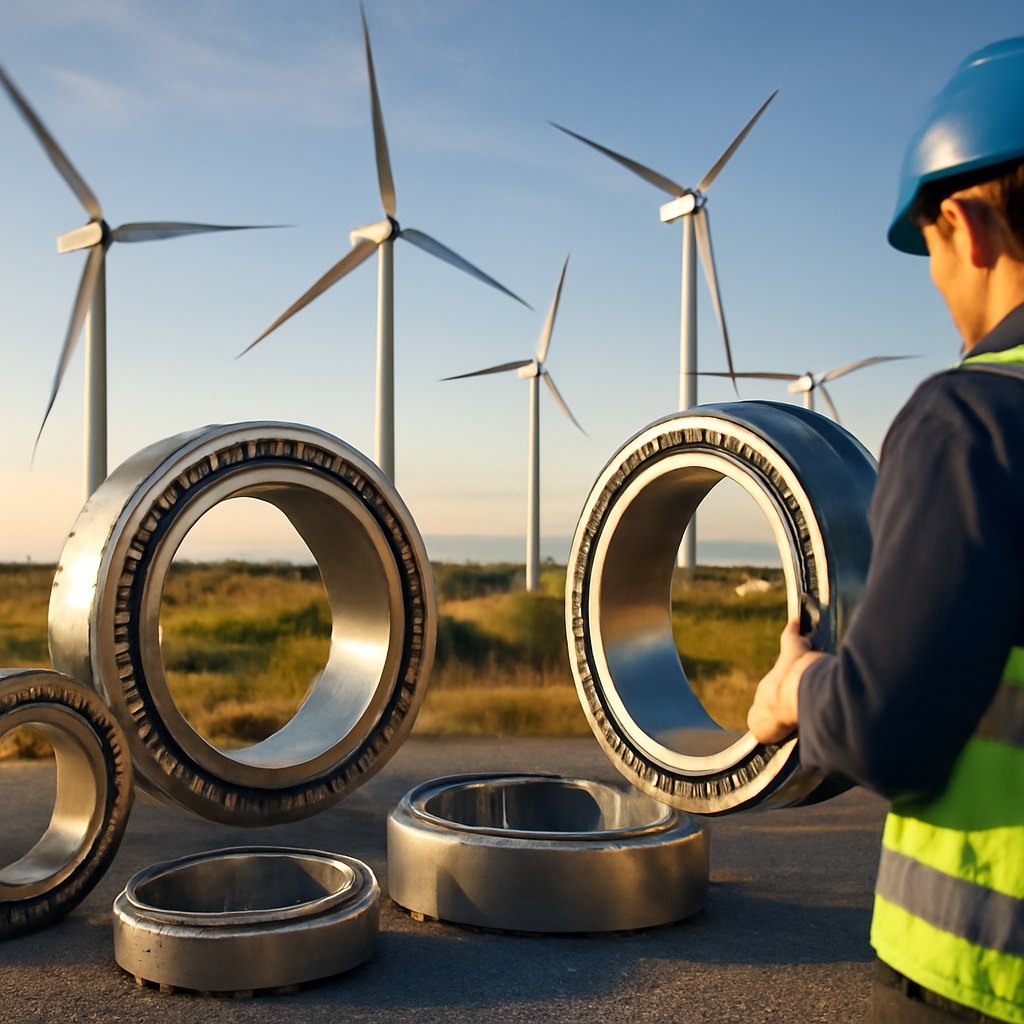
The wind turbine bearing market is one of the most concentrated and technically demanding corners of the global rolling bearing industry. A 5 MW offshore turbine carries 1-2 tonnes of bearings distributed across main shaft, gearbox stages, pitch and yaw drives, and generator. Lead times for wind-grade slewing rings run 9-18 months. Quality requirements are unforgiving — these bearings need to run for 20+ years at sea with very limited access. Five suppliers dominate this market.
1. SKF
SKF has been a wind energy bearing supplier since the early days of utility-scale turbines and remains a market leader. The portfolio covers main shaft spherical and cylindrical roller bearings, pitch and yaw slewing rings, gearbox bearings, and generator bearings (including insulated). Strengths: complete portfolio, deep application engineering, extensive installed base data, condition monitoring integration.
2. Schaeffler
Schaeffler (FAG and INA brands) is the closest competitor to SKF across the full wind portfolio. Particularly strong in gearbox bearings — a position reinforced by aggressive R&D investment to address the historical reliability problems of wind turbine gearbox bearings. Strengths: high-precision gearbox bearings, black oxide coating technology, X-life range.
3. NSK
NSK has a strong presence in main shaft and gearbox bearings, with particular strength in materials engineering (specialty bearing steel grades for the long fatigue life that wind requires). Strengths: NSK proprietary steel grades, application engineering for offshore conditions.
4. NTN
NTN supplies main shaft, gearbox, and generator bearings, with growing presence in large slewing rings. Strengths: large-diameter bearing manufacturing capacity, Japanese OEM relationships extending to global wind OEMs.
5. Liebherr-Bearings
Liebherr Components is the European specialist in very large slewing rings — the pitch and yaw bearings on the largest turbines. Less broad than SKF or Schaeffler but the reference supplier for the largest sizes. Strengths: very large diameter manufacturing capacity, custom engineering.
6. The Chinese challengers
A handful of Chinese bearing manufacturers (Tianma, ZWZ, LYC) are scaling wind-grade capability, particularly on slewing rings for the domestic market. Quality has improved markedly through 2020-2025; export reach into Europe is growing.
7. Where each supplier wins
- Main shaft spherical roller: SKF and Schaeffler dominant.
- Gearbox high-speed stages: Schaeffler and SKF.
- Generator insulated bearings: SKF Insocoat, Schaeffler INSOCOAT.
- Large pitch slewing rings: Liebherr, SKF, Rothe Erde (now part of ThyssenKrupp).
- Yaw slewing rings: similar set, with size-driven sourcing.
8. Persistent industry challenges
8.1 Gearbox bearing reliability
The historical Achilles heel of wind turbine drivetrains. Industry response: material upgrades, surface coatings (black oxide, DLC), drivetrain redesign toward direct-drive and medium-speed permanent magnet generators.
8.2 Main shaft bearing fatigue
White Etching Crack (WEC) failure mode emerged as a significant issue mid-2010s. Industry has largely addressed via material and lubrication improvements, but remains a watch point.
8.3 Slewing ring lead time
9-18 months for custom-engineered units. Capacity expansions ongoing but the bottleneck persists.
9. The 2026 outlook
Wind capacity additions are forecast above 110 GW per year through 2030. The bearing market for wind continues to grow as a structural beneficiary. NSK and NTN merging consolidates two of the top-five wind bearing suppliers, with potential downstream effects on competitive dynamics.
Conclusion
Wind energy bearings are a concentrated, technically demanding market that rewards engineering depth, manufacturing capacity, and long-term supplier relationships. The top five suppliers will likely remain the dominant players through the rest of the decade, with Chinese suppliers gaining ground in selected categories. For wind turbine OEMs and operators, supplier diversification remains a sensible long-term strategy.
The 2026 reliability investment thesis
For European industrial customers in 2026, the broader reliability investment thesis is decisive. The combination of affordable IoT sensors (under $50 per node, an 85% cost reduction since 2019), mature AI analytics platforms, documented ROI cases (6-18 month payback in mid-size plants), and supplier ecosystem support makes condition monitoring deployment economically realistic for virtually any plant with critical rotating equipment. The cumulative effect across years of deployment is meaningful: 30-50% reduction in unplanned downtime, 15-25% reduction in maintenance labour, and extended equipment service life.
For procurement leadership specifically, the reliability investment changes the supplier relationship dynamic. Bearing supply becomes part of an integrated reliability conversation rather than a transactional component supply. Engineering services, condition monitoring platforms, training programmes, and roadmap visibility all flow from strategic supplier relationships. The companies building these relationships now position themselves for the post-2028 industry structure where smart bearings and integrated reliability solutions become standard rather than premium.
What the next 18 months will tell us
The next 18 months will clarify several major industry questions. NSK + NTN antitrust filings progress through Q3-Q4 2026 will reveal the regulatory burden and possible remedies. SKF Automotive spin-off mechanics will be confirmed, with implications for both the SKF industrial businesses and the new standalone automotive entity. Schaeffler Yinchuan capacity ramp will reach steady-state output, affecting standard catalogue lead times and pricing dynamics. EU industrial demand recovery will be tested through H2 2026 and into 2027.
For organisations operating in this environment, active engagement with these developments — through industry events, supplier conversations, and trade press monitoring — supports informed strategic decisions. The bearing industry in 2026-2027 is not on autopilot; the strategic decisions made during this period set competitive positioning for years to come.
Industry consolidation effects on the European market
The European bearing market in 2026 is experiencing one of the most active consolidation periods in three decades. NSK and NTN signed a Memorandum of Understanding on 12 May 2026 to integrate by October 2027, creating a combined entity that will challenge SKF and Schaeffler for the global #1 position. SKF announced and is operationally preparing the separation of its Automotive business under a new three-segment structure (Bearing Solutions, Specialized Industrial Solutions, Automotive). Schaeffler completed major capacity expansion at its Yinchuan (China) facility, doubling manufacturing capacity for high-volume FAG deep groove ball bearings. SKF acquired G-Tech Instruments in March 2026, deepening condition monitoring capability.
For European industrial customers, these consolidation effects translate into specific operational implications. Lead times on standard catalogue ranges should normalise through H2 2026 as the Yinchuan capacity reaches steady-state output. Framework agreement negotiations should incorporate the consolidation context, with provisions for SKU continuity, substitution rights, and engineering support continuity through the transition period. Multi-supplier qualification becomes more important as the industry restructures around fewer larger entities.
Raw material costs and pricing dynamics
Bearing pricing dynamics in 2026 reflect several converging cost drivers. US steel tariffs at 50% (in force since June 2025) reshape global trade flows, with Asian bearing exporters redirecting volume away from the US into Europe and other markets. Bearing-grade alloy premiums continue to widen as demand for cleaner steel chemistry grows faster than supply. EU regulatory developments (CBAM, REACH SVHC updates, steel safeguards) add complexity to import economics.
For procurement teams, the practical posture is active engagement with these dynamics. Lock pricing on top-50 SKUs in framework agreements where leverage exists. Build steel-cost adjustment mechanisms into multi-year contracts rather than fixed pricing. Verify customs classifications carefully — the difference between an HS code that captures CBAM and one that does not can be material. Document supplier origin certifications for preferential trade agreement benefits.
The smart bearing transition and procurement implications
The bearing industry’s transition from component supply to integrated reliability platform delivery represents the defining strategic shift of the decade. Every major manufacturer (SKF Insight, Schaeffler OPTIME, NSK SAT, NTN smart bearing platforms) has built or acquired platform capability. The integrated offering combines instrumented bearings, cloud analytics, AI-based anomaly detection, prescriptive workflow integration, and integrated services.
For procurement leadership, the smart bearing transition reshapes the supplier evaluation criteria. Beyond bearing specifications and pricing, evaluation now includes platform capability, integration with existing CMMS and ERP systems, data ownership and portability terms, and ongoing software roadmap visibility. The platform commitment is multi-year — selecting a smart bearing platform is more consequential than selecting a bearing brand because the platform decision is harder to reverse.
Condition monitoring deployment economics in 2026
The deployment economics for IoT-based condition monitoring in 2026 are particularly favourable for European mid-size industrial plants. Sensor hardware costs have collapsed (under $50 per node, 85% reduction since 2019). Cloud platforms have matured into turnkey SaaS offerings with predictable subscription pricing. AI analytics layer adds capability that human analysts alone cannot match. Documented payback periods converge on 6-18 months for typical deployments.
For a mid-size plant with 50-100 critical assets, deployment economics typically run: €15,000-30,000 first-year capex for sensors, gateways, and integration; €10,000-20,000 annual recurring for cloud platform and ongoing services. Total 5-year cost: €55,000-130,000. Documented savings: 30-50% reduction in unplanned downtime, typically valued at €100,000-500,000 annually. The capital justification is straightforward; the organisational change to operate alongside the technology is the actual implementation challenge.
Looking ahead through 2030
The bearing industry continues structural evolution through the rest of the decade, driven by EV adoption acceleration, wind energy expansion, industrial robotics growth, humanoid robotics commercialisation, and smart bearing technology maturation. The market projection from $151.8B in 2026 to $301B by 2033 reflects these structural drivers operating in parallel. For European industrial customers, positioning the procurement strategy for this evolution now, rather than reacting in 2028, is the strategic foundation for competitive operational performance through the coming decade.
Related guides
- Wind Turbine Bearings
- Bearing Market Outlook 2026-2033
- NSK + NTN Merger
- Bearing Industry 2026 Status Report
- Schaeffler CES 2026
Need help with bearing selection? Our team supports you with cross-references and lead-times.