
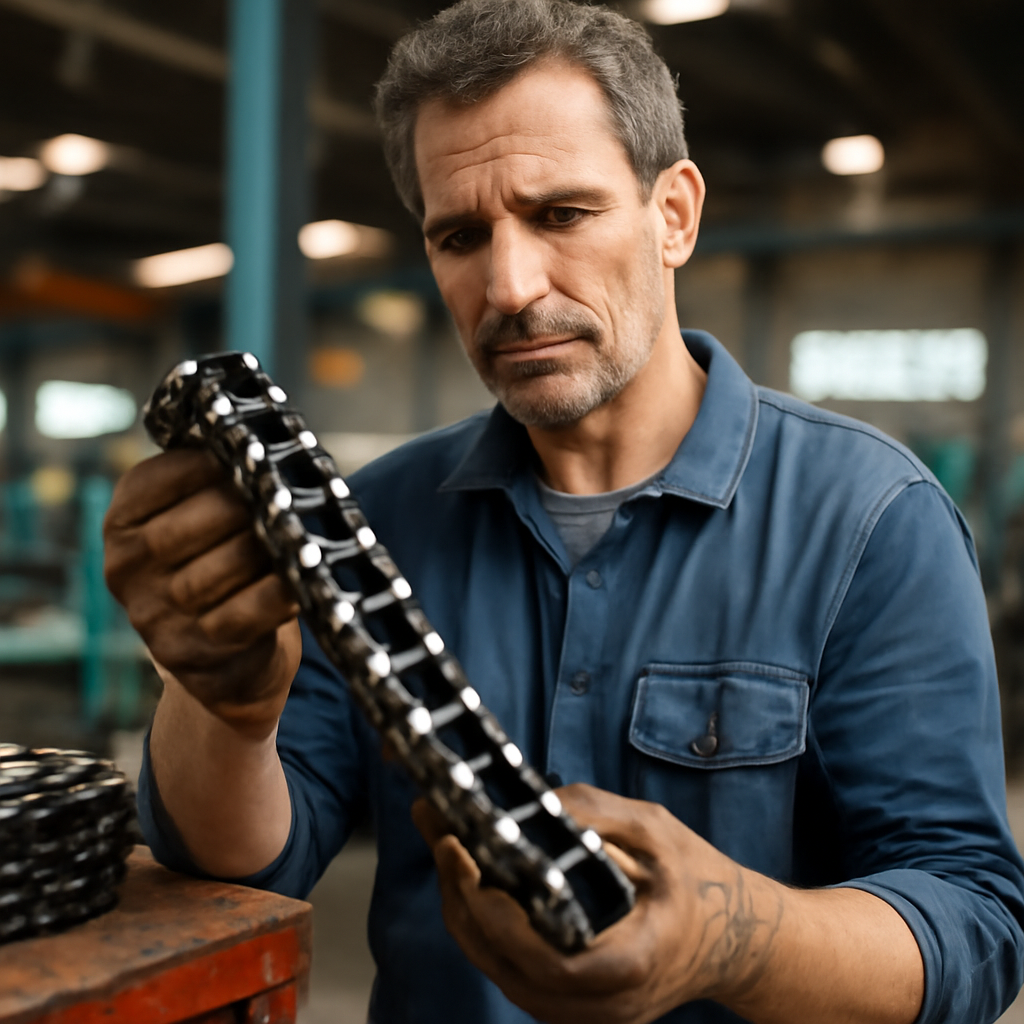
SEDIS, founded in 1929, is one of the European references for industrial transmission and conveyor chains. Roller chains, leaf chains, conveyor chains, attachment chains — the SEDIS catalogue covers virtually every industrial chain application. Selection and maintenance discipline determines whether a chain lasts the expected service life or fails far short. This guide walks through the practical considerations.
1. The SEDIS chain portfolio
- Roller chains (ANSI and ISO): simplex, duplex, triplex, multi-strand. The workhorse of industrial drives.
- Heavy-duty roller chains: oversized rollers and pins for higher load capacity in the same chain pitch.
- Stainless steel roller chains: for wash-down food, beverage, pharmaceutical.
- Self-lubricating roller chains: integrated sintered bushings reduce lubrication requirements.
- Conveyor chains: various standard configurations plus attachment chains for specific carrier mounting.
- Leaf chains: for forklift mast applications and lifting.
- Specialty chains: timing chains, agricultural chains, motorcycle chains.
2. Selection variables
2.1 Pitch
Standard pitches from 6 mm (small instrument chains) to 200 mm+ (heavy industrial). Match to the power and speed requirement.
2.2 Number of strands
Simplex (single), duplex (double), triplex (triple). More strands distribute load and increase capacity.
2.3 Material
- Standard carbon steel: most general industrial applications.
- Through-hardened: higher fatigue strength.
- Stainless steel: wash-down environments.
- Specialty surface treatments: corrosion or wear resistance.
2.4 Configuration
Standard rollers, hollow pins for attachment, specific attachment plates for carrier mounting on conveyor applications.
3. Sprocket pairing
The chain and sprockets must match — same pitch, compatible material, proper tooth count. Common sprocket considerations:
- Minimum 17-19 teeth on the driving sprocket for smooth power transmission.
- Larger sprockets generally improve chain life.
- Hardened sprockets for heavy duty.
4. Tension setup
- Standard horizontal drive: sag in the slack span should be 2-4% of the centre distance.
- Vertical and inverted drives: tighter tension to prevent slack-side disengagement.
- Use a tensioner where the centre distance cannot be adjusted.
5. Lubrication
Chain lubrication is application-specific:
- Low speed, light load: periodic manual oiling.
- Moderate to high speed: drip oiler or oil bath.
- Very high speed: oil stream or oil spray lubrication.
- Wash-down environments: NSF H1 food-grade chain lubricant.
- High temperature: synthetic chain lubricant.
Under-lubricated chains wear at the pins and bushings; over-lubricated chains attract dust and contamination.
6. Wear monitoring
Chains elongate as the pin-bushing joints wear:
- Measure pitch over 10 or 20 links; compare to original.
- Elongation over 2-3% indicates end-of-life — replace.
- Elongated chains skip teeth on sprockets and accelerate sprocket wear.
7. Common failure modes
- Joint wear elongation: normal end-of-life.
- Roller damage: misaligned sprockets or contamination.
- Plate cracks: shock load or fatigue.
- Pin shear: sudden overload.
- Corrosion: inadequate lubrication or environmental.
8. The maintenance discipline
- Weekly visual inspection.
- Monthly tension check.
- Quarterly elongation measurement.
- Annual sprocket inspection.
- Replace chain and sprockets together for best subsequent life.
9. The 2026 context
SEDIS chains have benefited from broader industrial demand. Stainless steel and food-grade variants particularly strong as European food and beverage processing modernise. The conveyor chain segment grows with logistics and e-commerce-driven warehouse automation expansion.
Conclusion
SEDIS industrial chains deliver reliable transmission and conveying when correctly selected, paired with the right sprockets, properly tensioned and lubricated. The maintenance discipline — inspection, lubrication, elongation monitoring — is what separates the assets that achieve their expected chain life from the ones that do not.
The European bearing industry 2026 landscape
The European bearing industry in 2026 enters one of the most active strategic transformation periods in three decades. The NSK + NTN MoU (12 May 2026, target closing October 2027), SKF Automotive spin-off preparation, Schaeffler Yinchuan capacity doubling, and SKF G-Tech Instruments acquisition (March 2026) collectively reshape the supplier landscape. The industry market projection from $151.8B (2026) to $301B (2033) reflects structural drivers operating in parallel: EV adoption acceleration, wind energy capacity expansion, industrial robotics growth, and smart bearing technology maturation.
For European industrial procurement teams, the practical implications converge on five operational priorities. Multi-supplier qualification across critical SKUs supports substitution agility through consolidation. Framework agreement renegotiation captures pricing leverage during the competitive window. Condition monitoring deployment delivers 6-18 month payback ROI on mid-size plant deployments. Smart bearing qualification positions for the 2028+ industry structure. Master data discipline supports informed substitution decisions during supply disruptions.
The smart bearing and condition monitoring transition
The bearing industry’s transition from component supply to integrated reliability platform delivery represents the defining strategic shift of the decade. Every major manufacturer (SKF Insight, Schaeffler OPTIME, NSK SAT, NTN smart bearing platforms) has built or acquired platform capability. The integrated offering combines instrumented bearings, cloud analytics, AI-based anomaly detection, prescriptive workflow integration, and reliability services. For European industrial customers, qualifying smart bearings on critical applications during 2026 positions the organisation for the post-2028 industry structure where smart bearings become standard rather than premium.
Industry surveys converge on 65% of maintenance teams planning AI adoption by year-end 2026 — a documented adoption signal that the industry transition is real and accelerating. For procurement and reliability leadership, the strategic question is no longer whether to deploy but how fast, at what scale, and on which platform.
Raw material costs and tariff dynamics
Bearing pricing dynamics in 2026 reflect converging cost drivers. US steel tariffs at 50% (in force since June 2025) reshape global trade flows, with Asian bearing exporters redirecting volume into Europe and other markets. Bearing-grade alloy premiums continue widening. EU regulatory developments (CBAM transitional phase, REACH SVHC updates, steel safeguards review activity) add complexity to import economics.
For procurement teams, the practical response combines tactical and strategic actions: lock pricing on critical SKU framework agreements during the H2 2026 window; build steel-cost adjustment mechanisms into multi-year contracts; verify customs classifications carefully on cross-border purchases; document supplier origin certifications for preferential trade agreement benefits; build inventory depth on critical references where carrying cost favours stock vs expected H2 2026 price step.
The European bearing industry 2026 strategic landscape
The European bearing industry in 2026 enters one of the most active strategic transformation periods in three decades. NSK + NTN MoU (12 May 2026, target closing October 2027), SKF Automotive spin-off preparation, Schaeffler Yinchuan capacity doubling, and SKF G-Tech Instruments acquisition (March 2026) collectively reshape the supplier landscape. The industry market projection from $151.8B (2026) to $301B (2033) reflects structural drivers operating in parallel: EV adoption acceleration, wind energy capacity expansion, industrial robotics growth, and smart bearing technology maturation.
For European industrial procurement teams, the practical implications converge on five operational priorities: multi-supplier qualification supports substitution agility through consolidation; framework agreement renegotiation captures pricing leverage during the competitive window; condition monitoring deployment delivers 6-18 month payback ROI on mid-size plant deployments; smart bearing qualification positions for the 2028+ industry structure; master data discipline supports informed substitution decisions during supply disruptions.
Smart bearing and condition monitoring transition
The bearing industry’s transition from component supply to integrated reliability platform delivery represents the defining strategic shift of the decade. Every major manufacturer (SKF Insight, Schaeffler OPTIME, NSK SAT, NTN smart bearing platforms) has built or acquired platform capability. The integrated offering combines instrumented bearings, cloud analytics, AI-based anomaly detection, prescriptive workflow integration, and reliability services. For European industrial customers, qualifying smart bearings on critical applications during 2026 positions the organisation for the post-2028 industry structure where smart bearings become standard.
Industry surveys converge on 65% of maintenance teams planning AI adoption by year-end 2026 — a documented adoption signal that the industry transition is real and accelerating. For procurement and reliability leadership, the strategic question is no longer whether to deploy but how fast, at what scale, and on which platform.
Raw material costs and pricing trajectory
Bearing pricing dynamics in 2026 reflect converging cost drivers. US steel tariffs at 50% (in force since June 2025) reshape global trade flows. Bearing-grade alloy premiums continue widening. EU regulatory developments (CBAM, REACH SVHC updates, steel safeguards) add complexity to import economics. For procurement teams, the practical posture is active engagement: lock pricing on top-50 SKUs in framework agreements; build steel-cost adjustment mechanisms; verify customs classifications; document supplier origin certifications; build inventory depth on critical references where carrying cost favours stock vs expected price step.
The H2 2026 procurement action list
For European industrial procurement leadership in H2 2026, the action list converges on five operational priorities. First, multi-supplier qualification across critical SKUs supports substitution agility through the NSK + NTN consolidation period. Second, framework agreement renegotiation captures pricing leverage during the competitive window before the integration closes. Third, condition monitoring deployment delivers documented 6-18 month payback on typical mid-size plant deployments. Fourth, smart bearing qualification on critical applications positions the organisation for the post-2028 industry structure. Fifth, master data discipline supports informed substitution decisions during supply disruptions.
The cumulative effect of disciplined execution across these priorities compounds across years. Organisations that build the capability now position themselves for the post-consolidation industry structure; those that delay will be implementing in 2028 against competitors who already have the foundation in place. The strategic window for proactive positioning is open through 2026 with diminishing returns thereafter.
Related guides
- SEDIS Chains Applications (legacy)
- OPTIBELT V-Belts Selection
- Strategies to Extend Belt Lifespan
- Belt Drive Alignment
- Bearings for Food Industry
Need help with bearing selection? Our team supports you with cross-references and lead-times.