
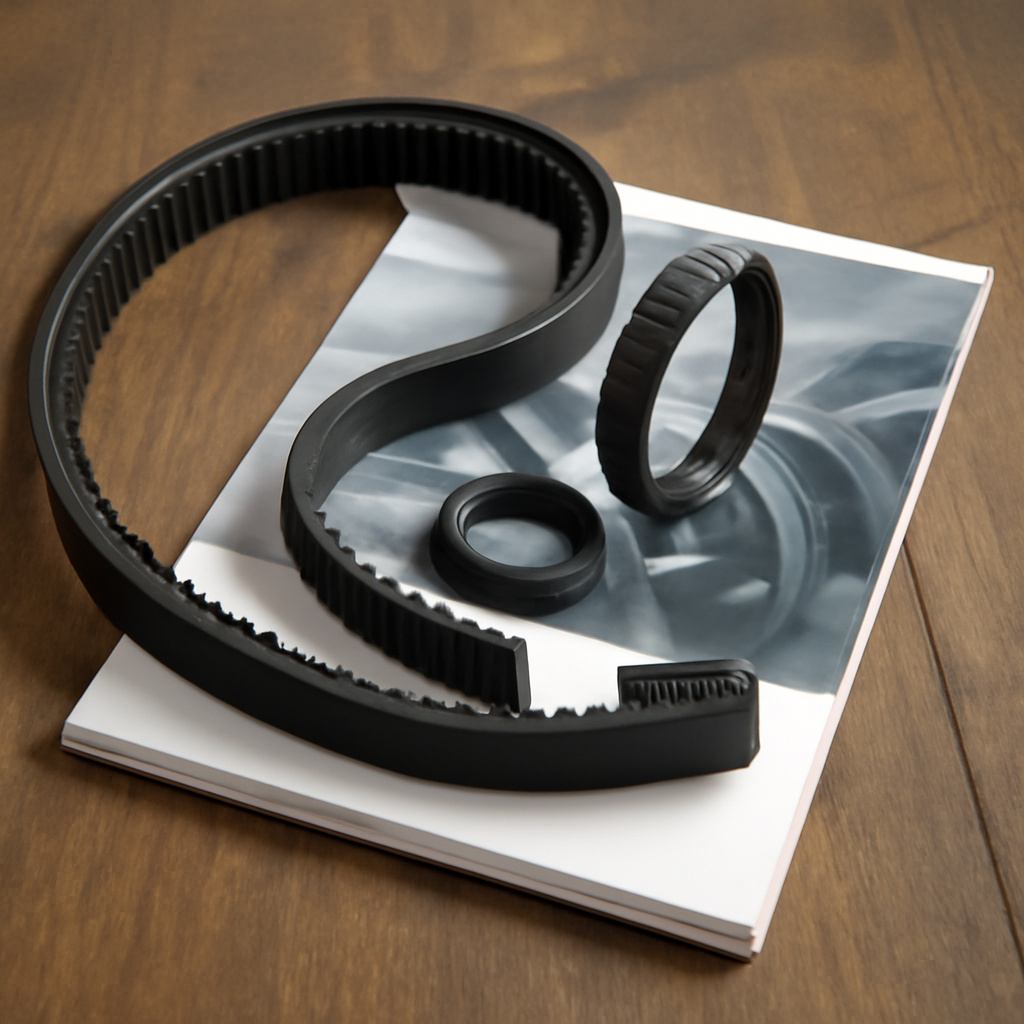
OPTIBELT, founded in 1872 in Höxter (Germany), is one of the most established belt-drive specialists in Europe. Its V-belt range covers every standard industrial profile and a wide aftermarket — but selecting the right belt is more than reading a part number off the old one. Here is a structured guide.
Understanding V-belt profiles
Industrial V-belts come in two main families:
- Classical profiles: SPZ, SPA, SPB, SPC (DIN 2215). Symmetrical wedge shape, broad selection of lengths and widths. Workhorse of general-purpose drives.
- Narrow / high-power profiles: 3V, 5V, 8V (American), XPZ, XPA, XPB, XPC (European). Higher power per centimetre of belt width, smaller pulley diameters possible.
OPTIBELT’s standout range is OMEGA HP — a high-performance, oil- and heat-resistant range designed for continuous operation in tough industrial environments.
Selecting the right belt — the five-step method
1. Calculate the design power
Multiply the nameplate motor power by the service factor (1.0 for steady loads, up to 2.0 for shock-loaded equipment like crushers). The result is the design power.
2. Choose the profile
Cross-reference the design power and the pulley speed against the OPTIBELT selection chart. Most general-purpose drives below 30 kW use SPA or SPB.
3. Calculate belt length
Use the centre-distance formula: L ≈ 2C + π(D+d)/2 + (D-d)²/(4C), where C is centre distance, D is large pulley diameter, d is small pulley diameter. Round to the nearest standard length.
4. Verify the number of belts
Divide design power by the per-belt power rating from the selection chart, round up. Always size for the duty cycle, not the average load.
5. Check pulley wrap angle
The wrap angle on the small pulley should be at least 120°; below that, slip becomes a problem and the belt life drops sharply.
Installation and tensioning
- Use a belt tension gauge, not your thumb. Under-tensioned belts slip and overheat; over-tensioned belts shorten bearing life on both pulleys.
- Re-tension after the first 24 hours of operation; new belts seat in and lose tension during the first hours of running.
- Replace belts in matched sets on multi-belt drives — mixing new and old belts overloads the new ones.
Common selection mistakes
- Picking a belt purely by length without checking the profile fit in the pulley groove.
- Ignoring service factor on shock-loaded drives.
- Running with mismatched belts after a single-belt failure.
- Not checking pulley alignment — a 1° angular misalignment cuts belt life by 25%.
The Optibelt OMEGA HP range in depth
The OMEGA HP range represents Optibelt’s premium positioning in industrial V-belts. The construction combines a chloroprene rubber compound (heat and ozone resistant), polyester tensile cord (low stretch, high strength), and a specific tooth profile (when used in matched timing applications) engineered for sustained operation under demanding industrial conditions.
Specific OMEGA HP advantages over standard V-belts: 30-50% longer calculated service life under typical industrial conditions, broader temperature range (-40 to +110 °C continuous), better resistance to oil and ozone contamination, lower noise emission, and consistent performance batch-to-batch. The price premium over standard belts is typically 20-30%; the breakeven is usually within the first replacement cycle of the standard alternative.
Cross-section selection by pulley diameter
V-belt cross-section selection is constrained by the smallest pulley diameter in the drive. Each cross-section has a minimum pulley diameter below which the belt bends excessively, accelerating fatigue:
- SPZ: minimum pulley diameter 67 mm.
- SPA: minimum 80 mm.
- SPB: minimum 125 mm.
- SPC: minimum 200 mm.
- XPA: minimum 80 mm but higher power density.
- XPB: minimum 125 mm but higher power density.
For drives that must use small pulleys (compact installations, retrofit scenarios), the narrow profile range (XPZ, XPA, XPB) often provides more power transmission capacity in the available pulley size than equivalent classical profiles.
Belt tension measurement and verification
Belt tension gauges fall into two categories: deflection-force gauges (measure force required to deflect the belt a specified distance at midspan) and frequency-based gauges (measure the natural frequency of the slack span and convert to tension). Frequency gauges are more accurate and faster; deflection gauges are simpler and cheaper.
The Optibelt selection charts specify target tension as either deflection force or frequency for each belt type and centre distance. Following the manufacturer’s tension specification produces the calculated belt life; tensioning by feel routinely produces 30-50% shorter belt life than the calculated value.
The retensioning workflow after installation
Belt tension drops during the first hours of operation as the belt seats into the pulley grooves. Standard industrial best practice: install the belt at the recommended initial tension (typically 10-15% above operating target), run for 24 hours, then re-tension to the operating target. Skip this step and the belt operates at 70-85% of design tension for its entire service life — producing predictably shorter belt life and accelerated pulley wear.
Drive replacement strategy in 2026
For aging V-belt drives, the practical replacement decision is rarely about a single belt failure. The question is whether to replace belt-only, belts-and-pulleys, or upgrade to a more modern drive type. Pulley wear accumulates progressively; running new belts on worn pulleys produces fast belt failure and is the most common reason for “I just replaced this belt last month” complaints.
For multi-year planning, schedule pulley replacement on a longer cycle (typically every 3-5 belt change cycles) and belt replacement on the normal interval. Document pulley condition at every belt change. The cumulative cost-of-ownership savings from this discipline are substantial across years of operation.
The Optibelt portfolio across European industrial sectors
Optibelt belts appear across virtually every European industrial sector. Specific product positioning by application:
- Manufacturing and process industries: classical V-belts (SPZ, SPA, SPB, SPC) and narrow profiles (XPZ, XPA, XPB) cover general industrial drives.
- Commercial vehicles: TruckPower KB and TruckPower RBK ranges engineered for sustained duty under heavy load.
- Automotive aftermarket: RBK ribbed belts and Marathon 2 belt range for replacement on passenger and light commercial vehicles.
- Agricultural and off-highway: heavy-duty variants with reinforced cord and resistant compound.
- Marine and offshore: specialty compounds for salt-air and chemical exposure.
- Wind energy: V-belts in some pitch and yaw drive systems on smaller turbines.
The 2026 product roadmap and OMEGA HP positioning
Optibelt continues investment in the OMEGA HP premium positioning with extended sizing, broader profile coverage, and specialty compound variants. The 2026 roadmap includes additional sizes in the XPA and XPB ranges, expanded OMEGA HP coverage in the commercial vehicle segment, and improved cord materials for high-power-density applications.
For European industrial distributors, the OMEGA HP positioning is increasingly important as customers seek extended service life and reduced maintenance burden. The price premium is real but the operational economics favour OMEGA HP for high-duty applications.
Belt installation tooling and good practice
Proper belt installation requires the right tools. Belt installation kits include specialised levers and shoe horns that allow the belt to be installed without forced bending — forced installation damages the cord structure and produces shortened belt life. For multi-belt drives, matched-set belts must be installed simultaneously to ensure equal load distribution.
Post-installation, the running-in period is critical. New belts seat into pulley grooves during the first 24 hours of operation, with measurable tension drop. Re-tensioning after this period is the single most consequential post-installation activity. Skip it and the belt operates at sub-optimal tension for its entire service life.
Drive monitoring integration with condition monitoring platforms
Modern condition monitoring platforms increasingly capture belt drive data alongside bearing data. Vibration signatures from belt drives include characteristic frequencies related to belt frequency, pulley frequency, and shaft speed. Trending these signatures over time identifies belt degradation, tension drift, and alignment issues before visible distress appears.
For maintenance organisations operating IoT-based condition monitoring, integrating belt drives into the monitoring scope is a natural extension. The same platform serves bearings, belts, chains, and other rotating mechanical components — providing fleet-wide reliability visibility from a single integrated data layer.
Industry context and supplier alignment
The European bearing industry continues to consolidate around fewer larger suppliers, more sophisticated technology platforms, and tighter integration between bearing supply and reliability services. For customers, the practical implication is supplier selection becoming a longer-term strategic decision rather than a transactional cost optimisation. The supplier relationship in 2026 carries forward a multi-year roadmap of product evolution, technology integration, and engineering partnership.
Customers who build deliberate, multi-source supplier relationships position themselves to navigate this consolidation effectively. The ability to substitute between suppliers — supported by clean cross-reference data and qualified engineering equivalence — protects against any single supplier’s strategic missteps and captures the competitive value of supplier rivalry while it persists.
Closing notes for 2026 procurement leadership
For European industrial customers in 2026, the bearing procurement environment requires active management rather than passive transactional cost optimisation. Multi-supplier qualification, framework pricing locks during the consolidation window, condition monitoring deployment, smart bearing qualification on critical applications, and master data discipline all compound across years of execution. The cumulative effect of disciplined operational excellence across these priorities positions the organisation favourably for the 2027-2028 post-consolidation industry structure.
Related guides on Eurobearing
Need help choosing the right bearing for your application? Our technical team can support you with selection, cross-references, and lead-time information.
Need help with bearing selection? Contact our technical team for a free consultation.
Related articles