
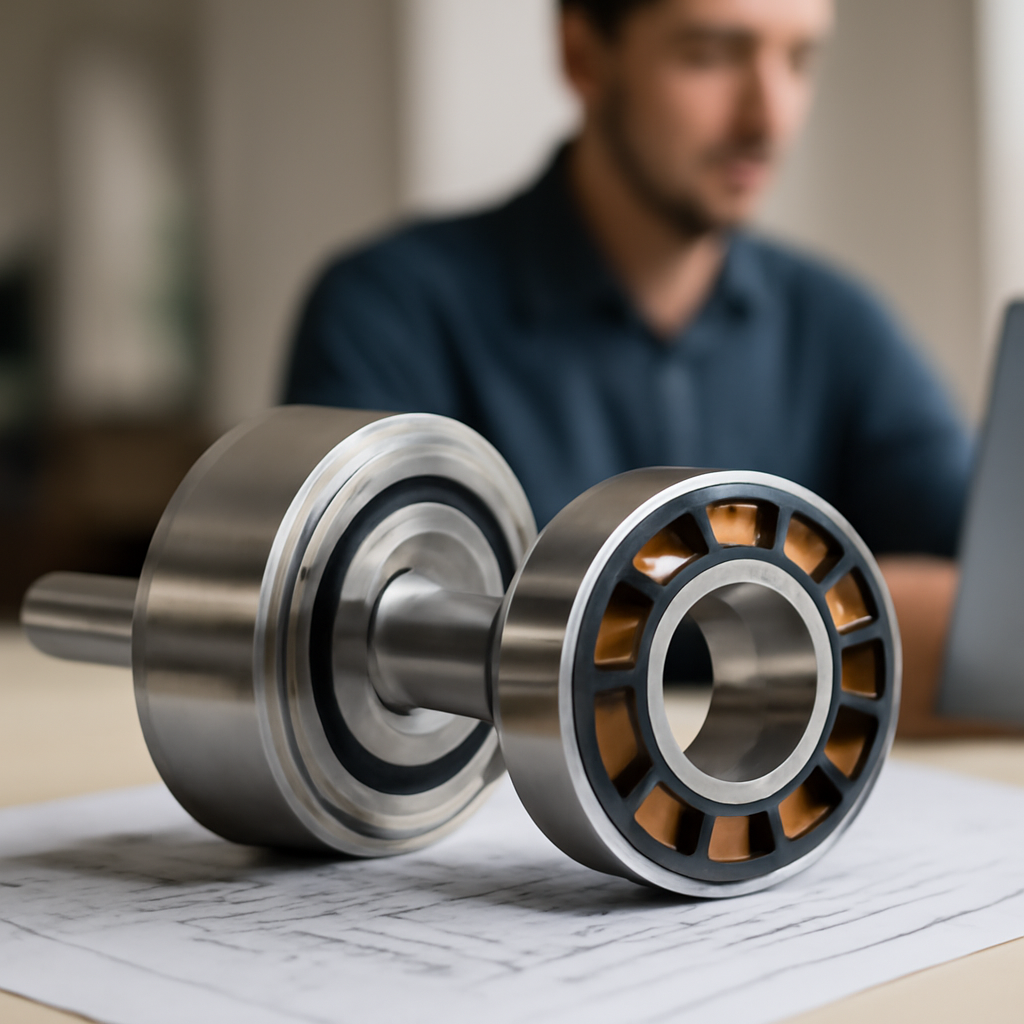
Magnetic bearings — bearings that levitate the shaft electromagnetically without physical contact — represent one of the most fascinating bearing technologies in industrial use. The promise is compelling: zero contact, zero friction, zero wear, infinite service life, no lubrication required. The reality is more nuanced: magnetic bearings serve specific applications where the unique characteristics justify their substantial cost and engineering complexity. This guide walks through when magnetic bearings actually make sense in 2026 and where conventional rolling bearings remain the right choice.
1. How magnetic bearings actually work
A magnetic bearing system consists of:
- Stator electromagnets: electromagnets generating controlled magnetic flux.
- Rotor laminations: ferromagnetic material on the rotor that interacts with stator flux.
- Position sensors: measuring rotor position in real-time at sub-micron resolution.
- Control system: digital controller adjusting electromagnet currents to maintain rotor position.
- Power amplifiers: providing the variable current to electromagnets.
- Backup bearings: conventional rolling bearings to support the shaft during system shutdown or power loss.
The control system runs at millisecond-level cycle rates, continuously adjusting electromagnet flux to maintain the rotor in suspended position against gravity, dynamic forces, and aerodynamic loads.
2. The fundamental advantages of magnetic bearings
- Zero contact: no mechanical wear of bearing surfaces.
- Zero friction: only aerodynamic losses, no bearing friction.
- No lubrication: eliminates lubrication system complexity and maintenance.
- Active vibration control: the control system can actively damp vibrations.
- Position monitoring: continuous shaft position measurement provides built-in condition monitoring.
- Wide speed range: from zero to very high speeds without bearing-imposed limits.
- Vacuum and special environment compatibility: no lubricant contamination concerns.
- Long service life: the bearing itself does not wear out.
3. The fundamental constraints of magnetic bearings
- High cost: typically 5-20x the cost of conventional rolling bearing solutions.
- Power consumption: continuous electrical power required to maintain levitation.
- Engineering complexity: control system tuning, sensor integration, power electronics.
- Backup bearing requirement: conventional bearings still needed for shutdown and emergency.
- Failure modes: control system failure or power loss requires immediate backup bearing engagement.
- Size constraints: limited to specific size ranges where magnetic flux economics work.
- Cost of repair: specialised expertise required for control system service.
4. Where magnetic bearings make practical sense
4.1 Turbo-expanders and turbo-compressors
High-speed turbo machinery in natural gas processing, refining, and air separation benefits from magnetic bearings. The combination of high speed, continuous operation, and specific process requirements (no lubricant contamination) justifies the cost.
4.2 Vacuum applications
Vacuum chambers and high-vacuum systems where lubricant outgassing is unacceptable. Semiconductor capital equipment, scientific instruments, particle accelerators.
4.3 High-purity process equipment
Pharmaceutical, food, and semiconductor processes where lubricant contamination is unacceptable.
4.4 Cryogenic and extreme temperature applications
Applications where lubricant freezes or degrades. Cryogenic pumps, liquefied gas handling.
4.5 Active vibration control applications
Precision spindles or rotating equipment where active vibration damping delivers measurable performance benefit.
4.6 Energy storage flywheels
Kinetic energy storage systems benefit from low-friction levitation. Magnetic bearings in flywheel energy storage are well-established.
5. Where magnetic bearings do NOT make sense
- Standard industrial motor applications: conventional rolling bearings are far more cost-effective.
- Standard pump and fan applications: conventional bearings deliver adequate service life.
- Heavy industrial duty: magnetic bearings struggle with heavy radial loads.
- Mobile equipment: power consumption and backup bearing complexity make conventional bearings preferable.
- Cost-sensitive applications: the price premium is operationally indefensible.
- Applications where occasional power loss is tolerable: conventional bearings provide passive operation.
6. The major magnetic bearing suppliers
- SKF Magnetic Bearings: integrated with SKF Specialized Industrial Solutions segment. Comprehensive product range.
- Waukesha Magnetic Bearings: US-based specialist serving oil and gas industry.
- Calnetix: integrated motor-bearing systems for industrial applications.
- S2M (Société Mécanique Magnétique): French specialist, part of SKF.
- Mecos: Swiss specialist in high-speed rotating machinery.
7. The integration with motor and process design
Magnetic bearings are typically not retrofitted to existing equipment. They are designed into new equipment from the concept stage, with motor topology, rotor design, and control system architecture optimised for the magnetic bearing application. The integration requires deep collaboration between bearing manufacturer, motor manufacturer, and equipment OEM.
8. Cost-benefit analysis framework
Magnetic bearing economic case requires:
- High-value application where bearing reliability has high operational impact.
- Specific technical requirement (no lubricant, high speed, vibration control) that conventional bearings cannot meet.
- Continuous duty cycle to amortise the engineering investment.
- Operator capability to maintain control system over equipment life.
For applications meeting these criteria, magnetic bearings can deliver compelling lifecycle economics despite high acquisition cost.
9. The maintenance implications
Magnetic bearing maintenance shifts from mechanical bearing service to control system maintenance:
- Control system firmware updates and tuning.
- Sensor calibration and replacement.
- Power amplifier servicing.
- Backup bearing inspection and periodic replacement.
- Specialised technician training for control system work.
10. The condition monitoring built-in
Magnetic bearings provide built-in condition monitoring: continuous shaft position measurement at sub-micron resolution provides extraordinary insight into rotor dynamics, balance changes, aerodynamic loads, and emerging failure modes. The monitoring data is intrinsic to the bearing operation rather than added as separate sensor instrumentation.
11. The 2026 market and growth outlook
Magnetic bearing market growth is concentrated in specific high-value applications. The technology is mature; the deployment is selective. Growth segments include:
- Natural gas processing turbo machinery.
- Semiconductor capital equipment.
- Pharmaceutical specialty equipment.
- Cryogenic and LNG applications.
- Energy storage flywheels.
The market is small in absolute terms (low single digit billion dollars globally) but growing at double-digit rates in specific segments.
12. The procurement guidance
- Magnetic bearings are application-specific selection rather than general procurement category.
- For OEM equipment design, evaluate magnetic vs conventional bearings based on the application requirements.
- For aftermarket service, work with the original magnetic bearing supplier for specialised support.
- Train maintenance teams on the unique aspects of magnetic bearing service.
- Plan for backup bearing inspection and periodic replacement as standard maintenance.
13. The strategic context
Magnetic bearings represent one element of the broader bearing industry’s evolution toward integrated reliability systems. The continuous condition monitoring built into magnetic bearing operation aligns with the broader smart bearing trajectory. As condition monitoring becomes standard across the bearing industry, the boundary between magnetic bearings and conventional bearings with integrated monitoring blurs progressively.
Conclusion
Magnetic bearings deliver unique technical capabilities in specific high-value applications where conventional rolling bearings cannot meet the requirements. The premium pricing pays back clearly in applications where the unique characteristics — zero contact, no lubrication, active control, continuous monitoring — deliver operational value that exceeds the cost. For European industrial procurement teams, magnetic bearing selection is a specialised engineering decision rather than a general procurement choice, but understanding when the technology makes sense supports better equipment specification and procurement guidance.
Related guides on Eurobearing
- High-Speed Spindle Bearings
- Top 6 Bearing Brands
- Aerospace Bearings 2026
- High-Temperature Bearings Selection
- Industrial IoT Sensors Buyers Guide
Need help with bearing selection? Our team supports you with cross-references and lead-times.