
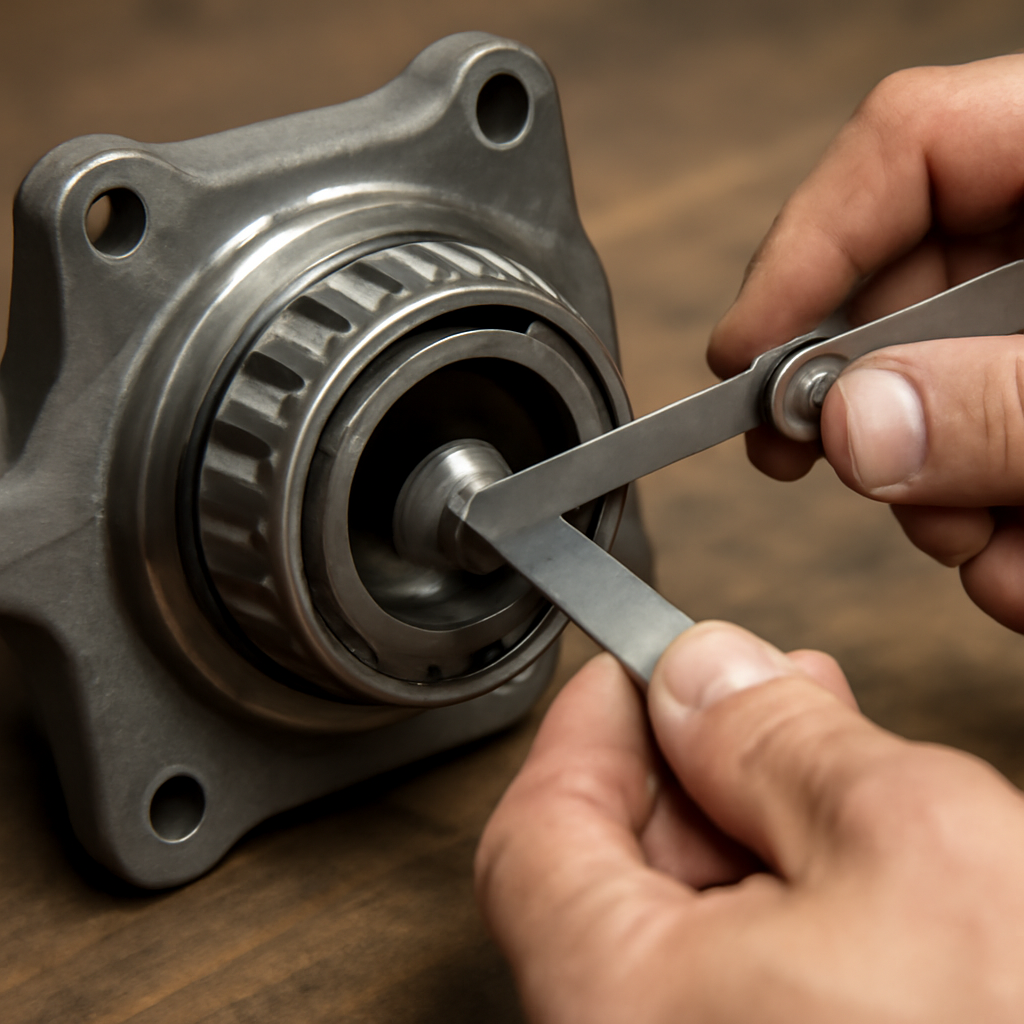
Setting taper roller preload correctly is the single most consequential decision in a paired-taper bearing installation. Too loose and the bearing runs with excess endplay. Too tight and the bearing runs hot, reducing service life. The catalog specifications give ranges but most workshops set preload by feel, which produces inconsistent results across technicians. This piece walks through the disciplined feeler gauge and endplay measurement method.
Why preload matters more than most technicians assume
Taper roller bearings work in pairs because a single taper roller cannot take reversing axial loads. The pair provides two-way axial capacity but only when the preload between the two bearings is set within a narrow window. Outside that window the bearing pair either runs with too much endplay or too much preload.
The feeler gauge method
The feeler gauge method sets preload by direct measurement of the axial clearance before final tightening. Position the assembled shaft and bearing pair in the housing with the outer nut backed off. Insert a feeler gauge between the bearing outer ring and the housing shoulder. Measure the clearance. Tighten the outer nut incrementally, remeasuring until specified. On TIMKEN paired-taper installations the target is typically 0.10 to 0.15 millimetres endplay before final preload adjustment.
The endplay verification step
After feeler gauge setting, verify endplay by rotating the shaft and measuring axial displacement with a dial indicator. Mount the dial indicator against the shaft end. Push the shaft firmly toward the fixed bearing, zero the dial. Pull the shaft firmly toward the free bearing and read the displacement. This is the total axial endplay. Should match the feeler gauge measurement within 20 microns.
Setting preload from endplay through nut torque
Once endplay is verified, the preload comes through additional nut torque. The catalog specifies the torque increment above the zero-endplay point. On a SKF paired taper installation for a heavy-truck axle application the torque increment might be 80 to 120 Newton-metres above the point where endplay reaches zero.
The temperature complication nobody discusses
Preload set at ambient temperature increases at operating temperature because the shaft expands more than the bearing race outer ring. On installations that will run at 80°C or more above ambient, the ambient preload needs to be lower than the operating temperature target. The thermal expansion calculation is straightforward but often forgotten. Rule of thumb: subtract 10 percent from the specified preload for each 30°C above ambient.
What proper preload feels like when it is right
An experienced technician can feel proper preload by hand rotation. The shaft rotates with steady, moderate resistance — not free-spinning, not gripping. If you can spin the shaft with one finger, the preload is too low. If the shaft requires visible force to rotate, the preload is too high.
The common mistakes on paired-taper installations
Three mistakes account for most premature paired-taper bearing failures. First: skipping the feeler gauge measurement and setting by feel alone. Second: forgetting the temperature correction. Third: reusing the retaining nut and lock washer — the plastic deformation from the previous installation compromises the preload retention.
The takeaway for the workshop discipline
Feeler gauge setting plus endplay verification takes 20 to 30 minutes on a typical paired-taper installation. The alternative — setting by feel and hoping — costs 3 to 6 months of bearing life at typical duty cycles.
Related coverage on Eurobearing
- TIMKEN Tapered Roller Heavy Industry
- The Four Fits Framework
- Bearing Installation Mistakes
- TIMKEN vs SKF Tapered Selection
- Bearing Buyers Handbook 2026
Need help with paired-taper preload? Our team supports European rebuild shops with preload verification methods. Book a free consultation.