
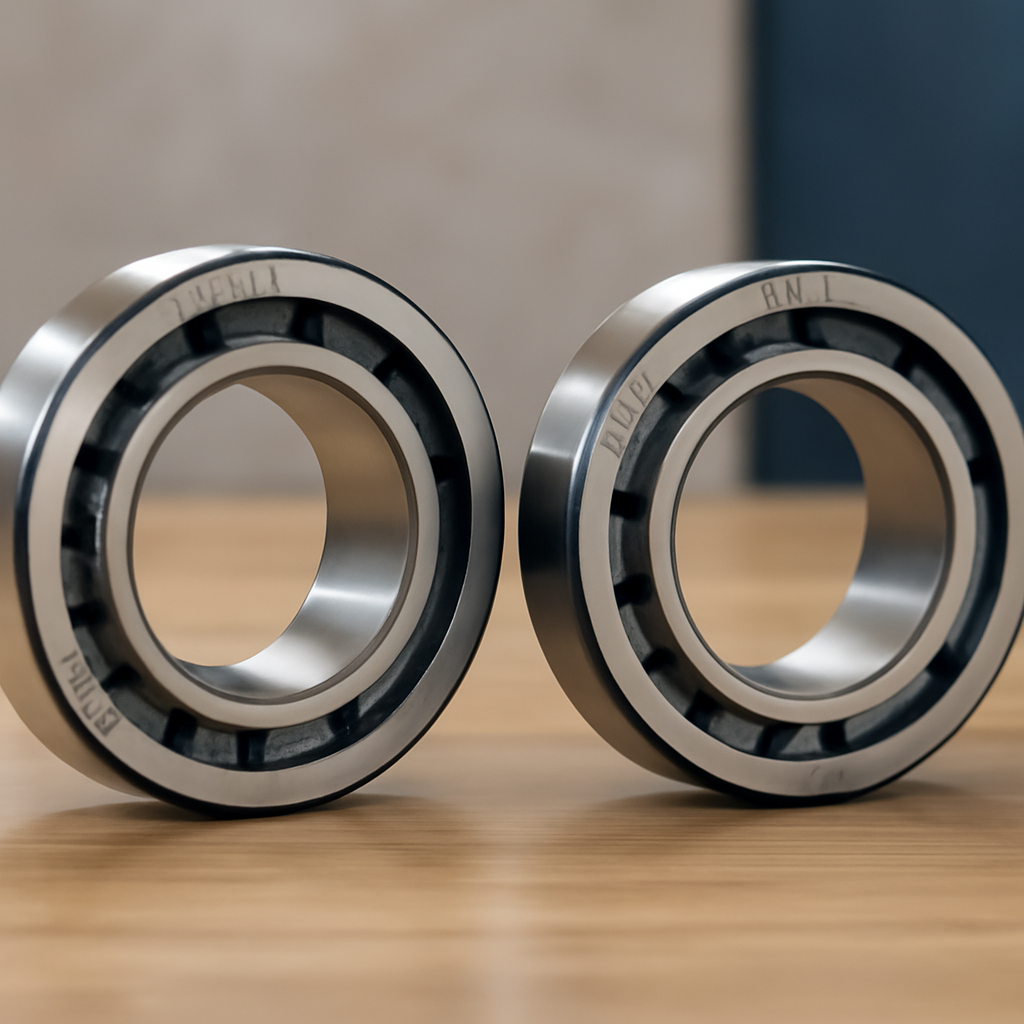
TIMKEN invented the tapered roller bearing in 1898; SKF is the world’s largest bearing manufacturer and offers a complete tapered roller range. Their products cross-reference dimensionally on standard sizes but compete on different strengths in the European industrial market. This is the practical side-by-side selection comparison.
1. The portfolio comparison
1.1 TIMKEN
- Standard metric (DIN 720) and imperial tapered roller ranges.
- Heavy industrial four-row tapered bearings.
- SPEXX enhanced fatigue life range.
- Sealed pre-lubricated truck wheel end units.
- Specialty bearings for railway, mining, aerospace.
1.2 SKF
- Metric tapered roller bearings (30000/32000 series).
- Explorer enhanced fatigue life range.
- SKF Hub Bearing Units (wheel hubs).
- Industrial-grade tapered ranges for heavy duty.
- Marine, wind, papermaking applications.
2. Where TIMKEN wins
- Heavy industrial duty: four-row tapered, mining gearboxes, rolling mills.
- Truck wheel ends: established OEM relationships and aftermarket dominance.
- Railway axle bearings: long heritage and specialty knowledge.
- Imperial sizes: where the application or OEM specifies imperial.
- Aerospace: certified positions where TIMKEN is the qualified supplier.
3. Where SKF wins
- General European industrial: broad availability through European distribution.
- Integrated reliability programmes: where condition monitoring is part of the offering.
- Marine and wind: established positions in those segments.
- Hub bearing units: where SKF Gen 3 units are factory-fit on European vehicle programmes.
- Metric-only environments: simpler local sourcing through SKF distribution.
4. Cross-reference compatibility
TIMKEN and SKF tapered roller bearings cross-reference cleanly on dimensional standards. A TIMKEN 30206 fits the same shaft and housing as an SKF 30206. The differences are in:
- Internal geometry (subtle, affects fatigue life and noise).
- Cage design and material.
- Heat treatment and material specification details.
- Surface finish.
- Premium-range coatings and treatments.
For standard catalogue duty, cross-substitution is generally fine. For engineering-class or premium applications, verify with application engineering.
5. Pricing
List prices are broadly comparable on standard catalogue tapered roller bearings. Premium ranges (TIMKEN SPEXX vs SKF Explorer) carry similar premium and deliver comparable enhanced life characteristics.
6. Lead times and availability
- Standard tapered roller bearings: comparable availability through European distribution.
- Large four-row tapered bearings: TIMKEN often has the broader heavy industrial range; check specific application.
- Truck wheel end units: TIMKEN strong on commercial vehicle aftermarket; SKF strong on European passenger car aftermarket.
7. The application selection matrix
- Truck wheel hub: TIMKEN.
- Passenger car wheel hub: SKF Gen 3.
- Industrial gearbox shaft: SKF or TIMKEN equivalent.
- Mining or steel mill: TIMKEN four-row or SKF heavy industrial.
- Railway axle box: TIMKEN.
- Wind turbine main shaft: SKF (primary supplier).
- Marine propulsion: SKF (primary supplier).
- Aerospace certified: TIMKEN (where qualified).
8. The cross-purchase strategy
Many European industrial buyers maintain dual qualification on TIMKEN and SKF for tapered roller bearings — alternating sourcing based on availability, pricing, and specific application strengths. This is a sound strategy that builds supply resilience without losing engineering performance.
Conclusion
TIMKEN and SKF are both excellent tapered roller bearing suppliers with distinct strengths and natural application territories. Specifying by strength rather than habit — and maintaining dual qualification where practical — delivers better matched selections and better supply resilience.
The European bearing industry 2026 landscape
The European bearing industry in 2026 enters one of the most active strategic transformation periods in three decades. The NSK + NTN MoU (12 May 2026, target closing October 2027), SKF Automotive spin-off preparation, Schaeffler Yinchuan capacity doubling, and SKF G-Tech Instruments acquisition (March 2026) collectively reshape the supplier landscape. The industry market projection from $151.8B (2026) to $301B (2033) reflects structural drivers operating in parallel: EV adoption acceleration, wind energy capacity expansion, industrial robotics growth, and smart bearing technology maturation.
For European industrial procurement teams, the practical implications converge on five operational priorities. Multi-supplier qualification across critical SKUs supports substitution agility through consolidation. Framework agreement renegotiation captures pricing leverage during the competitive window. Condition monitoring deployment delivers 6-18 month payback ROI on mid-size plant deployments. Smart bearing qualification positions for the 2028+ industry structure. Master data discipline supports informed substitution decisions during supply disruptions.
The smart bearing and condition monitoring transition
The bearing industry’s transition from component supply to integrated reliability platform delivery represents the defining strategic shift of the decade. Every major manufacturer (SKF Insight, Schaeffler OPTIME, NSK SAT, NTN smart bearing platforms) has built or acquired platform capability. The integrated offering combines instrumented bearings, cloud analytics, AI-based anomaly detection, prescriptive workflow integration, and reliability services. For European industrial customers, qualifying smart bearings on critical applications during 2026 positions the organisation for the post-2028 industry structure where smart bearings become standard rather than premium.
Industry surveys converge on 65% of maintenance teams planning AI adoption by year-end 2026 — a documented adoption signal that the industry transition is real and accelerating. For procurement and reliability leadership, the strategic question is no longer whether to deploy but how fast, at what scale, and on which platform.
Raw material costs and tariff dynamics
Bearing pricing dynamics in 2026 reflect converging cost drivers. US steel tariffs at 50% (in force since June 2025) reshape global trade flows, with Asian bearing exporters redirecting volume into Europe and other markets. Bearing-grade alloy premiums continue widening. EU regulatory developments (CBAM transitional phase, REACH SVHC updates, steel safeguards review activity) add complexity to import economics.
For procurement teams, the practical response combines tactical and strategic actions: lock pricing on critical SKU framework agreements during the H2 2026 window; build steel-cost adjustment mechanisms into multi-year contracts; verify customs classifications carefully on cross-border purchases; document supplier origin certifications for preferential trade agreement benefits; build inventory depth on critical references where carrying cost favours stock vs expected H2 2026 price step.
The European bearing industry 2026 strategic landscape
The European bearing industry in 2026 enters one of the most active strategic transformation periods in three decades. NSK + NTN MoU (12 May 2026, target closing October 2027), SKF Automotive spin-off preparation, Schaeffler Yinchuan capacity doubling, and SKF G-Tech Instruments acquisition (March 2026) collectively reshape the supplier landscape. The industry market projection from $151.8B (2026) to $301B (2033) reflects structural drivers operating in parallel: EV adoption acceleration, wind energy capacity expansion, industrial robotics growth, and smart bearing technology maturation.
For European industrial procurement teams, the practical implications converge on five operational priorities: multi-supplier qualification supports substitution agility through consolidation; framework agreement renegotiation captures pricing leverage during the competitive window; condition monitoring deployment delivers 6-18 month payback ROI on mid-size plant deployments; smart bearing qualification positions for the 2028+ industry structure; master data discipline supports informed substitution decisions during supply disruptions.
Smart bearing and condition monitoring transition
The bearing industry’s transition from component supply to integrated reliability platform delivery represents the defining strategic shift of the decade. Every major manufacturer (SKF Insight, Schaeffler OPTIME, NSK SAT, NTN smart bearing platforms) has built or acquired platform capability. The integrated offering combines instrumented bearings, cloud analytics, AI-based anomaly detection, prescriptive workflow integration, and reliability services. For European industrial customers, qualifying smart bearings on critical applications during 2026 positions the organisation for the post-2028 industry structure where smart bearings become standard.
Industry surveys converge on 65% of maintenance teams planning AI adoption by year-end 2026 — a documented adoption signal that the industry transition is real and accelerating. For procurement and reliability leadership, the strategic question is no longer whether to deploy but how fast, at what scale, and on which platform.
Raw material costs and pricing trajectory
Bearing pricing dynamics in 2026 reflect converging cost drivers. US steel tariffs at 50% (in force since June 2025) reshape global trade flows. Bearing-grade alloy premiums continue widening. EU regulatory developments (CBAM, REACH SVHC updates, steel safeguards) add complexity to import economics. For procurement teams, the practical posture is active engagement: lock pricing on top-50 SKUs in framework agreements; build steel-cost adjustment mechanisms; verify customs classifications; document supplier origin certifications; build inventory depth on critical references where carrying cost favours stock vs expected price step.
The H2 2026 procurement action list
For European industrial procurement leadership in H2 2026, the action list converges on five operational priorities. First, multi-supplier qualification across critical SKUs supports substitution agility through the NSK + NTN consolidation period. Second, framework agreement renegotiation captures pricing leverage during the competitive window before the integration closes. Third, condition monitoring deployment delivers documented 6-18 month payback on typical mid-size plant deployments. Fourth, smart bearing qualification on critical applications positions the organisation for the post-2028 industry structure. Fifth, master data discipline supports informed substitution decisions during supply disruptions.
The cumulative effect of disciplined execution across these priorities compounds across years. Organisations that build the capability now position themselves for the post-consolidation industry structure; those that delay will be implementing in 2028 against competitors who already have the foundation in place. The strategic window for proactive positioning is open through 2026 with diminishing returns thereafter.
The H2 2026 procurement action list
For European industrial procurement leadership in H2 2026, the action list converges on five operational priorities. First, multi-supplier qualification across critical SKUs supports substitution agility through the NSK + NTN consolidation period. Second, framework agreement renegotiation captures pricing leverage during the competitive window before the integration closes. Third, condition monitoring deployment delivers documented 6-18 month payback on typical mid-size plant deployments. Fourth, smart bearing qualification on critical applications positions the organisation for the post-2028 industry structure. Fifth, master data discipline supports informed substitution decisions during supply disruptions.
The cumulative effect of disciplined execution across these priorities compounds across years. Organisations that build the capability now position themselves for the post-consolidation industry structure; those that delay will be implementing in 2028 against competitors who already have the foundation in place. The strategic window for proactive positioning is open through 2026 with diminishing returns thereafter.
Related guides
- TIMKEN Tapered Roller
- SKF Bearings Complete 2026
- Top 6 Bearing Brands
- Spherical Roller Bearings
- Guide to TIMKEN Maintenance
Need help with bearing selection? Our team supports you with cross-references and lead-times.