
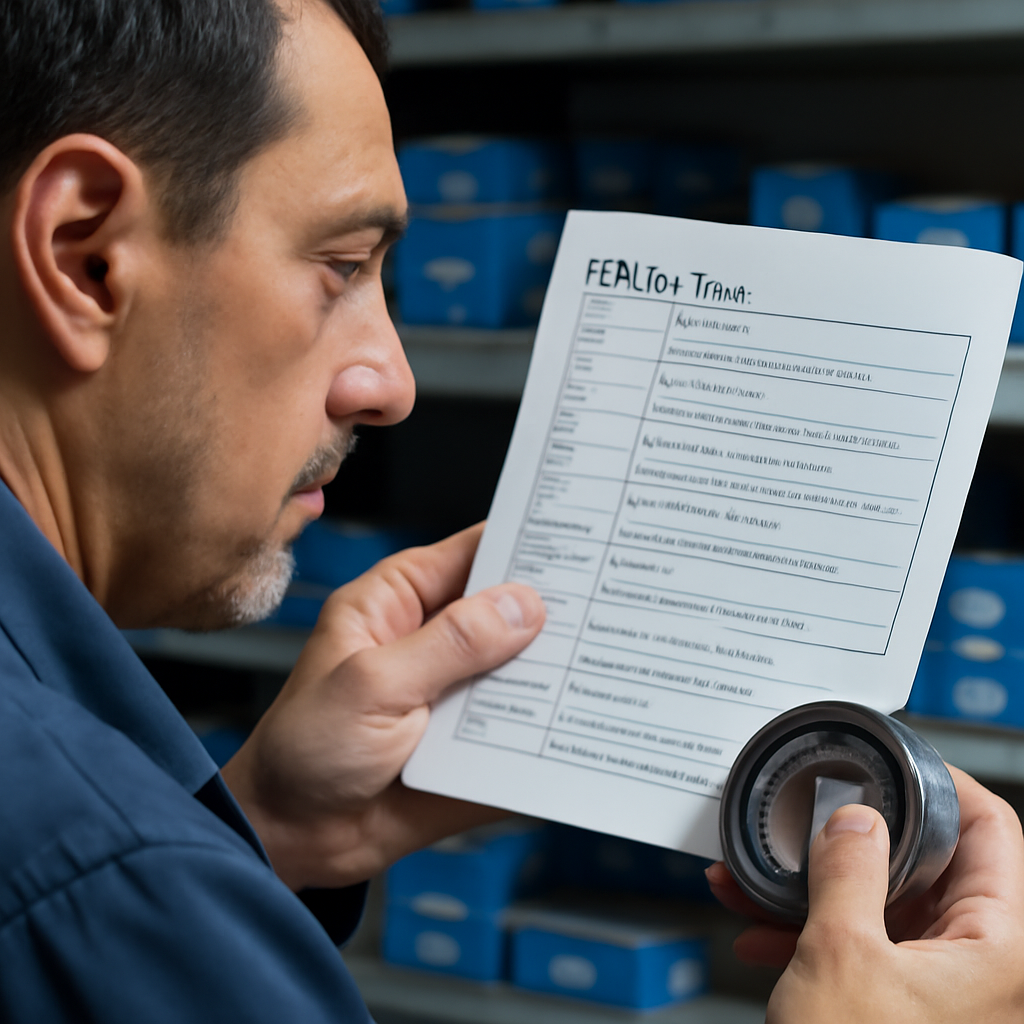
Every distributor counter person eventually needs to decode SKF bearing suffixes without the technical manual open. A customer walks in with a designation like SKF 6205-2RSH/GJN and needs the equivalent aftermarket specification. Recognising the suffix meanings at a glance saves customer conversation time and produces the right cross-reference. This piece walks through the most common SKF suffixes with the practical meaning that matters at the parts counter.
The seal and shield suffixes
SKF uses distinct suffix conventions for seal and shield configurations. Two rubber seals both sides is 2RS. Two rubber seals with high-performance seal design is 2RSH. Two rubber seals with H1 food-grade grease is 2RS1. Two metal shields both sides is 2Z. Single-side seals or shields drop the leading 2. The most common variants at the parts counter are 2RS1 for general industrial applications and 2RSH for upgraded contamination resistance.
The internal clearance suffixes
Internal clearance codes appear after a slash separator. CN is default clearance and often not printed explicitly. C2 is tighter than CN. C3 is looser than CN — the standard specification for gearbox and elevated temperature industrial applications. C4 is further looser than C3 for extreme temperature applications. C5 is the loosest specification for unusual thermal expansion conditions. The most common at the parts counter is C3.
The precision grade suffixes
Precision grades follow ISO 492 convention. P0 or no suffix is normal grade for general applications. P6 is elevated precision for machine tool applications. P5 is high precision for spindle applications. P4 is very high precision for critical spindle applications. P2 is ultra precision reserved for specialty applications. Most parts counter conversations involve P0 grade. Higher precision grades typically come as OEM specifications where the customer knows what they need.
The cage material suffixes
SKF cage material suffixes vary by bearing type. On deep groove ball bearings, TN or TN9 indicates polyamide cage. On roller bearings, M indicates brass cage, MA indicates specific brass cage design, CA indicates steel cage. J indicates specific cage design on cylindrical roller bearings. The parts counter conversations rarely require cage material specification unless the customer has specific application requirements.
The special features suffixes
Special features suffixes indicate specialty designs. VL0241 indicates insulated outer ring for VFD motor applications preventing electrical fluting damage. HC indicates ceramic hybrid rolling elements. GJN indicates high-temperature grease pre-fill. FA indicates specific arrangement for automotive applications. Recognising these suffixes at the counter reveals whether the customer needs a specialty bearing at premium pricing rather than a standard bearing.
The explorer premium range indicators
SKF Explorer bearings carry the Explorer designation as part of the product family rather than as a suffix. Explorer bearings deliver 30 to 45 percent longer L10 life than standard SKF range at 25 to 45 percent price premium. The Explorer branding is prominent on packaging and in catalog listings. If the customer’s original specification includes Explorer, the aftermarket replacement should generally match.
The cross-brand translation
SKF suffixes do not always translate cleanly to other brands. FAG 2RSR is functionally equivalent to SKF 2RS but the mechanical design differs slightly. TIMKEN uses different suffix conventions entirely for equivalent functionality. Cross-referencing works cleanly for common applications but requires attention on premium ranges where the manufacturing tolerance differences matter.
The rolling-element bearing designation conventions
SKF designation conventions have evolved over decades and older bearings from the 1970s and 1980s use somewhat different suffix conventions than current designations. For older bearing replacements, cross-reference tables from SKF technical support are more reliable than assumed suffix meanings. Do not assume older designations translate directly to current conventions without verification.
The takeaway for parts counter staff
Recognising the six suffix categories — seal/shield, clearance, precision, cage, special features and premium range — at a glance handles roughly 90 percent of parts counter conversations without opening the technical manual. Investing 2 to 3 hours of training on the suffix conventions pays back through customer retention and reduced wrong-part deliveries. Distributors serving European industrial aftermarket should include this training in staff onboarding programmes.
Related coverage on Eurobearing
- Reading Catalogue Tolerance Codes
- FAG Designations Decoder
- Bearing Cross-Reference Software
- 6205 Bearing Variants
- Top 6 Bearing Brands
Need help training staff on SKF suffix decoding? Our team supports European distributors with parts counter training programs. Book a free consultation.