
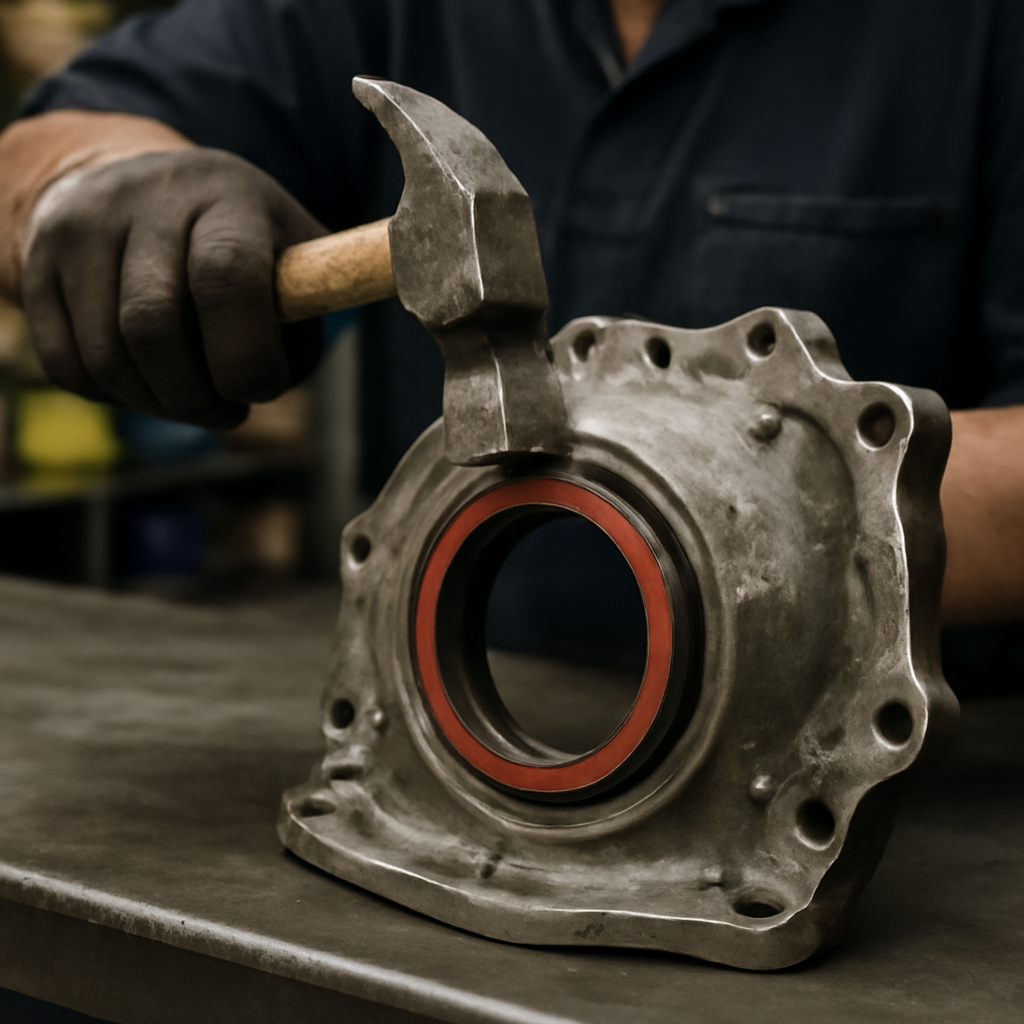
Every rebuild shop faces the situation where a customer arrives with a warped housing and a fresh CORTECO shaft seal to install. The housing has been through years of thermal cycling and the bore is no longer perfectly cylindrical. Getting the seal to sit properly requires a specific workshop recovery method that saves the housing without expensive machining. This piece walks through the practical technique.
The typical warped housing signature
Warped housings show three common signatures. First: visible ovalization at the bore opening — measurable with a dial indicator on a magnetic base. Second: tilted bore axis relative to the housing mounting surface — visible under precise measurement. Third: bore surface irregularities from previous seal installations or removals that damaged the surface finish. Any of the three complicates the fresh seal installation.
Assessing whether recovery is possible
Before deciding to install a seal, measure the bore distortion. Total indicated runout under 40 microns allows recovery through the workshop method. Between 40 and 70 microns the method works but requires specific technique. Above 70 microns the housing needs machining or bore sleeve installation rather than field recovery.
The recovery method: sacrificial installation ring
The sacrificial installation ring approach uses a soft aluminum or brass ring machined to the seal outer diameter and press-fit onto the seal before installation. When you press the assembly into the housing bore, the ring absorbs the distortion by deforming slightly around the low points. The seal itself remains cylindrical and seals properly against the shaft. The ring stays in place during service life.
Preparing the housing bore properly
Clean the bore thoroughly before installing anything. Any grease residue or debris pushes the seal off-square. Use a lint-free cloth with light oil. Inspect the bore for burrs — common where previous seals were pried out — and de-burr with fine emery. A rotary shaft seal installed against burrs develops leaks quickly regardless of installation care.
The adhesive choice for the seal outer edge
Anaerobic adhesive on the seal outer edge fills the small gaps between the seal and the distorted bore. Loctite 5188 or equivalent from other suppliers serves this purpose. Apply a thin bead — excessive adhesive creates its own installation problems. The adhesive sets in 24 to 72 hours and provides both sealing and mechanical retention against pressure differential.
Installation technique that maintains seal squareness
Use a proper seal driver matched to the seal outer diameter. Do not use a drift pin, socket or improvised tool. The driver distributes installation force evenly around the seal outer edge and prevents cocking during entry. Press slowly and steadily. Watch the seal remain visually square as it enters. If it tilts, back off and re-align. Force-installing a cocked seal into a distorted bore guarantees a leak within weeks.
Verifying the installation before service
Rotate the shaft by hand after installation. The shaft should turn without binding. Check the seal lip contact if accessible. Fill the housing to normal service oil level and check for immediate leaks before applying operating pressure. This 15-minute verification catches most installations that would fail early.
When the recovery method fails
Recovery method limits exist. Bore distortion above 70 microns, thermal damage to the housing material, or severe surface damage all defeat the sacrificial ring approach. At these points the pragmatic decisions are: bore the housing to accept an oversize CORTECO seal, install a bore sleeve insert, or replace the housing entirely. Choose based on housing criticality and downtime cost.
What the workshop should stock
Distributors serving European rebuild aftermarket should carry sacrificial installation rings in aluminum matching common CORTECO seal outer diameters — 40, 50, 62, 72, 85 and 100 millimetre sizes. Add anaerobic adhesive in small tubes. Position these as a recovery kit alongside the CORTECO seal range. Customers appreciate the complete solution rather than piecing together components.
The takeaway for the workshop
Warped housing recovery is a learnable skill that saves customers meaningful expense compared to housing replacement. The sacrificial ring method works within specific distortion limits. Match the recovery approach to the distortion severity. Distributors who train customers on the technique differentiate on service depth from generic parts suppliers.
Related coverage on Eurobearing
- CORTECO Seal Square Housing
- Why CORTECO on Top Shelves
- CORTECO Code Decoding
- CORTECO Hydraulic Seals
- Oil Seal Materials 2026
Need help with warped housing seal recovery method? Our team supports European rebuild shops. Book a free consultation.