
The phone at the parts counter rings at half past eight, and the buyer on the line wants a quote for ABEC tolerance classes on forty deep groove ball bearings for a batch of centrifugal pump motors, because a datasheet from a US machine builder says “ABEC 3 minimum” and nobody in the plant knows what that means in European catalogue language. The question sounds simple, yet it hides three separate issues: how the American ABEC scale maps onto ISO and DIN designations, what a tolerance class actually controls inside a bearing, and whether the motor needs the upgrade at all. Answer only the first and the plant pays a premium for nothing measurable at the shaft. This article walks through the mapping, the measured features, the blind spots of the ABEC grade and the applications where a tighter class genuinely earns its price.
Three naming systems describing the same steel
The ABEC scale comes from the American Bearing Manufacturers Association and runs in odd numbers: ABEC 1, 3, 5, 7 and 9, with 9 being the tightest. ISO 492 describes radial bearings with the classes Normal, 6, 5, 4 and 2, again from loosest to tightest, while the German DIN 620 tradition adds a P in front, so Normal becomes P0, then P6, P5, P4 and P2. In practice ABEC 1 corresponds to Normal or P0, ABEC 3 to P6, ABEC 5 to P5, ABEC 7 to P4 and ABEC 9 to P2. The match is close rather than perfect, since a few individual limits differ by a micron, but for purchasing it holds. European manufacturers rarely print ABEC on their boxes; they use the P suffix, and a standard bearing without any tolerance suffix is Normal class. If you want a refresher on where that suffix sits in a designation, our note on reading a catalogue tolerance code without a decoder covers the layout.
What a tolerance class actually measures
A tolerance class sets two families of limits. The first is dimensional accuracy: the permitted deviation of the mean bore diameter and the mean outside diameter from nominal, the variation of those diameters within a single ring, and the deviation and variation of ring width. The second is running accuracy: radial runout of the inner and outer ring, and in the tighter classes also axial runout, side face runout with reference to the bore and the inclination of the outside surface. To give a sense of scale for a bearing in the 18 to 30 mm bore range, the mean bore tolerance in Normal class is 0 to minus 10 micrometres, narrowing to roughly 0 to minus 5 in class 4. Inner ring radial runout falls from 13 micrometres in Normal class to around 3 in class 4 and about 2.5 in class 2. That is why a P4 bearing can hold a spindle nose to a couple of microns, but only on a shaft ground to match.
What ABEC does not tell you
The most common misunderstanding at the counter is that ABEC rates overall bearing quality. It does not. A tolerance class says nothing about radial internal clearance, which is governed separately by the clearance groups C2, CN, C3 and C4, so an ABEC 7 bearing can still have the wrong clearance for a hot motor shaft. It says nothing about noise and vibration levels, which manufacturers test against their own internal limits. It ignores cage design, steel cleanliness and heat treatment, grease and sealing. Even the ball grade, defined by ISO 3290 and quoted as G5, G10 or similar, sits outside the ABEC scale, although precision bearings naturally use finer balls. This is why a quiet, well-made Normal class bearing from a reputable manufacturer will often outlive a cheaper bearing stamped with a higher grade. Read a tolerance class as one requirement among several.
A practical consequence follows for anyone writing a purchase specification. If the real concern behind an “ABEC 3 minimum” line is motor noise, the more useful requirement is a low-noise grade and a defined clearance, typically C3 for an electric motor running warm, not the tolerance class on its own. European manufacturers combine both in one suffix: SKF and FAG, for example, use P63 to indicate class 6 tolerances together with C3 clearance, which is exactly what many motor builders specify. When the concern is shaft runout on a measuring or grinding device, the tolerance class becomes the primary lever, but then the seating surfaces must follow it. Our article on shaft and housing fits for rotating ring load explains why a precision bearing pressed onto a seat with poor cylindricity simply copies the error of the seat into the rotating assembly. Translate the functional need into the right mix of suffixes instead of buying the highest number.
Where P5 and P4 earn their price
Tighter classes pay off where running accuracy is part of the product being made. Machine tool spindles are the obvious case: the runout of the bearing appears directly as form error and surface finish on the workpiece, so grinding, turning and milling spindles use P4 or better, usually as super-precision angular contact bearings mounted in matched sets with defined preload. High-speed applications form the second group. Above a certain fraction of the speed rating, small geometric errors become imbalance and heat, and a P5 bearing in a high-speed fan, a small turbine or a textile spindle runs cooler and quieter than a Normal class part. The third group covers runout-critical equipment such as encoders, printing cylinders, indexing tables and metrology heads. Our overview of spindle bearing selection at leading machine tool builders shows how these choices are made in practice, always starting from the accuracy demanded at the workpiece.
Why pumps and motors run happily on Normal class
Most industrial rotating equipment does not need anything tighter than Normal class, and the reason is the tolerance chain around the bearing. A standard process pump or a four-pole motor runs at moderate speed with shaft seats ground to k5 or j6 and housings bored to H7 or J7, and those fits, plus coupling misalignment and impeller imbalance, dominate the vibration picture by a wide margin. Shaving a few microns of bearing runout disappears in that noise. What does matter on these machines is clearance, lubrication, sealing and correct mounting, which is why the bulk of the super-precision bearings range is aimed at machine tools rather than general plant. A maintenance team replacing a failed bearing should match the original specification rather than upgrade by reflex. If the failure was caused by contamination or poor alignment, a higher tolerance class will fail for the same reason, only at a higher price.
Cost, lead time and stock reality
Price and availability move sharply as you climb the scale. Normal class deep groove and angular contact bearings are produced in very large volumes and sit on distributor shelves across Europe, so they are usually available the same day. Class 6 versions carry a moderate premium and are stocked for popular sizes. From class 5 upward the bearing becomes a different product, with longer grinding cycles, fuller inspection and production in campaigns. That translates into a significant price multiple and lead times that can stretch to weeks when the size is not in a central warehouse. During a breakdown, that matters more than the invoice. The ideas behind tight tolerances are not new; our piece on how aerospace tolerances apply to industrial bearings traces them from flight hardware into factory machinery. The commercial lesson is simple: specify the tightest class the function needs, keep critical spares on site, and never let a precision grade appear on a pump drawing just because someone copied it from a spindle.
Writing a specification that buyers can source
A good specification states the tolerance class in ISO terms, the clearance group, the seal or shield type and, where it matters, the cage material and noise grade. For a plant buying from European distributors, writing “ISO 492 class 6, C3, 2Z” or simply the manufacturer suffix such as P63-2Z removes all ambiguity, while “ABEC 3” alone leaves the counter guessing about the rest. If a drawing originates in North America, translate ABEC numbers to P classes once and record the translation in the maintenance system, so every future order uses the same language. Brands such as SKF and FAG publish their precision suffixes clearly, and comparing the two catalogues side by side quickly shows how equivalent parts are named. Finally, record the seat tolerances alongside the bearing class. A P5 bearing on a coarsely ground shaft is wasted money, and the mismatch is only visible when both values sit on the same page.
The phone call from the pump plant usually ends with a change of order rather than an upgrade. Once the buyer understands that ABEC 3 equals ISO class 6, that clearance is a separate decision and that the motor builder probably cared about noise consistency more than geometry, the order becomes a standard bearing in class 6 with C3 clearance and shields, sourced from stock. The real savings come from that translation step: knowing that ABEC 1 to 9 map onto Normal, P6, P5, P4 and P2, knowing that the class covers dimensions and runout but not clearance, noise, cage, steel or ball grade, and reserving P5 and P4 for spindles, high-speed shafts and runout-critical equipment where the extra microns reach the finished product. Everywhere else, money is better spent on alignment, clean lubrication and correct fits.
Not sure whether your application needs P6, P5 or simply Normal class? Our team supports engineers and buyers in translating ABEC requirements into ISO and DIN designations and finding stocked equivalents. Book a free consultation.
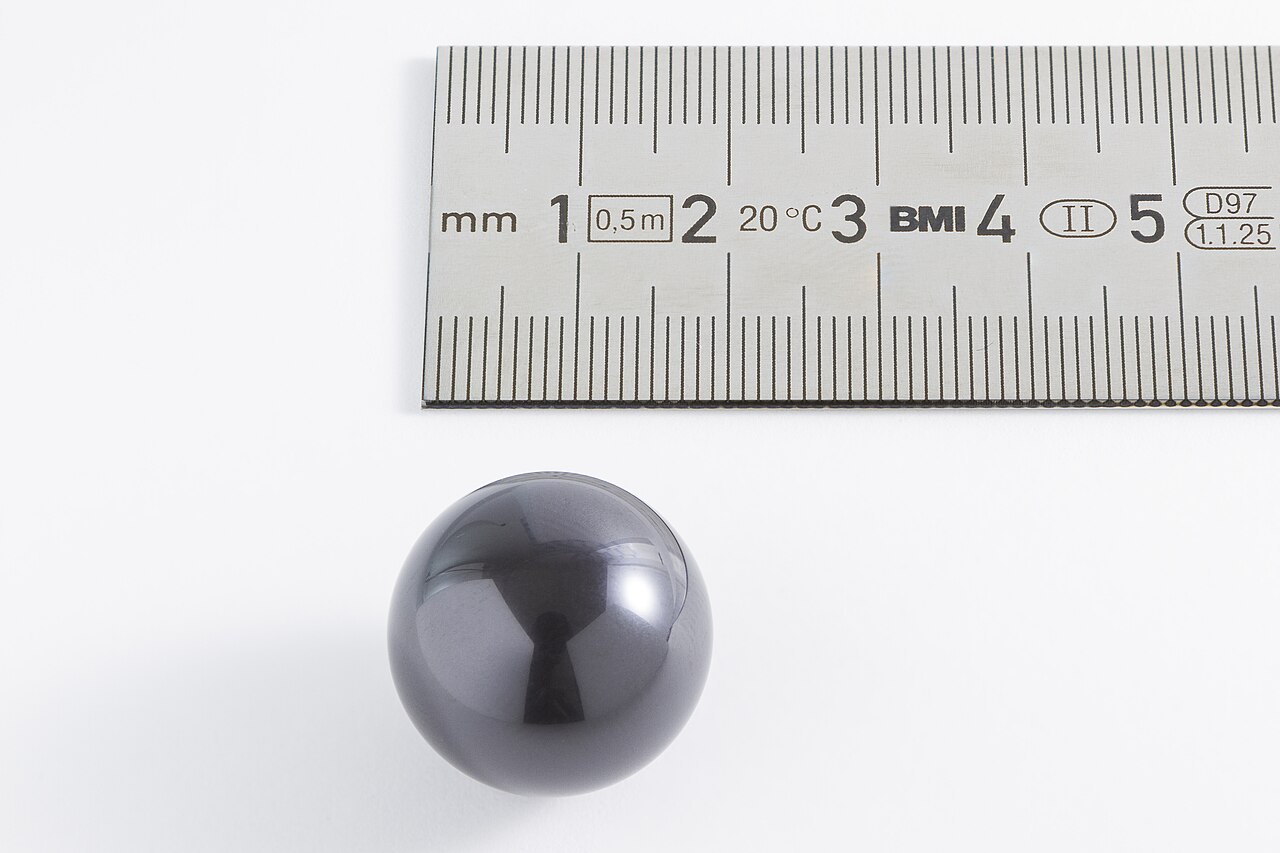
Image credits: “Silicon nitride Si3N4 bearing ball 20 mm G28” by Lucasbosch (CC BY-SA 3.0), via Wikimedia Commons.