
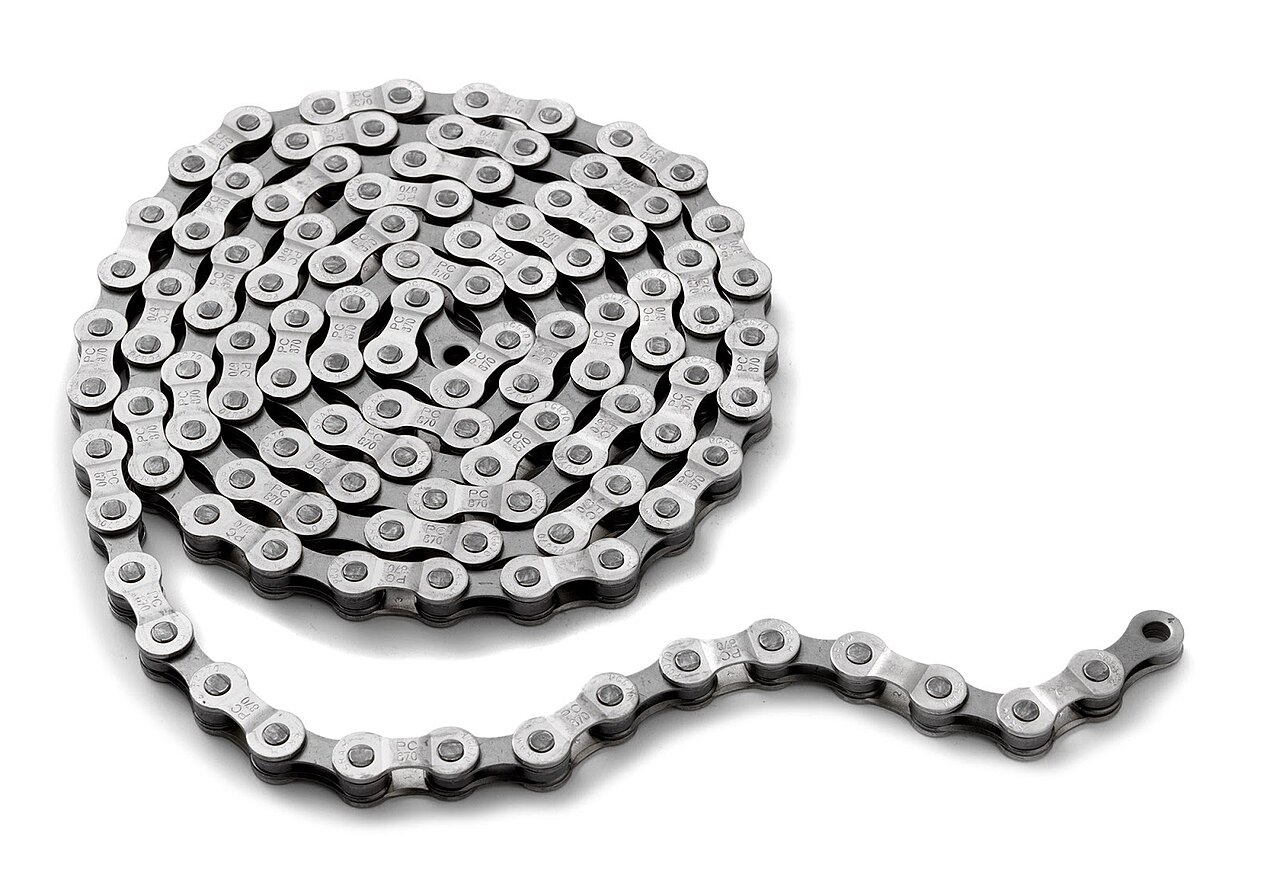
The conveyor fitter from a biscuit plant laid the broken strand on the counter, still greasy, with a bent attachment plate hanging off one link, and asked for the same chain by the afternoon; before anything else, the technician reached for a caliper to confirm the SEDIS roller chain pitch, because three different chains on that site looked almost identical from a metre away. Chain enquiries are deceptively simple. Pitch, roller diameter and inner width define whether a chain meshes with its sprocket, but the standard series, strand count, material and attachment type decide whether it actually does the job. SEDIS, a French manufacturer with a long industrial history, offers a programme broad enough to cover most of these choices, and that breadth is only useful if the buyer understands how it is organised. This article walks through the pitch range, multi-strand and stainless options, attachments, and how SEDIS sits beside bearing brands in a mixed transmission order.
European B series and ANSI A series as the first fork
Every roller chain order starts with a choice between two standards that are close enough to cause mistakes. ISO 606 covers both the European B series, derived from British practice, and the A series, which corresponds to the ANSI chains common in North American designs. At half-inch pitch, an 08B chain has a roller of about 8.5 mm and an inner width of about 7.75 mm, while the ANSI 40 equivalent, designated 08A, has a roller of about 7.9 mm and a similar inner width. Because the pitch is identical, a mismatched chain may even run on the wrong sprocket for a while, but the tooth form does not suit the roller, and wear on both chain and sprocket accelerates. European-built machinery generally uses the B series, while equipment built to American designs, including some packaging and agricultural imports, may carry A series chain. Checking the roller diameter with a caliper, not just the pitch, is the reliable way to tell the two families apart before quoting a replacement.
The pitch range from 3/8 inch upwards
Within the B series, the leading number expresses pitch in sixteenths of an inch, so 06B is 3/8 inch (9.525 mm), 08B is 1/2 inch (12.70 mm), 10B is 5/8 inch, 12B is 3/4 inch and 16B is 1 inch, continuing up to the large pitches used on heavy conveyors and mill drives. The SEDIS range follows this ladder, and two sizes dominate a general-industry counter: the SEDIS RECORD ISO 9.525 mm pitch chain, used on light drives, packaging machines and small conveyors, and the SEDIS RECORD ISO 12.70 mm pitch chain, a staple size on almost every maintenance shelf. Choosing between adjacent pitches is a genuine trade-off: a larger pitch carries more load per strand but produces greater polygonal speed variation and more noise at a given sprocket tooth count. As a design rule, when speed is high it is usually better to move to a smaller pitch with more strands than to a coarser pitch on a single strand.
Simplex, duplex and triplex strands
When a single strand cannot carry the load at the required pitch, multi-strand chain multiplies capacity without increasing pitch. A duplex chain such as 08B-2 joins two strands on common pins, and a triplex 08B-3 joins three. Capacity does not rise in exact proportion to strand count, because load sharing between strands is never perfect, so power rating tables apply a multi-strand factor, commonly around 1.7 for duplex and 2.5 for triplex, rather than simply doubling or tripling the simplex rating. The practical consequences go beyond capacity. Multi-strand chain needs matching double or triple sprockets, more accurate shaft alignment and careful lubrication, since the inner strands receive oil less readily than the outer ones. On the counter, a common error is supplying simplex chain to run on one row of a duplex sprocket, which works mechanically but abandons the design capacity of the drive. The shop’s roller chain range is organised by strand count for exactly this reason, so the buyer chooses strands before anything else.
Stainless INOX chain and where it earns its price
Stainless steel chain solves a corrosion problem, not a strength problem, and buyers who forget this specify it in the wrong places. The SEDIS RECORD INOX 12.70 mm pitch chain keeps the familiar half-inch geometry but uses stainless components, which makes it suitable for wash-down food lines, bottling, dairy, chemical environments and outdoor installations where carbon steel chain would rust between shifts. The trade-off is lower tensile strength and wear resistance than a hardened carbon steel chain of the same size, so a drive that was marginal in carbon steel may wear quickly or fail if it is simply converted to stainless. Stainless chain still needs lubrication suited to its environment, typically a food-compatible product where incidental contact with product is possible. The discussion of SEDIS industrial chain selection and maintenance goes deeper into lubrication practice, while the rule here is simple: specify INOX for corrosion and hygiene, then check whether the reduced load rating still covers the drive.
Attachments, extended pins and conveyor duty
Many SEDIS chains on European sites are not driving anything; they are carrying product. Conveyor duty uses attachment links in place of standard outer links at defined intervals. In the usual European convention, K-type attachments are bent plates that form a horizontal platform alongside the chain, ideal for fixing slats, flights or carriers, while M-type attachments are straight plates extending the side plate in its own plane, used for pushers and dogs. Each type is available with one or two fixing holes, and attachments can be fitted on one side or on both. Extended pins, which project beyond the outer plates, provide another mounting method, carrying rods, rollers or carrier bars between two parallel strands. When ordering, the buyer needs to specify the base chain, attachment type, hole count, side and spacing, for example an attachment every fourth link on both sides. Getting the spacing wrong means the carriers no longer register with downstream equipment, which is why a sample or drawing is always worth more than a verbal description.
Wear, elongation and the case for a known brand
Chain wear shows up as elongation, the cumulative wear between pins and bushes that makes the chain longer than its nominal pitch multiple. A widely used replacement threshold for drive chain is about 3 percent elongation measured over a known number of links, with tighter limits often applied to timing-critical conveyors and to chains running on large sprockets, where a worn chain climbs the teeth sooner. Chain quality governs how quickly that limit arrives, through pin and bush hardness, surface finish and factory pre-loading, which is why branded chain usually justifies its premium on continuous-duty lines. The bottling-line case in SEDIS versus generic chains on a bottling line shows how that difference appears in practice. Whatever the brand, replacing chain without inspecting the sprockets is false economy: hooked or thinned teeth will damage a new chain quickly, so worn sprockets should be renewed at the same time and the old chain kept as a reference sample.
Where SEDIS sits in a multi-brand transmission basket
Few plants buy chain in isolation. A typical transmission order mixes bearings, housed units, seals, belts, sprockets and chain, and buyers often consolidate bearings around SKF, Timken or another premium maker while treating chain as a separate decision. Both SKF and Timken have offered chain within their transmission programmes, so a buyer may be tempted to source everything from one name for simplicity. The counter-argument is specialisation. A dedicated chain manufacturer such as SEDIS builds its whole range around chain geometry, attachments and conveyor variants, and the depth of that catalogue matters when the requirement is an INOX chain with K attachments every third link rather than a standard drive strand. In practice, a sensible basket assigns each component to the brand whose range best covers the plant’s real needs, and keeps interchangeability at the standard level, ISO 606 for chain and ISO boundary dimensions for bearings, so no single supplier becomes a constraint. The SEDIS brand page lists the current chain programme.
Ordering SEDIS chain well comes down to answering a short sequence of questions in the right order. Is the machine built to the European B series or the ANSI A series, and does the roller diameter confirm it? What pitch and how many strands does the load demand, remembering that multi-strand capacity is not a simple multiple of the simplex rating? Does the environment justify stainless INOX, and does the reduced rating still cover the drive? Is the chain a drive strand or a conveyor carrier with K or M attachments or extended pins at a defined spacing? With those answers on paper, the technician can quote the right SEDIS reference and pair it with matching simplex pilot bore sprockets or their duplex equivalents. The chain then takes its place in the plant’s transmission basket alongside the bearing brands, chosen on its own merits rather than by default.
Unsure whether your conveyor needs 08B or 08A, simplex or duplex? Our team supports maintenance buyers with SEDIS chain selection, attachment specification and matching sprockets for multi-brand transmission orders. Book a free consultation.
Image credits: “Chain 22062016” by Knightrider1uk (CC BY-SA 4.0), via Wikimedia Commons.