
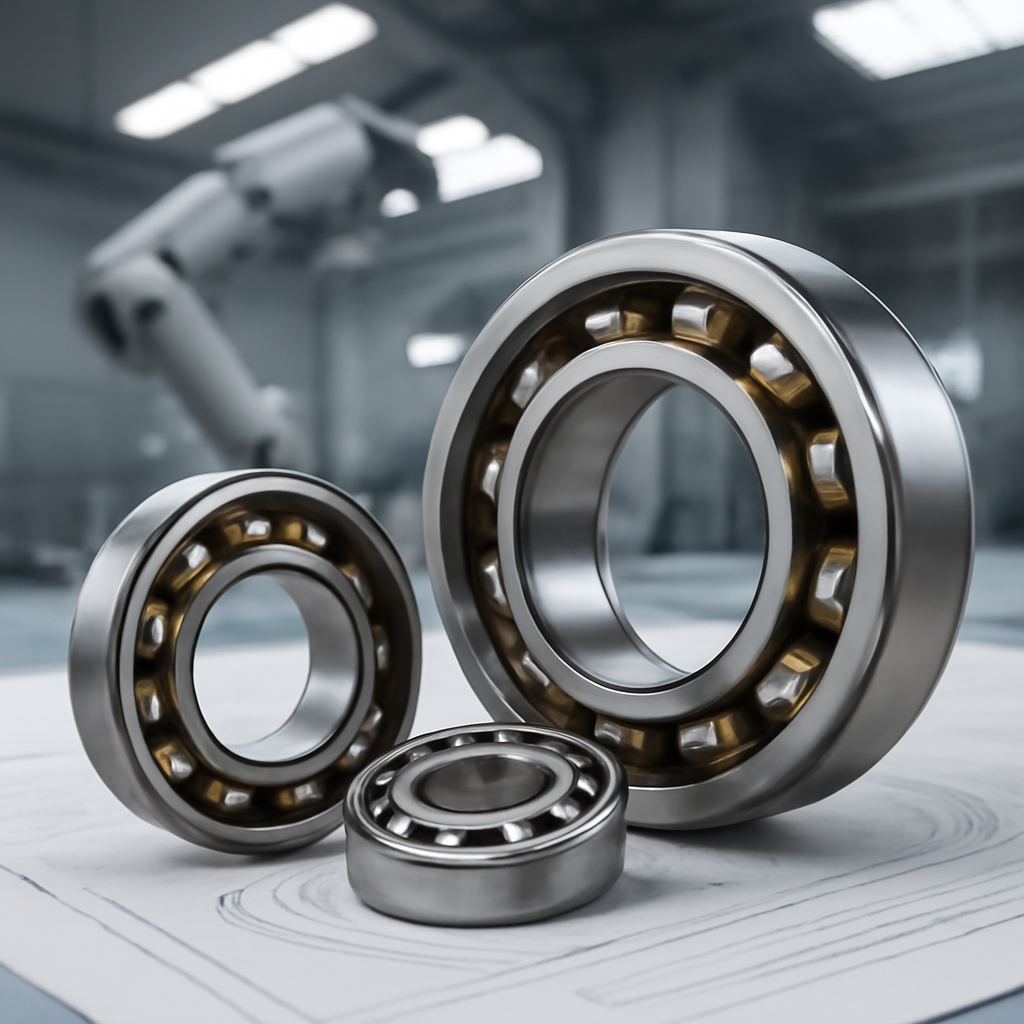
Angular contact ball bearings are the standard choice when a single bearing must carry combined radial and axial loads, or when a pair of bearings can be configured to handle axial load in both directions with high precision. They sit between standard deep groove bearings (cheap, simple, less capable on combined loads) and tapered roller bearings (high capacity but more complex). This is the practical guide to when and why to use them.
1. The geometry that defines them
The defining feature: the line of contact between balls and raceways is tilted at a contact angle α relative to the bearing radial plane. Standard contact angles:
- 15°: highest speed, lowest axial load capacity. Machine tool spindles.
- 25°: balanced general-purpose. Most industrial applications.
- 40°: highest axial load capacity, lower speed limit. Heavy-duty applications.
The contact angle directly determines the trade-off between speed and axial-load capacity.
2. Single-row vs double-row
Single-row angular contact (7000, 7200 series)
Carries axial load in one direction only. Must be used in pairs (or with another axial-supporting bearing) to handle bidirectional axial loads. The most flexible configuration.
Double-row angular contact (3200, 3300 series)
Two rows of balls running on inclined raceways in opposite directions, carrying axial load in both directions in a single unit. Compact, simpler installation.
Four-point contact (QJ series)
A single-row bearing where each ball contacts the raceway at four points (two inner, two outer). Carries axial load in both directions with axial guidance in a slim envelope.
3. Mounting arrangements for paired single-row bearings
3.1 Back-to-back (X arrangement)
Wide effective support spread. Highest tilt rigidity. Best for shafts with cantilevered loads or where deflection matters.
3.2 Face-to-face (O arrangement)
Narrow effective support spread. More tolerant of misalignment between the bearing seats. Common in machine tool spindle nose positions.
3.3 Tandem (T arrangement)
Two bearings facing the same direction, sharing axial load in that direction. Used when very heavy axial load in one direction must be supported.
4. Where angular contact bearings are the natural choice
- Machine tool spindles: typically Super-precision angular contact in O or X arrangement. 15° contact angle for highest speed.
- Automotive transmissions: input shafts, output shafts, layshafts.
- Pumps with combined loads: centrifugal pumps with shaft thrust due to pressure differential.
- High-precision instruments: where preload and rigidity matter.
- Robotic joints: small angular contact pairs combined with crossed-roller bearings.
5. Preload
Angular contact bearing pairs are usually preloaded — a small axial force applied during assembly that eliminates internal clearance and increases rigidity. Standard preload classes:
- Light preload: balanced friction and rigidity.
- Medium preload: higher rigidity, more friction.
- Heavy preload: highest rigidity, shorter calculated life.
Preload selection is application-specific — engage manufacturer engineering on high-precision applications.
6. Lubrication
- General industrial: standard grease, NLGI 2, lithium-complex thickener.
- High-speed spindles: oil mist or oil-air lubrication, very low viscosity oil.
- Pre-greased sealed variants for moderate-speed applications.
7. Common application mistakes
- Specifying single-row angular contact and not providing axial support in the opposite direction.
- Using the wrong contact angle for the speed/load profile.
- Preload too high — shortens calculated life dramatically.
- Confusing back-to-back and face-to-face arrangements at installation.
- Mixing bearings from different manufacturers in a preloaded pair — slight geometry differences ruin the preload calculation.
8. Cross-reference notes
SKF, FAG, NSK, NTN angular contact bearings all use compatible base designations. Suffixes for contact angle and arrangement differ between manufacturers — verify carefully when cross-substituting.
Conclusion
Angular contact bearings are the right answer when combined loads, high rigidity, and high precision are needed in a compact envelope. The selection involves contact angle, single vs double row, arrangement, and preload — four interlocking decisions that benefit from manufacturer application engineering on critical applications.
Industry consolidation effects in 2026
The bearing industry consolidation period is reshaping the European supplier landscape. The NSK and NTN Memorandum of Understanding (signed 12 May 2026, target closing October 2027) creates a combined entity that will challenge SKF and Schaeffler for the global #1 position. SKF’s separation of its Automotive business under a new three-segment structure (Bearing Solutions, Specialized Industrial Solutions, Automotive) sharpens segment focus. Schaeffler’s Yinchuan capacity expansion doubles standard catalogue capacity, normalising lead times that have been intermittently long since 2022. SKF’s G-Tech Instruments acquisition (March 2026) deepens condition monitoring capability.
For European industrial customers, these dynamics translate into specific operational implications. Multi-supplier qualification becomes more important across critical SKUs. Framework agreement negotiations should incorporate the consolidation context with substitution provisions and SKU continuity guarantees. Pricing leverage exists during the competitive window before NSK + NTN integration closes; framework agreements signed during 2026 lock favourable terms through the transition period.
Smart bearing platforms and procurement implications
The smart bearing transition is reshaping the broader supplier relationship. Every major manufacturer (SKF Insight, Schaeffler OPTIME, NSK SAT, NTN smart bearing platforms) has built or acquired platform capability. The integrated offering combines instrumented bearings, cloud analytics, AI-based anomaly detection, prescriptive workflow integration, and integrated services. For procurement leadership, the smart bearing decision involves more than the bearing — it involves the broader reliability ecosystem.
For European industrial customers, qualifying smart bearings on critical applications during 2026 positions the organisation for the post-2028 industry structure where smart bearings become standard rather than premium. The decision criteria expand beyond bearing specification and pricing to include platform capability, integration with existing CMMS and ERP, data ownership terms, and roadmap visibility.
Condition monitoring economic case
The deployment economics for IoT-based condition monitoring in 2026 are particularly favourable. Sensor hardware costs (under $50 per node) have collapsed 85% since 2019. Cloud platforms have matured into turnkey SaaS offerings. AI analytics adds capability that human analysts alone cannot match. Documented payback periods converge on 6-18 months for typical European mid-size industrial plant deployments.
For a typical mid-size plant with 50-100 critical assets, deployment cost runs €15,000-30,000 first-year capex plus €10,000-20,000 annual recurring. Documented savings: 30-50% reduction in unplanned downtime, typically valued at €100,000-500,000 annually. The capital justification is straightforward; the organisational change to operate alongside the technology is the actual implementation challenge.
The strategic procurement posture
For European industrial procurement leadership in 2026, the strategic posture distils to active engagement rather than passive reaction. Build supplier substitution agility across critical SKUs. Lock framework pricing where leverage exists during the competitive window. Invest in condition monitoring capability that delivers documented ROI. Qualify smart bearings on critical applications. Build master data discipline that supports informed substitution decisions during supply disruptions.
The cumulative effect of these procurement disciplines compounds across years. Organisations that build the capability now position themselves to outperform through the industry transition; those that delay will be implementing in 2028 against competitors who already have the foundation in place. The strategic window for proactive positioning is open through 2026 with diminishing returns thereafter.
Strategic procurement actions for H2 2026
For European industrial procurement teams in 2026, the practical action list during H2 2026 distils to several converging priorities. First, multi-supplier qualification on critical SKUs supports substitution agility through the consolidation period. The combined NSK + NTN entity will reshape supply dynamics post-2027; building qualified alternatives now provides operational protection regardless of how the integration unfolds. Second, framework agreement renegotiation captures pricing leverage that exists during the competitive window before consolidation closes. Multi-year locks on standard catalogue ranges deliver predictable cost discipline.
Third, condition monitoring deployment delivers documented ROI within 6-18 months for typical European mid-size industrial plants. The technology has matured; the economic case is clear; the implementation pathway is well-understood. Fourth, smart bearing qualification on critical applications positions the organisation for the post-2028 industry structure where smart bearings become standard. Fifth, master data discipline (clean bearing reference data, accurate cross-references, documented engineering equivalence) supports informed substitution decisions during the consolidation period.
The 2026 supplier ecosystem dynamics
The European bearing supplier ecosystem in 2026 is undergoing one of the most active restructuring periods in three decades. SKF’s restructuring around three reporting segments (Bearing Solutions, Specialized Industrial Solutions, Automotive) sharpens strategic focus. Schaeffler’s Yinchuan capacity expansion doubles standard catalogue capacity. NSK and NTN are integrating under a joint holding company target closing October 2027. JTEKT (Koyo) faces strategic positioning pressure from the broader consolidation. TIMKEN continues independent strategic direction in heavy industrial.
For European industrial customers operating in this environment, the supplier landscape that emerges in 2027-2028 will be materially different from 2025. Procurement strategy needs to evolve in parallel: multi-supplier qualification with engineering equivalence, framework provisions that anticipate consolidation effects, smart bearing platform commitments aligned with long-term reliability strategy, and condition monitoring infrastructure that supports data-driven supplier engagement. The investments made during 2026 set the procurement foundation for the coming decade.
The operational reality for European industrial customers
For European industrial customers operating in 2026, the bearing supply environment requires active management rather than passive procurement. Multi-supplier qualification, framework agreement renegotiation, condition monitoring deployment, smart bearing platform qualification, and master data discipline are all converging priorities. The strategic window for proactive positioning is open through 2026 with diminishing returns thereafter.
The cumulative effect of disciplined execution across these priorities compounds across years. Organisations that build the capability now position themselves for the post-2028 industry structure where smart bearings, condition monitoring, and integrated reliability services become standard rather than premium. The companies that wait will face higher capability gaps in 2028 against competitors who already have the foundation in place.
Related guides
- How to Choose the Right Bearing
- FAG Ball Bearings 2026
- Cylindrical Roller Bearings Guide
- TIMKEN Tapered Roller Bearings
- SKF Bearings Complete 2026 Guide
Need help with bearing selection? Our team supports you with cross-references and lead-times.