
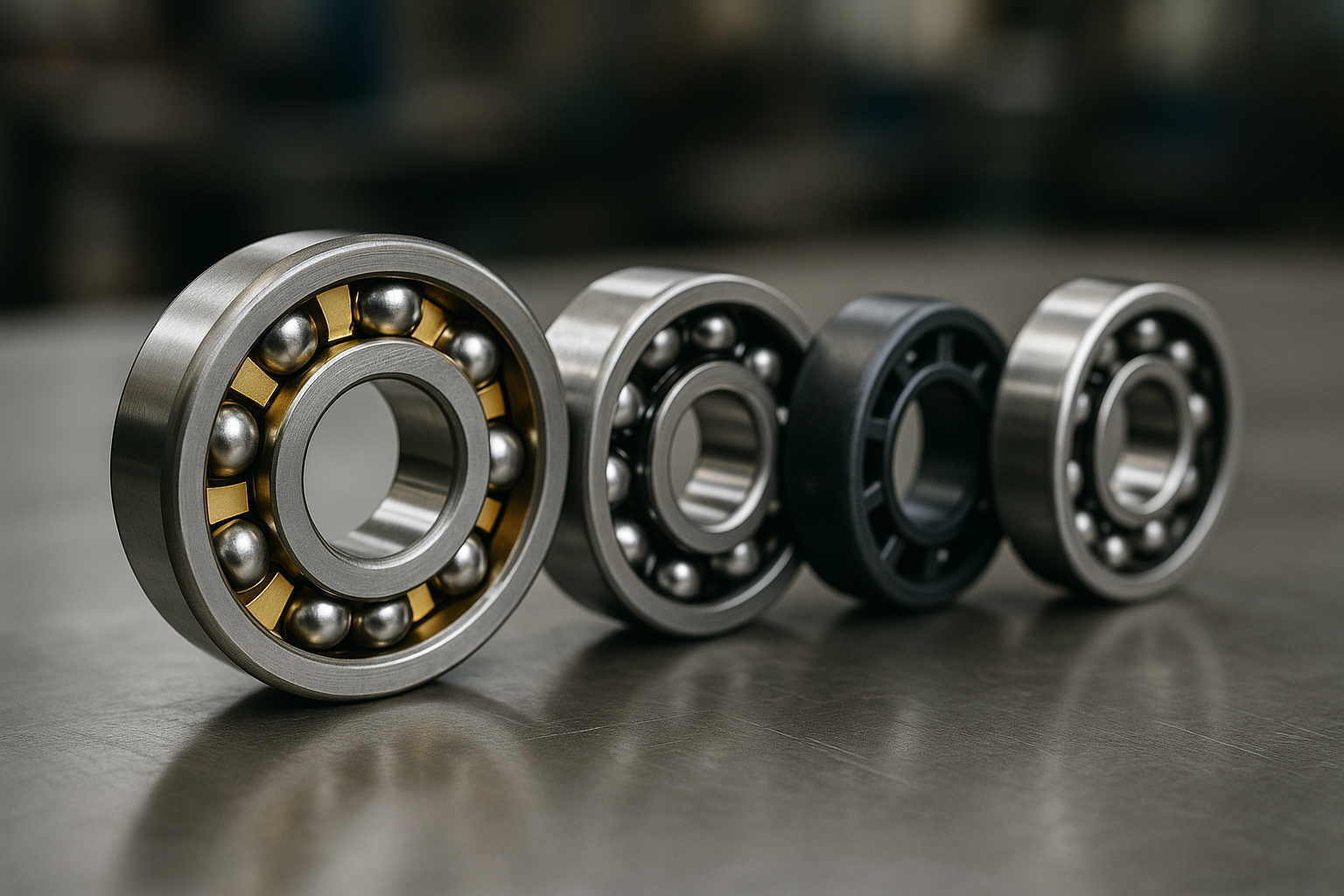
The cage is the part of a bearing nobody thinks about until it is the thing that failed. It does not carry load in any meaningful sense; it simply keeps the rolling elements evenly spaced and stops them touching each other. Yet bearing cage material — pressed steel, machined brass or moulded polymer — determines how fast the bearing can run, how quietly it does so, how it behaves when lubrication is marginal and how much it costs. Choosing it by default rather than deliberately is common and occasionally expensive.
Pressed steel, and why it is the default for good reason
The stamped steel cage is what arrives unless you specify otherwise, and for the great majority of industrial positions that is the correct outcome. It is cheap, mechanically reliable across ordinary speeds and temperatures, and adequate in everything from conveyor idlers to gearbox shafts to general machinery. Specifying anything else on a moderate-duty position is over-engineering. The limits show up at high speed, where the pressed form flexes and the guidance becomes less precise, and at temperature extremes where the friction characteristics at the cage-element contact degrade.
Machined brass, and where the premium buys something real
A brass cage is machined rather than stamped, which means tighter dimensional control, better guidance of the rolling elements and a surface that develops a more reliable lubricant film at the sliding contact. The practical results are higher usable speed, better behaviour at sustained high temperature, and quieter running. The premium runs thirty to sixty percent over the equivalent steel-caged bearing. Where it earns that is machine tool spindles above twelve thousand revolutions, continuous high-temperature service above roughly a hundred and fifty degrees, and positions where the customer is paying for acoustic performance. Everywhere else it is money spent on a specification the application cannot use. Spindle selection in particular turns on this choice, as our guide to spindle bearing selection sets out.
Polymer, and the temperature limit that decides everything
Glass-reinforced polyamide cages run quieter than either metal option because the material damps rather than transmits vibration, weigh less, and tolerate marginal lubrication better thanks to the different friction pair at the contact. This is why automotive applications use them in volume and why they suit positions where noise matters commercially. The constraint is absolute: roughly minus thirty to plus a hundred and twenty degrees. Above that the polymer degrades and the cage fails, usually taking the bearing with it. Below it the material embrittles and impact loading breaks it. Verify the operating temperature — including transient peaks, not just the steady state — before specifying polymer, because the failure when you get it wrong is sudden rather than gradual.
The four questions that settle it
What speed does it run at, and is it above roughly twelve thousand revolutions? What temperature does it reach, including the peaks? Does noise matter commercially in this application? And is the lubrication regime comfortable or marginal? High speed or high temperature points to brass. Noise or marginal lubrication within the temperature envelope points to polymer. Neither, which describes most positions, points to steel. Running those four questions takes a minute and produces a defensible answer instead of whatever the catalogue listed first.
Mixing cage types across one machine is sensible, not inconsistent
There is no reason for every bearing on a machine to share a cage type. High-speed positions can take brass while general positions take steel and quiet-running positions take polymer, each chosen against its own duty. Plants that standardise on one type across everything are either over-paying on the easy positions or under-specifying on the hard ones. The engineering effort of deciding per position is modest and the saving is real, particularly on larger machines where the position count makes uniform premium specification expensive.
What this means for stock
A distributor should carry steel-caged executions across the volume designations in the deep groove and spherical roller categories, brass on the twenty to thirty designations where high-speed and high-temperature demand concentrates, and polymer on the automotive-adjacent sizes. Reading which execution a customer’s existing part number specifies is part of the counter job, since cage type hides inside the suffix and a substitution that ignores it can change the bearing’s behaviour materially — our suffix cheat sheet covers where to look. Equivalent executions exist across SKF, FAG, NSK and KOYO, which helps when a specific cage variant runs long on lead time.
Unsure which cage execution a position needs? Our team supports European industrial customers on bearing specification for speed, temperature and acoustic requirements. Book a free consultation.