
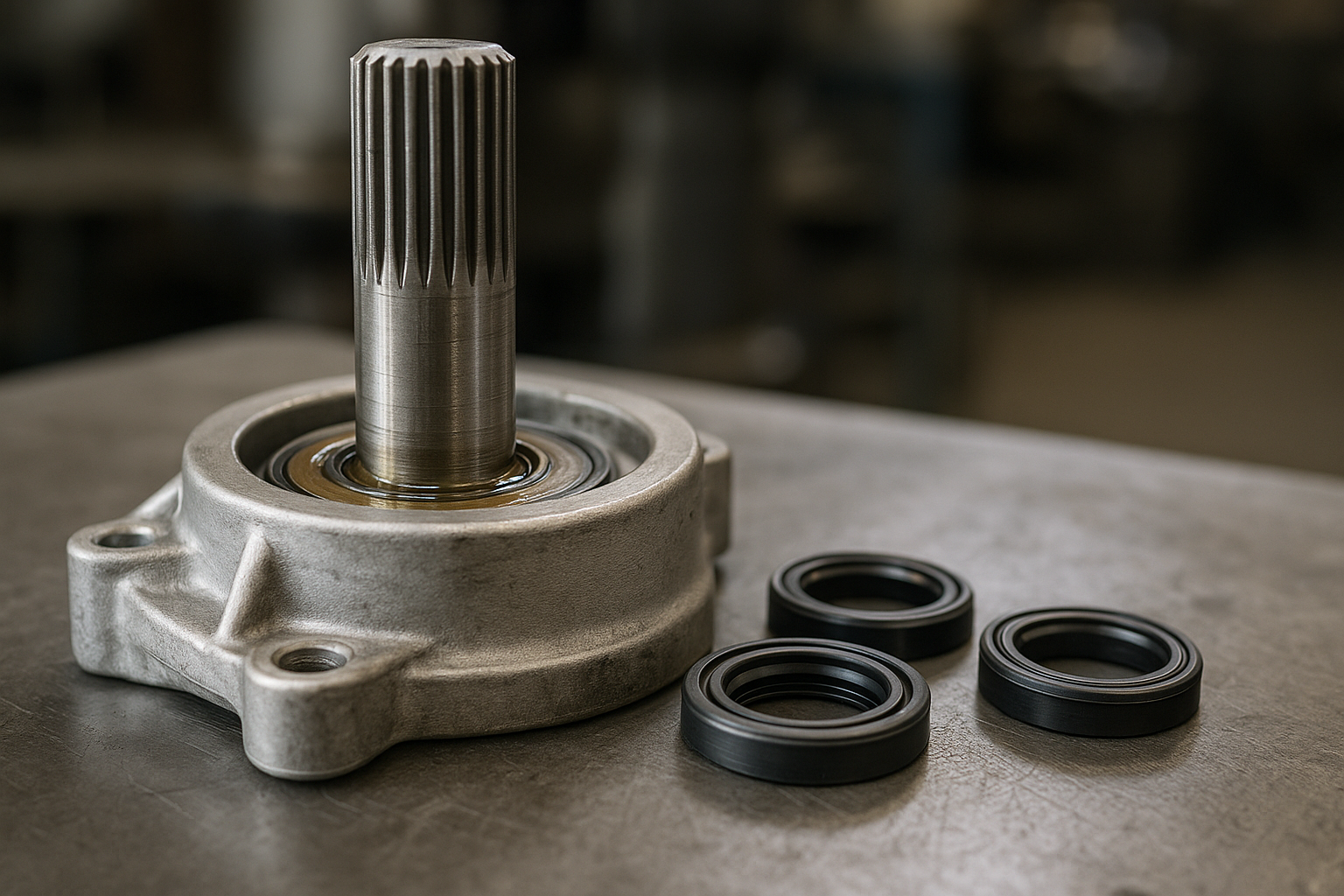
A helical bevel gear unit on a conveyor drive has had three output shaft seals in two years. Each one was the correct reference, fitted square, on a shaft that looked fine, and each one started weeping within a few months. The maintenance log records three seal replacements and no diagnosis, which is the normal outcome, because rotary shaft seal selection gets treated as a dimensional lookup rather than an engineering decision. Bore diameter, shaft diameter, width — three numbers, order the part. That approach works on an easy position and fails repeatedly on a hard one, and the gearbox output shaft is among the hardest positions in general industry. The variables that actually decide the outcome are surface speed, temperature, shaft finish, internal pressure and the contamination the seal faces from outside, and none of them appears in the dimensional code.
Why the output shaft is the hardest position on the gearbox
The input shaft turns fast but carries little torque and sits behind a coupling in relatively clean air. The output shaft is the opposite in every respect. It turns slowly, which means the lip spends more time in boundary contact and less time riding on a hydrodynamic film, and low surface speed is a genuine problem rather than an easy ride. It carries the full output torque, so any radial load from a chain, belt or overhung sprocket deflects the shaft and moves the seal counterface eccentrically relative to the bore. It is the shaft most likely to be hosed down, exposed to dust, or sitting under a product stream. And it is frequently the shaft that has been in service longest, carrying a wear groove from previous seals. Any one of these would make the position demanding; together they explain why a seal specification that works everywhere else on the unit fails here. Diagnosing a repeat leak therefore starts with the operating conditions rather than with the seal that came out.
What the lip is doing, and the pumping effect
A radial shaft seal does not work by squeezing the shaft hard enough to block oil. It works by maintaining a contact band a fraction of a millimetre wide, held against the shaft by a garter spring, within which a microscopically thin film of oil is generated and actively pumped back toward the oil side by the asymmetric deformation of the elastomer under shear. That pumping action is why a seal can run for years without either leaking or running dry. It also explains several otherwise puzzling behaviours. A seal fitted backwards leaks immediately because the pumping direction reverses. A lip contact band that has worn flat and wide has lost the asymmetry and therefore the pumping, which is why a seal can leak while still visibly touching the shaft. And a seal run without oil for even a short period destroys the lip through heat in minutes, because the film it depends on is also its only cooling path. The garter spring is not optional decoration: a seal with a lost or corroded spring has no controlled contact force at all.
Single lip with a dust lip, and when the second lip costs you
The instinct on a dirty shaft is to specify a double lip seal, and it is often right, but not always. The secondary lip on a standard dust-lip seal runs dry by design, facing outward into the atmosphere with no lubricant behind it. It generates friction and heat with no cooling, and on a slow shaft in a clean environment that heat does nothing useful while measurably shortening the primary lip’s life. Where the outside environment genuinely carries dust, washdown water or product, the trade is clearly worth it, because contamination reaching the primary lip abrades the contact band and ends the seal quickly. Where it does not, the single lip is the better part. The middle path, often overlooked, is a single lip seal protected by a separate external shield, flinger or labyrinth, which keeps contamination away without adding a dry rubbing contact. On a heavily contaminated position a double lip rotary shaft seal is still the pragmatic answer, and greasing the cavity between the lips at installation extends its life considerably.
Elastomer choice before geometry
The compound decides more outcomes than the lip count. Nitrile rubber is the default for good reason — it is inexpensive, it handles mineral oils well, and it covers roughly minus thirty to plus one hundred degrees continuous. Its limits arrive faster than people expect. Sustained oil sump temperatures above about one hundred degrees harden it, and gearboxes running hot in summer with a high ambient can sit there for weeks. Synthetic gear oils, particularly polyglycol and some ester-based products, attack it. And it has poor resistance to ozone and to many cleaning chemicals used in food and beverage washdown. Fluoroelastomer handles all three cases: continuous service to around two hundred degrees, excellent chemical resistance, and much better ageing behaviour, at several times the price. The decision rule is simple enough to apply at the counter — synthetic oil, high temperature, aggressive washdown or long intended service interval all point to fluoroelastomer, and everything else stays nitrile. Reading which compound a given reference actually uses is the point of our guide to decoding oil seal codes at the parts counter.
PTFE lips and the cases that justify them
A PTFE lip seal works on a different principle: instead of a spring-loaded elastomer lip, a thin PTFE element is formed against the shaft, often with a machined hydrodynamic pattern to provide the pumping action. PTFE tolerates dry running far better than any elastomer, handles very high surface speeds, is chemically inert to essentially everything found in a gearbox, and operates across an extreme temperature range. Those properties make it the right answer in specific cases: shafts that see periods without lubricant, very high speed positions, aggressive chemical service, and applications where a conventional seal’s friction is unacceptable. The trade-offs are real. PTFE has no elastic memory, so it will not conform to a worn or eccentric shaft the way rubber does, and it is much less tolerant of installation damage and of runout. It also generally needs a better shaft surface finish. Specifying PTFE to solve a leak caused by shaft eccentricity or a wear groove will make the problem worse rather than better, which is the most common way these seals disappoint.
Shaft surface finish, hardness and the wear groove
The seal is only half the tribological pair. A shaft counterface should be plunge ground rather than turned, because a turned surface carries a helical lead that acts as a screw thread and pumps oil steadily in one direction regardless of what the lip is trying to do. Surface roughness has a window rather than a minimum: too rough abrades the lip, too smooth prevents the lubricant film from forming and causes the lip to run effectively dry. Hardness of at least 45 HRC on the running track resists the groove that otherwise forms after a few thousand hours. That groove is the reason so many repeat leaks occur. Once a visible step has worn into the shaft, a new seal sitting in the same axial position has no chance, because the lip cannot follow the groove’s edges. The standard remedies are to move the seal axially by a few millimetres using a spacer so the lip runs on fresh surface, or to fit a thin wear sleeve over the damaged area and use the seal size matched to the sleeve’s outside diameter. Both are quick; neither happens if nobody measures the shaft.
Pressure, breathers and the leak that is not a seal fault
Standard rotary shaft seals are designed for essentially zero differential pressure, tolerating perhaps 0.3 to 0.5 bar before the lip deforms, the contact band widens and the pumping action collapses. A gearbox is supposed to sit at atmospheric pressure, and it does so through its breather. When that breather blocks with paint, dust or product, the air in the housing expands as the unit warms and generates internal pressure with nowhere to go except past the seals. The result is oil pushed out of the output seal, a replacement fitted, and the same leak returning within weeks — precisely the three-seals-in-two-years pattern described at the start. Checking the breather takes thirty seconds and should be the first action on any repeat gearbox leak, before the seal is even ordered. Where genuine pressure is unavoidable, pressure-rated seal designs with reinforced lips exist and should be specified deliberately rather than hoped for. This is the same class of diagnostic discipline described in our workshop note on fitting a seal into a warped housing.
Fitting: squareness, lip protection and the first minute
A high proportion of early seal failures are created during the thirty seconds of installation. The lip passes over a shaft end, a keyway, a splined section or a threaded portion, and any sharp edge nicks the contact band invisibly. A fitting sleeve or a wrap of thin plastic film over the shaft end prevents it, and a smear of the operating oil on the lip provides lubrication for the first revolutions before the film establishes. The seal must go in square: a seal driven in cocked by even a degree runs eccentrically and leaks, and the correct tool is a flat-faced drift bearing on the outer case, never on the lip side and never a screwdriver at three points around the rim. Metal-cased seals need an interference fit in a clean, undamaged bore, and where the bore is worn a bore-repair compound or a sealant on the outside diameter is a legitimate recovery rather than a bodge. Finally, run the unit and look at the seal after a minute: a properly fitted seal shows a trace of oil film and nothing more, and a drip at one minute will still be a drip at one month. A quality-tier reference such as a CORTECO seal from the NBR rotary shaft seal range rewards this care; a carelessly fitted premium seal performs worse than a carefully fitted cheap one.
The route out of a repeat leak is therefore to stop ordering the same part and start measuring. Check the breather, measure the shaft for a groove and for runout, establish the actual sump temperature in summer rather than the design figure, and confirm what oil is in the unit, because a switch to synthetic lubricant some years ago is a very common and entirely undocumented cause of nitrile seals starting to fail. Only then choose the seal, and choose it on compound and lip configuration rather than on the three dimensions alone. The work adds perhaps twenty minutes to a job that will otherwise be repeated twice more. Positions that genuinely need an exotic seal are rarer than the sales literature suggests, and positions that need a blocked breather cleared are far more common than anybody’s records show. For a deeper look at why particular aftermarket ranges dominate this application, see our piece on what keeps these seals on European shelves.
Third seal on the same shaft? Our team supports European plants and gearbox repairers with compound selection, wear sleeve options and cross-references when a dimensional match is not the answer. Book a free consultation.