
There is a pattern in German industrial purchasing that anyone who has sold into the Mittelstand through two downturns will recognise without needing the data to prove it. The PMI turns down, nothing happens for a quarter, and then the orders change shape all at once — smaller, less frequent, consolidated, and preceded by a conversation about price that did not used to happen. Understanding the lag in German mechanical sector bearing procurement is what lets a distributor position stock ahead of that shift rather than discovering it when the quarter closes short.
The lag is three to six months and it has been stable for fifteen years
Across the 2008-10, 2011-13, 2019-20 and 2022-23 cycles, sustained PMI weakness in German manufacturing preceded a visible change in bearing procurement behaviour by roughly a quarter to two quarters. The mechanism is not mysterious: PMI reflects incoming orders, incoming orders determine production schedules, production schedules determine maintenance planning, and maintenance planning determines when somebody signs off a stock replenishment. Each step adds delay. The consistency of that lag across four quite different downturns is what makes it usable as a planning input rather than an observation after the fact.
What the contraction phase looks like from the counter
Inventory investment gets cut first, which shows up as customers running down what they hold rather than reordering. Order intervals stretch and orders consolidate, because fewer, larger purchase orders mean less administrative work per euro. Price pressure arrives on standard specifications while premium tiers hold rather better, since the positions that justified premium still justify it and nobody wants to explain an avoidable failure during a bad quarter. Substitution enquiries increase — customers who never asked about cross-references suddenly want to know what else fits. Recognising this cluster early tells you the phase has started even before the quarterly numbers confirm it.
What the recovery phase looks like, and why it is easy to miss
When PMI turns back above fifty and holds, procurement does not resume gradually. Inventory that was run down over four quarters gets rebuilt over two, which produces a demand spike considerably sharper than the underlying consumption recovery would suggest. That restocking window typically runs six to twelve months and then normalises. Distributors positioned with stock when it opens capture disproportionate volume; those who wait for confirmation before committing capital spend the window quoting lead times instead of shipping. The awkward part is that committing early means carrying inventory through a period where the recovery is still unconfirmed, which is a real risk rather than a theoretical one.
Reading the sub-indices rather than the headline
The headline PMI number is the least useful part of the release for this purpose. New orders lead everything else and therefore lead your demand by the longest margin. Order backlog tells you how much cushion exists before production schedules actually change. Employment signals what manufacturers believe about the medium term, which is a better guide to capital equipment demand than to consumables. Output prices indicate the pricing environment you will be negotiating in two quarters out. Following those four gives considerably more warning than watching a single index cross fifty. The most recent German detail is in our August sector breakdown, with the European aggregate in the August PMI note.
Where the current cycle sits
The 2024-26 cycle has followed the established pattern closely: sustained weakness through 2024 drove the destocking phase, and the stabilisation signals appearing through the first half of 2026 have not yet produced the restocking behaviour that would confirm a turn. On the historical lag, a genuine PMI recovery confirmed through the autumn would put the rebuild into the first half of 2027. That is a planning assumption rather than a forecast, and the honest position is that the confirming data has not arrived. What can be done now is preparing for both outcomes rather than committing to either, and the current channel behaviour across European distributors — which we tracked in our note on stockpiling patterns before Q4 2026 — suggests most of the market is doing exactly that.
Adjusting stock and conversation to the phase
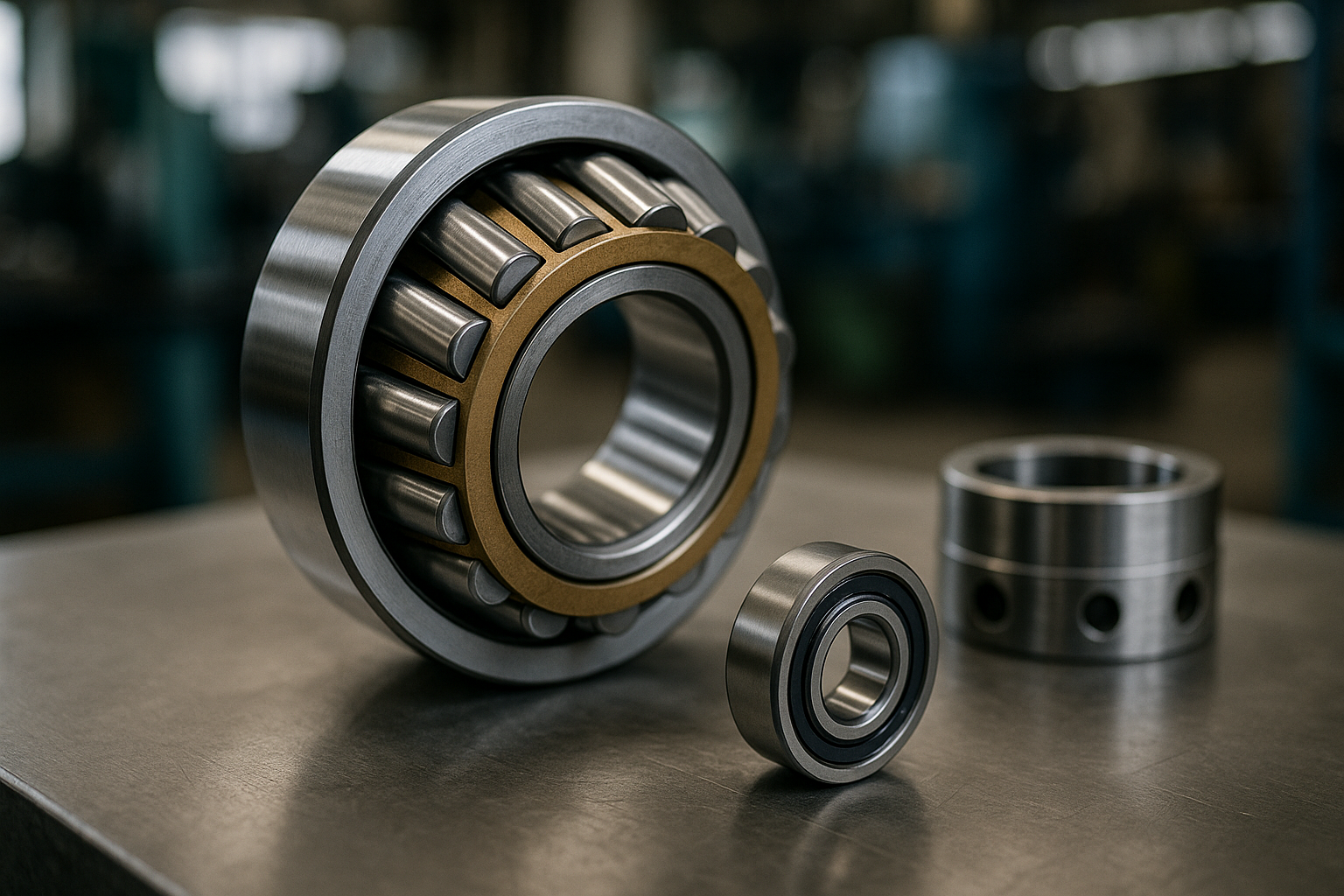
During contraction, reduce exposure on commodity specifications, hold premium depth where customer commitment supports it, and preserve cash for the rebuild. Compete on technical service and total cost of ownership rather than on headline price, because price competition during a contraction is a race nobody wins. During recovery, commit inventory ahead of confirmation, lead with supply security and availability, and engage customers about their own rebuild timing before a competitor does. The specifications that move first in a German mechanical rebuild are predictable — the volume sits in the deep groove, taper roller and cylindrical roller categories, alongside the shaft seals that accompany every one of those replacements.
The point of tracking any of this
None of it predicts the market. What it does is convert a vague sense that things feel slow into a specific expectation with a timeline attached, which is enough to make stocking decisions deliberate rather than reactive. Distributors who work this way are not right more often than anyone else about where the cycle goes; they are simply ready earlier when it moves, and in a business where the rebuild window lasts two quarters, being ready earlier is most of the advantage available.
Building a cycle-aware stocking plan for German mechanical accounts? Our team supports European distributors on demand calibration and inventory positioning. Book a free consultation.