
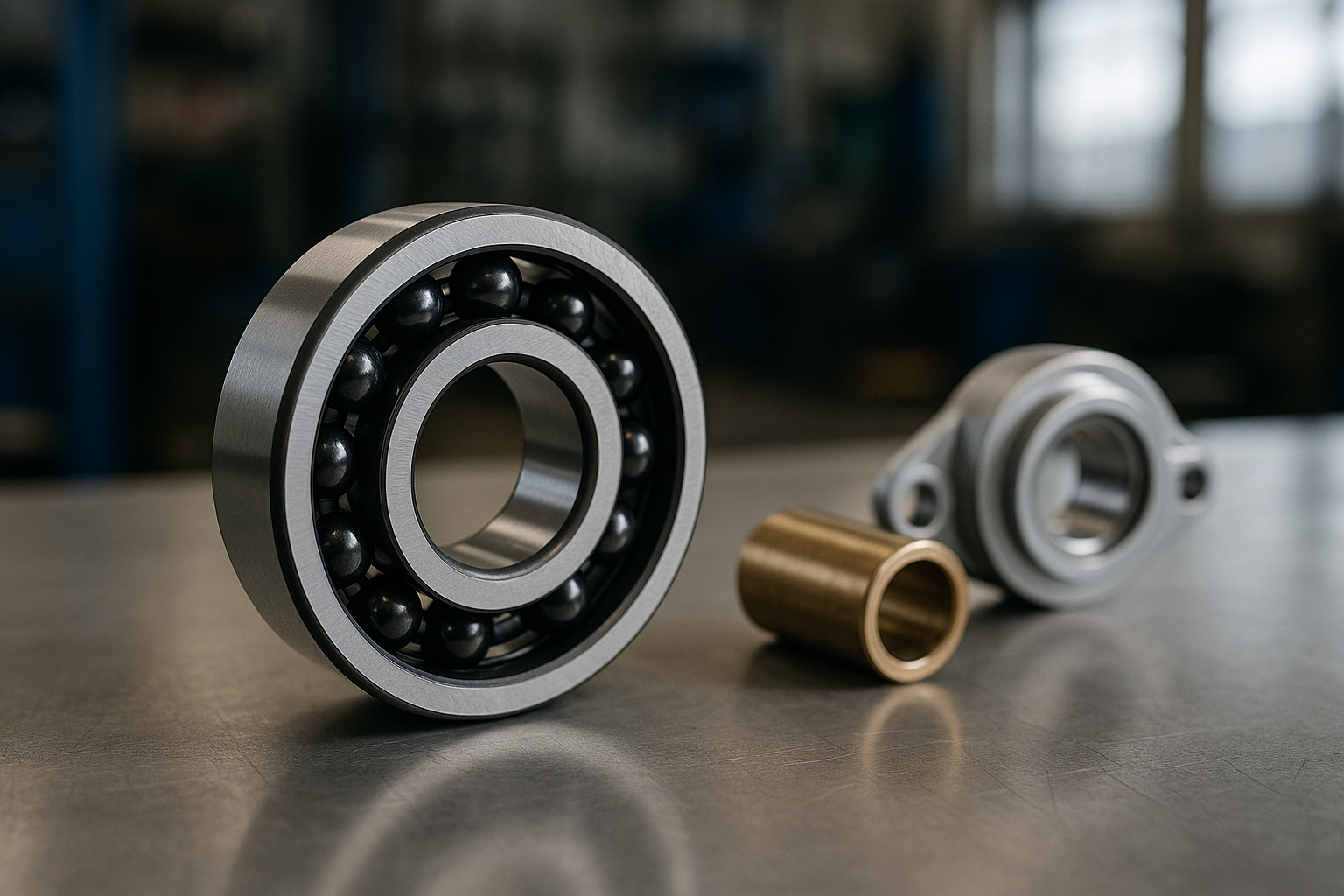
Hybrid bearings cost three to five times what the equivalent steel bearing costs, which means the decision to fit one deserves more thought than most specification choices. SKF hybrid bearings pair silicon nitride ceramic rolling elements with steel rings, and the properties of that ceramic solve four specific problems extremely well. Outside those four problems they solve nothing that steel does not already handle, and the money is simply spent. Knowing which situation you are in takes about two minutes of thinking about the application.
Where the advantage comes from
Silicon nitride is roughly forty percent the density of bearing steel, considerably harder, dimensionally stable across a wide temperature range, and electrically insulating. Lower mass means less centrifugal load on the outer raceway at speed and less heat generated. Greater hardness and a different friction pair mean better behaviour when the lubricant film is marginal. Electrical insulation means current cannot pass through the bearing. These are material properties rather than manufacturing refinements, which is why the premium is a multiple rather than a percentage, and why it cannot be matched by a better steel bearing.
Variable frequency drives are the most common real case
A VFD-driven motor generates shaft voltages that discharge through the bearing to earth, and the resulting micro-arcing erodes the raceway into the regular washboard pattern known as fluting. Once fluting starts the bearing is noisy, then rough, then finished, and no lubricant or seal change prevents it because the cause is electrical rather than mechanical. Ceramic elements break the circuit entirely. On VFD motors above modest power ratings this is not an upgrade, it is the correct specification, and fitting steel there means accepting a failure mode you could have designed out. If you are seeing repeat motor bearing failures with an unexplained pattern, this is the first thing to check.
High-speed spindles, where steel runs out of room
Above roughly fifteen thousand revolutions the centrifugal loading from steel balls starts to dominate the bearing’s behaviour, generating heat that limits both speed and life. Ceramic elements push that ceiling substantially higher while running cooler, which is why precision spindles in the twenty to forty thousand range specify hybrid as standard rather than as an option. Below about twelve thousand the advantage is real but rarely worth the multiple. The broader selection logic for spindle positions is set out in our guide to machine tool spindle bearing selection, and the specific mid-range case in our piece on choosing a precision spindle bearing for a CNC lathe.
Marginal lubrication and temperature extremes
Where the lubrication regime is genuinely difficult — inaccessible positions with stretched intervals, high temperatures that degrade grease faster than it can be replaced, applications where the film thins under load — the ceramic-on-steel contact tolerates conditions that would damage a steel-on-steel pair. Similarly, silicon nitride holds its dimensions and properties across a wider temperature band than bearing steel, which matters above two hundred degrees or below minus forty. These are narrower cases than the first two, but they are genuine, and they are frequently the explanation when a position keeps failing for no reason the load calculation can account for.
When it is straightforwardly the wrong choice
Moderate speed, moderate temperature, no electrical path, adequate lubrication, normal positioning requirements. That describes the overwhelming majority of industrial bearing positions, and on all of them a standard or premium steel bearing from the deep groove or angular contact ranges does everything required. Specifying hybrid there is not cautious, it is wasteful, and it takes budget away from positions that would genuinely benefit. The honest limits of ceramic in industrial service — including where it underperforms steel — are worth knowing, and we covered them in our piece on ceramic bearings and their real limits.
What a distributor should keep on the shelf
Ten to fifteen hybrid designations covering the common VFD motor and spindle sizes will meet most genuine demand, with anything unusual routed to specialty supply on customer commitment. The stocking decision follows the application distribution rather than the catalogue: hybrid demand clusters tightly around a small number of sizes because the applications that need it cluster too. Brands beyond SKF — including NSK and FAG — offer comparable hybrid ranges, and qualifying equivalents is worth doing given the lead times these specifications sometimes carry.
The two-minute test before you quote
Is there a variable frequency drive or any other electrical path through the shaft? Does it run above fifteen thousand revolutions? Is the lubrication genuinely marginal or the temperature genuinely extreme? Yes to any of those and hybrid earns its multiple. No to all of them and steel is the answer, whatever the customer read about ceramic. Getting this right in both directions is what stops you from either selling an expensive bearing into an application that cannot use it, or watching a motor eat its third set of bearings because nobody asked about the drive.
Unsure whether a position justifies hybrid specification? Our team supports European industrial customers on bearing selection for electrical, high-speed and extreme-temperature applications. Book a free consultation.