
A fitter from a packaging plant rings the trade counter at ten past eight, reading a code off a gearbox bearing he has just pulled, and his real question is about KOYO bearing interchange: will the Japanese part printed on the old ring fit where he would normally buy SKF, and is it worth waiting for? It is a call every counter technician knows. KOYO sits in an awkward spot in many European workshops, respected by the people who meet it in original equipment and half-forgotten by those who stock to a Swedish or German habit. The brand rarely needs defending on quality; what it needs is positioning, so that the person behind the counter can explain in thirty seconds where it fits, what it costs relative to the alternatives, and when swapping it out is sensible rather than lazy. This article is that thirty-second explanation, expanded into the reasoning that sits behind it.
Where KOYO comes from and why that still matters
KOYO is a Japanese bearing maker with roots in Osaka, and its identity on the counter is shaped by that origin more than by any marketing line. Japanese automotive and machinery builders grew up specifying domestic bearings, so KOYO arrives in Europe embedded in cars, light commercial vehicles, agricultural machines, machine tools and pumps designed in Japan or by Japanese-owned plants. That matters because the bearing in the failed assembly is often a KOYO not by a buyer’s choice but by the designer’s, and the designer may have used a dimension, internal geometry or seal arrangement that only exists in that maker’s catalogue. When a fitter brings in such a part, the first job is to establish whether it is a standard ISO boundary-dimension bearing with a KOYO stamp, which any of the major brands will replace, or an application-specific part where interchange becomes a research task. For a broader view of the product families, the full overview of KOYO’s bearing range is a useful companion to the counter-level argument made here.
The four strengths a counter technician should know
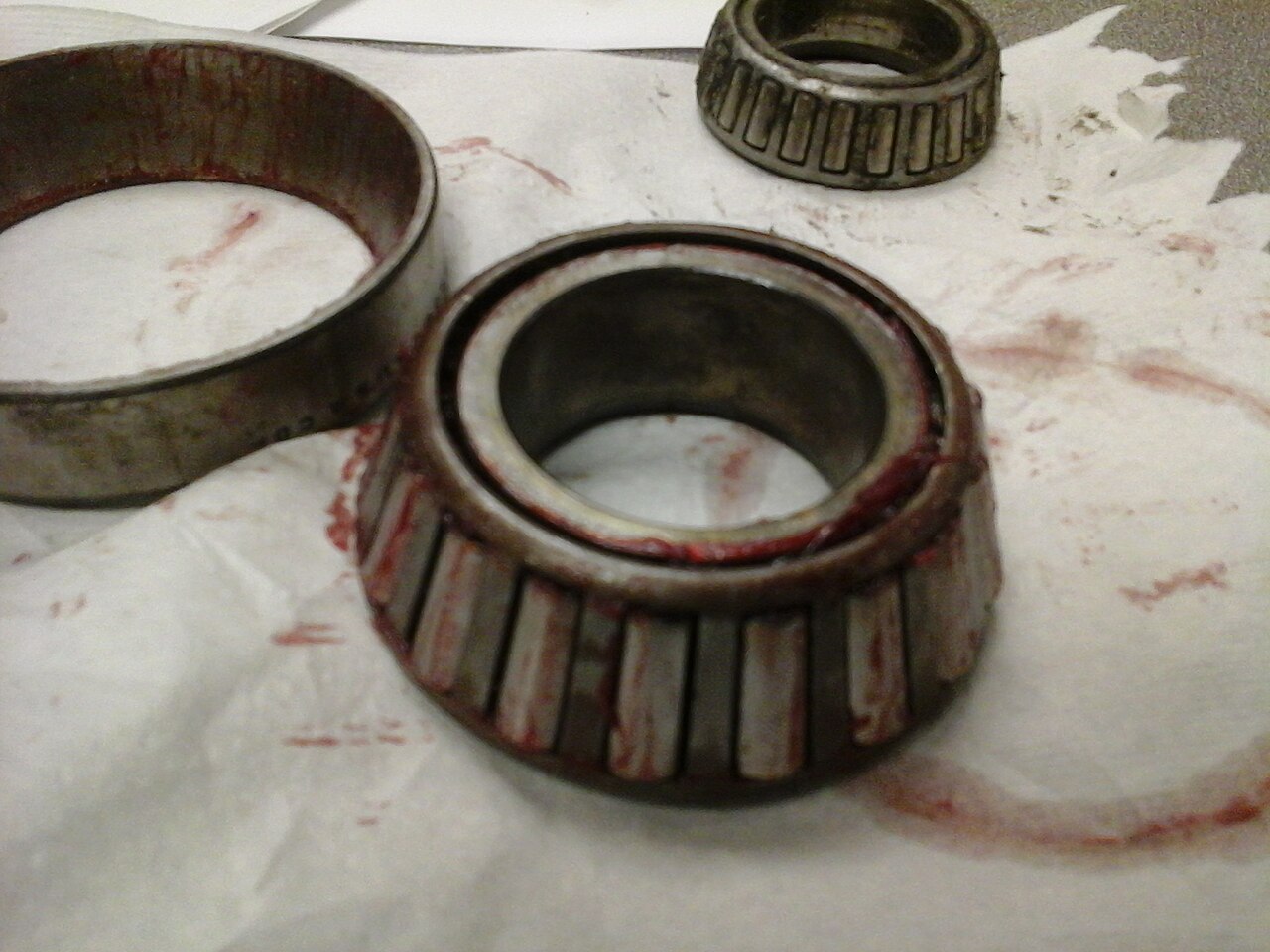
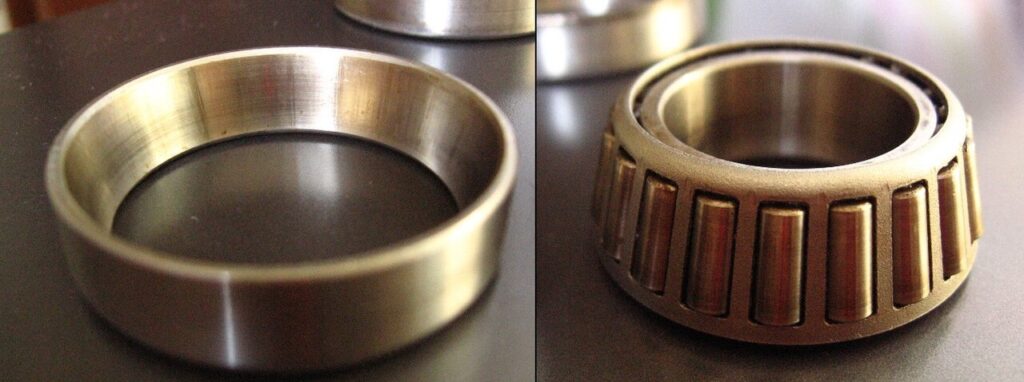
If a technician remembers only four things about KOYO, they should be tapered rollers, needle rollers, deep groove ball bearings and housed units. The tapered roller range covers both metric series built to ISO 355 and the inch-dimensioned cone-and-cup families that originated in North America, which is why KOYO turns up as a credible alternative to Timken on the taper roller bearing shelf, particularly in wheel-end and differential positions. Needle rollers, including drawn cups and caged assemblies, are a long-standing speciality, and KOYO needle parts appear widely in gearboxes, steering systems and small engines. Deep groove ball bearings form the volume business, from miniature sizes up to electric-motor sizes, with quiet-running variants aimed at appliance and motor builders. Housed units, the cast-iron pillow blocks and flanges carrying insert bearings, complete the picture and are a common sight on Japanese agricultural and conveyor equipment. Knowing these four pillars tells the technician where KOYO stock will turn over steadily and where it will simply gather dust on the shelf.
Price tier and availability against SKF, FAG and NSK
On price, KOYO generally sits in the same premium-manufacturer tier as SKF, FAG and NSK rather than among budget imports, but the counter experience depends heavily on the distribution channel and the specific part number. For common deep groove sizes a distributor may find KOYO priced close to NSK and somewhat below the headline SKF list, although street prices shift with volume agreements and stock positions, so no fixed ratio holds across the whole range. Availability is the sharper differentiator. SKF and Schaeffler run dense European warehouse networks, which means a 6205 or a 22216 from them is usually a next-day item, while a KOYO equivalent may come from a smaller pool of stock or a longer replenishment cycle. The practical consequence is simple: for a standard boundary-dimension bearing on a line that is down, the technician sells whichever premium brand is on the shelf; for a part where the KOYO internal design matters, the customer is told the realistic lead time and why waiting is worthwhile.
Reading suffixes when the brand changes
Interchange errors at the counter rarely involve the boundary dimensions, which ISO standardises, and almost always involve suffixes. KOYO marks steel shields as ZZ and contact rubber seals as 2RS, conventions familiar to anyone used to NSK, whose shields are also ZZ but whose contact seals are designated DDU. SKF writes shields as 2Z and contact seals as 2RSH or 2RS1, while FAG uses 2Z and 2RSR. Radial internal clearance follows the ISO 5753 classes, so C3 means the same thing on all four brands, but the way it is printed varies, and some makers omit the normal clearance marking entirely. Cage materials, heat stabilisation and noise grades carry their own brand-specific codes that do not translate letter for letter. A technician who learns to separate the shared language (size, seal type, clearance) from the proprietary language (cage, grease, special tolerances) will cross-reference safely. The same discipline applies to reading SKF suffixes without a manual, and the habit transfers directly between brands.
When the part number is not an ISO size
The harder cases are the parts that never appear in a general catalogue. Take the KOYO 50KB801LT, a 50 x 80 x 22 mm bearing whose designation follows KOYO’s own logic rather than the ISO 60 or 62 series pattern. Its bore and outside diameter match a 6010 deep groove ball bearing, but a 6010 is only 16 mm wide, so a standard bearing would leave six millimetres of axial difference in the housing and offer a different load capacity. Parts like this exist because a vehicle or machine designer needed a specific width, seal arrangement or rating, and the bearing maker produced it for that fitment. The counter rule is to treat any non-ISO designation as a fitment-specific part until proven otherwise: measure the sample, photograph the markings, check the equipment builder’s parts list and, where possible, supply the original reference. Improvising with a shimmed standard bearing in an automotive or gearbox position saves a day and frequently costs a repeat failure a few months later.
Customers who ask for KOYO by name
Some customers will not accept an alternative, and they usually have good reason. Maintenance teams running Japanese-built machine tools, injection moulding machines, forklifts or compact agricultural tractors often specify KOYO because the equipment manual, the warranty conditions or simple experience tell them the original fitment runs quietly and lasts. Vehicle workshops working on Japanese cars and vans meet KOYO in wheel bearings, gearbox shafts and steering columns, where the exact internal geometry and sealing affect noise and service life. Plant buyers under a validated maintenance regime, such as food or pharmaceutical lines, may have the brand written into their spares specification and cannot change it without paperwork. In each case the counter technician’s job is not to argue for a brand switch but to confirm the full designation, including suffixes, and source it reliably. Where the customer is open to alternatives, the conversation moves to equivalence, and that is where knowing the strengths of SKF, FAG and NSK side by side earns its keep.
Housed units and the interchange trap
Housed units deserve a separate note because they look interchangeable and often are, up to a point. The KOYO UKFC 218 combines a UK-series insert with a tapered bore, mounted on an adapter sleeve, inside a cast-iron round flanged cartridge housing with a spigot that locates in a machined recess. With the matching H2318 sleeve it suits an 80 mm shaft. The insert series, housing type codes and sleeve sizes follow a convention shared by Japanese and many other makers, so UK, UC and UCP style references are widely understood, and inserts from different brands frequently drop into each other’s housings. The trap lies in the details: grease nipple positions, lubrication groove arrangements, spigot tolerances and bolt-hole patterns can differ enough to cause trouble on a machine frame. Before swapping a whole unit, compare the housing drawing, not just the code. The range of bearing housings and units on the shop shows how much variation sits behind similar designations.
The positioning, then, is straightforward once it is said out loud. KOYO is a premium Japanese manufacturer, strongest in tapered rollers, needle rollers, deep groove ball bearings and housed units, priced broadly alongside SKF, FAG and NSK, and occasionally slower to source in Europe. For standard ISO sizes it is a fair swap in either direction, provided suffixes are translated with care; for fitment-specific numbers it is the part to supply, even if the customer has to wait. Cross-reference tools help, but as the review of bearing cross-reference software makes clear, they do not replace measuring the sample and reading the old ring. A counter that stocks the fast-moving KOYO sizes, knows the brand’s strengths and can quote realistic lead times for the rest will win the customers who own Japanese equipment, and those customers tend to come back. Current stock is listed on the KOYO brand page.
Need a KOYO part number checked against SKF, FAG or NSK? Our team supports counter staff and maintenance buyers with suffix-level interchange checks and sourcing for fitment-specific KOYO references. Book a free consultation.
Image credits: “Greased roller bearing and race 2013-07-22 10-12” by SkyMWard (CC BY-SA 3.0); “Insieme cuscinetto rulli” by Remulazz (CC BY-SA 3.0), via Wikimedia Commons.