
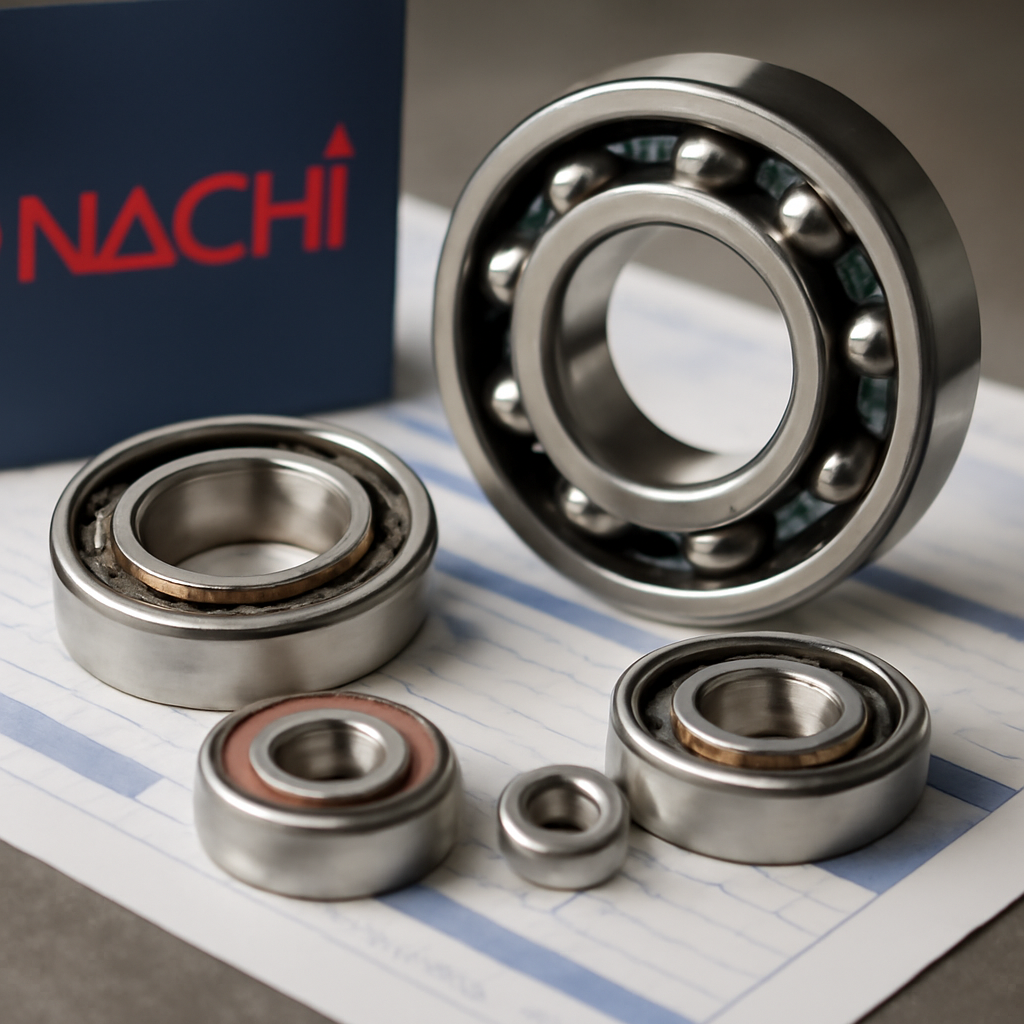
NACHI-Fujikoshi Corporation, founded in 1928 in Toyama, Japan, is one of the established Japanese bearing manufacturers operating across precision machine tools, hydraulic systems, robots and industrial bearings. While smaller than the top-five players (SKF, Schaeffler, NSK, NTN, TIMKEN), NACHI carries a strong reputation in specific industrial segments and represents a credible secondary or tertiary supplier qualification for European procurement teams. This guide walks through the NACHI bearing range, positioning in 2026, and cross-references to support multi-source procurement strategies.
1. The NACHI corporate context
NACHI-Fujikoshi operates four main business segments: bearings, machine tools (especially broaches and high-speed steel cutting tools), hydraulic systems, and industrial robots. The integrated manufacturing platform gives NACHI internal expertise in precision steel manufacturing and heat treatment that supports bearing quality. The company is publicly traded on the Tokyo Stock Exchange.
2. The NACHI bearing portfolio
- Deep groove ball bearings: 6000, 6200, 6300 series across general industrial applications.
- Angular contact ball bearings: 7000 series, including high-precision spindle ranges.
- Cylindrical roller bearings: NU, N, NJ, NUP configurations including precision spindle variants.
- Tapered roller bearings: metric and imperial across general industrial.
- Spherical roller bearings: 22000, 23000 series.
- Needle roller bearings: drawn cup, solid, combined.
- Super-precision angular contact ball bearings: machine tool spindle range (P4, P2 tolerance).
- Insert bearings (Y-bearing equivalents): UC series for pillow blocks and flanges.
3. Where NACHI has competitive strength
3.1 Machine tool spindle bearings
NACHI’s vertical integration with machine tool manufacturing supports deep expertise in spindle bearing applications. Super-precision angular contact ranges are NACHI’s distinctive strength area, competing with NSK Super-Precision, SKF Super-Precision, and FAG high-precision ranges.
3.2 Robot bearings
NACHI manufactures industrial robots and consequently has internal experience with the bearing requirements for robotic joints. Crossed-roller bearings, harmonic drive bearings, and small precision bearings for robotic applications benefit from this integrated knowledge.
3.3 Heat treatment expertise
NACHI’s machine tool steel heritage produces deep heat treatment expertise that supports bearing material quality. Enhanced fatigue life ranges leverage this internal capability.
3.4 Asian industrial market presence
NACHI distribution is strong in Japan, China, and broader Asia. European distribution exists but is less extensive than the major brands.
4. Where NACHI faces competitive challenges
- Smaller scale than the top-five players limits R&D investment and product range breadth.
- European distribution depth is more limited than SKF, Schaeffler, NSK, NTN.
- Brand recognition among European procurement teams is lower.
- Specialty premium ranges (smart bearings, condition monitoring integration) have less developed positions.
5. Decoding NACHI designations
NACHI follows standard ISO designations. 6205 ZZE C3 reads as deep groove ball bearing, 25 mm bore, double metal shield (ZZ), enhanced design (E), C3 clearance. Specific NACHI suffixes:
- ZZE: double metal shields (enhanced).
- NSE: double contact lip seals (enhanced).
- K: tapered bore (for adapter sleeve mounting).
- E: enhanced internal design.
6. Cross-reference with major brands
NACHI standard catalogue bearings cross-reference cleanly with SKF, FAG, NSK, NTN, TIMKEN, Koyo on dimensional standards. Tolerance class designations follow ISO (P0/P6/P5/P4) identically. For aftermarket replacement, the cross-reference is straightforward on standard ranges. For enhanced fatigue life ranges, the engineering equivalence should be verified with manufacturer technical support.
7. Where NACHI is the natural specification
- Machine tool spindle applications, especially for Japanese OEM machine builders.
- Industrial robot bearings (internal NACHI robot integration).
- Multi-source qualification on critical industrial bearings (secondary or tertiary supplier).
- Cost-sensitive applications where premium brand pricing exceeds operational requirements.
- Japanese OEM equipment serving European markets.
8. The European distribution structure
NACHI Europe operates through authorised distributors across major industrial markets. Standard catalogue availability covers the most common SKUs; specialty and large-size bearings may require longer lead times. The European distribution network is established but smaller than the top-five players’ networks. For procurement teams, lead time and stocking depth should be verified locally before committing to NACHI as primary supplier on critical applications.
9. The 2026 strategic positioning
NACHI’s 2026 strategic positioning emphasises continued investment in machine tool spindle technology, robot bearing integration with the broader NACHI robot business, and incremental product range expansion. The company is not pursuing the smart bearing platform race aggressively but maintains adequate condition monitoring integration through partnerships. For European customers seeking a credible secondary or tertiary supplier with specific strength areas, NACHI fits the role well.
10. Procurement guidance for European industrial customers
- Evaluate NACHI for multi-source qualification on critical SKUs, especially in machine tool and robotic applications.
- For standard industrial bearings, compare NACHI pricing against the primary supplier — NACHI often delivers cost advantage of 10-25%.
- Verify European stocking depth and lead times before committing on supply-critical applications.
- For machine tool spindle applications, NACHI Super-Precision deserves serious consideration alongside NSK, SKF, FAG.
- Build cross-reference data for NACHI equivalents on the top-100 SKUs.
11. The competitive positioning in the consolidation era
As NSK + NTN consolidate and the broader industry restructures, NACHI’s strategic positioning as a focused specialty supplier becomes more valuable. Multi-supplier qualification across the consolidation period benefits from having credible secondary and tertiary suppliers like NACHI in the qualified base. The strategic value to procurement teams of maintaining NACHI relationships increases as primary supplier consolidation reduces competitive alternatives.
12. Integration with broader procurement strategy
NACHI fits within broader European procurement strategy as a credible alternative supplier supporting substitution agility through industry consolidation. Combined with framework agreement renegotiation, condition monitoring platform commitments, and master data discipline, NACHI’s role as multi-source backup supports the strategic procurement priorities driving European industrial buyers through 2026-2027.
Conclusion
NACHI Bearings (NACHI-Fujikoshi) represents a credible Japanese bearing supplier with specific strengths in machine tool spindles and industrial robot bearings. While smaller than the top-five players, NACHI’s specialty positioning and cost competitiveness make it a sound choice for multi-source qualification on critical SKUs. European procurement teams operating through the consolidation period benefit from maintaining qualified NACHI relationships as part of substitution-agile supplier strategies.
Industry context
NACHI operates in a European bearing market that in 2026 remains dominated by SKF, Schaeffler and the two large Japanese groups NSK and NTN, with TIMKEN holding the tapered-roller franchise. Within that context, NACHI plays a specific role: a credible second- or third-source supplier for OEM procurement teams that want to avoid single-sourcing on standardised catalogue references. European industrial buyers increasingly split their qualification lists between a lead brand and one or two backup brands, and NACHI’s price point, technical documentation and lead-time consistency make it a natural fit for the backup slot. In machine tools, hydraulics and robotics — three segments where NACHI has genuine engineering depth — the brand is often specified directly by end users rather than just accepted as a substitute. Understanding that context helps buyers position NACHI correctly in the qualification matrix rather than treating it as a generic aftermarket alternative.
Selection criteria for buyers
When qualifying NACHI as a secondary supplier, European procurement teams should focus on four criteria that matter more than headline price. First, cross-reference completeness: NACHI publishes competitive cross-references against SKF, FAG, NSK and NTN for its main catalogue families, but coverage varies by product line — deep groove and cylindrical roller are well documented, while some specialty ranges require direct engineering support. Second, precision class alignment: NACHI catalogues use ISO precision classes (P0, P6, P5, P4), and buyers should confirm equivalence to their internal specifications, especially where FAG or SKF tolerances are called out on drawings. Third, seal and cage options: NACHI’s cage material choices (steel, brass, polyamide) don’t always mirror the lead brand one-to-one, so functional equivalence should be verified. Fourth, European stock availability through authorised distributors — this is often the make-or-break factor for aftermarket replacements where downtime cost dominates the calculation.
Long-term reliability factors
Long-term reliability with NACHI bearings in industrial service depends less on the brand itself and more on how the qualification and monitoring loop is set up. In our experience across European industrial customers, NACHI performs on par with the lead Japanese brands in properly specified applications — the failures we see are almost always attributable to installation, lubrication or contamination issues rather than manufacturing defects. To capture that reliability, buyers should establish a baseline vibration signature within the first 100 operating hours, standardise the lubrication regime (regrease intervals matched to speed and temperature), and document field failures with photographs and mounting records so root-cause analysis is possible. Over a 24-month qualification window, the data will show whether NACHI belongs on the primary qualification list, the backup list or should be rotated out. The reliability discussion is fundamentally an evidence discussion, not a brand-loyalty discussion.
The take-away for European industrial procurement is that qualifying NACHI is a low-cost, medium-reward move: the brand delivers reliably in the applications it was designed for, and the qualification effort pays back the first time a lead-brand shortage or price hike puts the primary supplier under stress. Treat NACHI as a strategic backup, not a spot-buy alternative, and the reliability data will accumulate to support that positioning.
Related guides on Eurobearing
- Top 6 Bearing Brands
- Koyo JTEKT Bearings Guide
- NSK + NTN Merger Analysis
- Bearing Buyers Handbook 2026
- SKF Bearings Complete 2026 Guide
Need help with bearing selection? Our team supports you with cross-references and lead-times.