
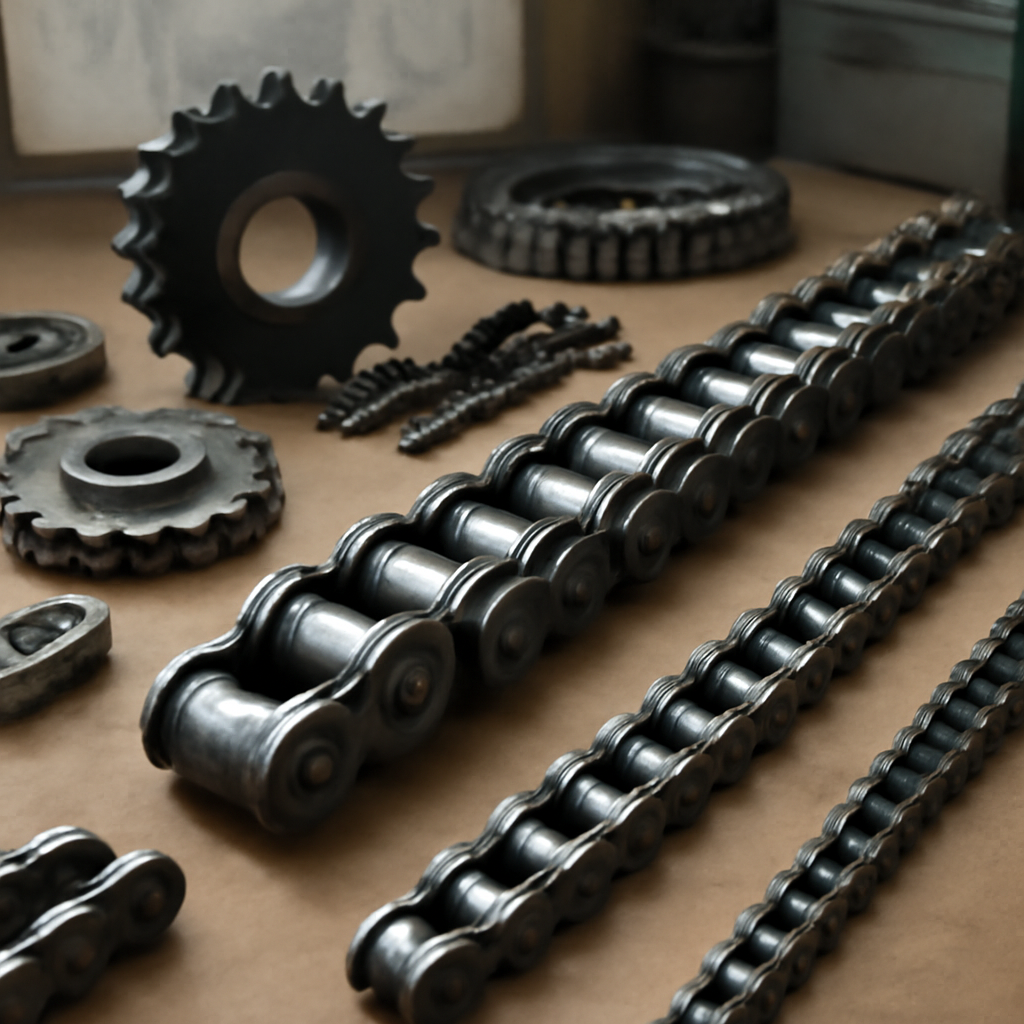
Tsubakimoto Chain Co., known globally as Tsubaki, has been manufacturing precision roller chains since 1917. Today the Japanese company is one of the world’s largest industrial chain manufacturers, with a portfolio spanning roller chains, conveyor chains, engineering chains, specialty chains, and integrated drive solutions. For European industrial customers, Tsubaki sits alongside SEDIS and Renold as one of the established premium chain references. This complete guide walks through the Tsubaki range, where it dominates, and how to specify it correctly in 2026.
1. The Tsubaki global position
Tsubakimoto operates manufacturing facilities across Japan, the US, Europe (Netherlands, Czech Republic), and Asia (China, Thailand, Vietnam). The European headquarters in Tilburg coordinates distribution across the continent. Annual revenue exceeds $2 billion, with industrial chain as the core business alongside power transmission products, automotive timing chains, and material handling systems.
2. The Tsubaki chain portfolio
2.1 Standard roller chains
ANSI and ISO/DIN roller chains from #25 (6.35 mm pitch) to #240 (76.2 mm pitch). Simplex, duplex, triplex configurations. The workhorse of industrial drives.
2.2 Heavy-duty roller chains (HKS, RS)
Enhanced fatigue life through improved materials and heat treatment. The RS-HT range delivers 10-20% longer service life than standard equivalents under typical industrial duty.
2.3 Lambda chains
Tsubaki’s distinctive Lambda range incorporates oil-impregnated sintered bushings, dramatically reducing or eliminating routine lubrication requirements. The strategic positioning: maintenance-reduced operation in clean environments where re-lubrication is operationally expensive or undesirable. Lambda chains are particularly popular in food processing, packaging, and electronics manufacturing.
2.4 Neptune chains
Specialty corrosion-resistant range using zinc-nickel plating plus specialty seal arrangements. Used in aggressive environments — chemical processing, marine deck machinery, food wash-down lines.
2.5 Stainless steel chains
Full AISI 304/316 stainless construction for the most aggressive corrosion environments. Premium pricing, premium performance.
2.6 Conveyor chains
Heavy-duty conveyor chains for material handling, including specialty attachments (carriers, side rollers, snap-on attachments). The Tsubaki conveyor chain catalogue is one of the broadest in the industry.
2.7 Engineering chains
Heavy industrial duty chains for severe applications: cement production, sugar processing, paper and pulp, mining. Specialty configurations engineered for specific applications.
2.8 Specialty chains
Cam clutch chains, leaf chains for forklift masts, silent chains for high-speed applications, and various specialty configurations.
3. Where Tsubaki dominates
- Japanese OEM machine builders: Tsubaki is the default Japanese industrial chain reference.
- Lambda technology applications: clean-environment maintenance-reduced drives.
- Heavy industrial duty: engineering chains for cement, sugar, paper, mining.
- Asian growth markets: Tsubaki distribution depth is strongest in Asia Pacific.
- Premium European applications: where service life and reliability justify premium pricing.
4. Decoding Tsubaki designations
Tsubaki follows standard ANSI and ISO conventions. RS80 is an ANSI #80 standard roller chain. Specific Tsubaki suffixes:
- HT: Heavy Duty enhanced fatigue life.
- Lambda: oil-impregnated sintered bushings (maintenance-reduced).
- Neptune: corrosion-resistant zinc-nickel.
- SS: stainless steel construction.
- L: leaf chain (forklift applications).
- CT: silent chain for high-speed applications.
5. Cross-reference with SEDIS, Renold, and others
Standard Tsubaki ANSI/ISO chains cross-reference cleanly with SEDIS, Renold, Iwis, and other major chain manufacturers on the dimensional standard. Specialty ranges (Lambda, Neptune, stainless) have proprietary features that should not be substituted without engineering equivalence verification. For aftermarket replacement, the cross-reference is straightforward on standard catalogue ranges.
6. Sprocket compatibility and pairing
Tsubaki sprockets and chain are designed as a system. While Tsubaki chains work with sprockets from other manufacturers (dimensional compatibility on standard ANSI/ISO ranges), the Tsubaki integrated sprocket-chain pairing delivers measurable performance benefits. For premium ranges (HT, Lambda), Tsubaki sprockets are recommended.
7. Lubrication strategy for Tsubaki chains
Lubrication recommendations vary by chain type:
- Standard roller chains: periodic oil application or drip oiler at moderate speeds; oil bath or stream at higher speeds.
- Lambda chains: factory-impregnated, no additional lubrication required for the design life. Sometimes light surface oiling extends life further.
- Neptune chains: corrosion-resistant base allows reduced lubrication; specific oil specifications matter in chemically aggressive environments.
- Engineering chains: specialty heavy-duty oils, often with automatic central lubrication systems.
8. Tension and wear monitoring
Tsubaki chain wear management follows standard chain practice:
- Initial tension setup: 2-4% sag in slack span for horizontal drives.
- Re-tension after 24-48 hours of operation (initial wear-in).
- Elongation measurement quarterly on critical drives, semi-annually on standard.
- Replace chain when elongation reaches 2% (or per OEM specification, sometimes 1.5% for precision applications).
- Replace chain and sprockets together for best subsequent service life.
9. The Tsubaki aftermarket presence in Europe
Tsubaki European distribution operates through authorised distributors across all major industrial markets, coordinated from the Tilburg European headquarters. Standard catalogue availability is comparable to SEDIS and Renold; specialty ranges (Lambda, Neptune) require slightly longer lead times in some sizes. For volume customers, the Tilburg distribution centre supports direct supply.
10. The 2026 strategic positioning
Tsubaki enters 2026 well-positioned across all major industrial chain segments. Continued investment in maintenance-reduced technology (Lambda), specialty environment chains (Neptune, stainless), and engineering applications maintains the premium positioning. The strategic challenge: continued price competition from Chinese chain manufacturers at the standard catalogue end.
11. Procurement guidance for European industrial customers
- For standard industrial drives, evaluate Tsubaki standard against SEDIS and Renold based on availability and pricing.
- For clean environments where re-lubrication is operationally expensive, Lambda’s reduced-maintenance positioning often pays back.
- For corrosive environments, Neptune or stainless options compete with specialty offerings from other manufacturers.
- For heavy industrial duty (cement, sugar, paper), engineering chain selection benefits from manufacturer application engineering consultation.
- Build cross-reference data for Tsubaki standard sizes to support substitution agility.
12. Integration with broader maintenance strategy
Industrial chains are one element of broader power transmission reliability strategy. Integration with belt drives (Optibelt and equivalent), bearings, coupling alignment, and condition monitoring delivers compounding operational benefits. Plants treating power transmission as integrated reliability systems rather than independent components systematically outperform those operating in silos.
Conclusion
Tsubaki industrial chains represent one of the European premium chain options across virtually every application category. The combination of Japanese engineering heritage, specialty technology ranges (Lambda, Neptune), broad portfolio, and established European distribution makes Tsubaki a credible choice for European industrial procurement. Specification benefits from understanding the specialty ranges (where the premium delivers measurable operational benefit) and the standard ranges (where competitive comparison with SEDIS, Renold, and Asian alternatives matters).
Related guides on Eurobearing
- SEDIS Chains Applications
- SEDIS Industrial Chains
- Extend Power Transmission Belt Lifespan
- Guide to OPTIBELT Drive Belts
- Belt Drive Alignment
Need help with bearing selection? Our team supports you with cross-references and lead-times.