
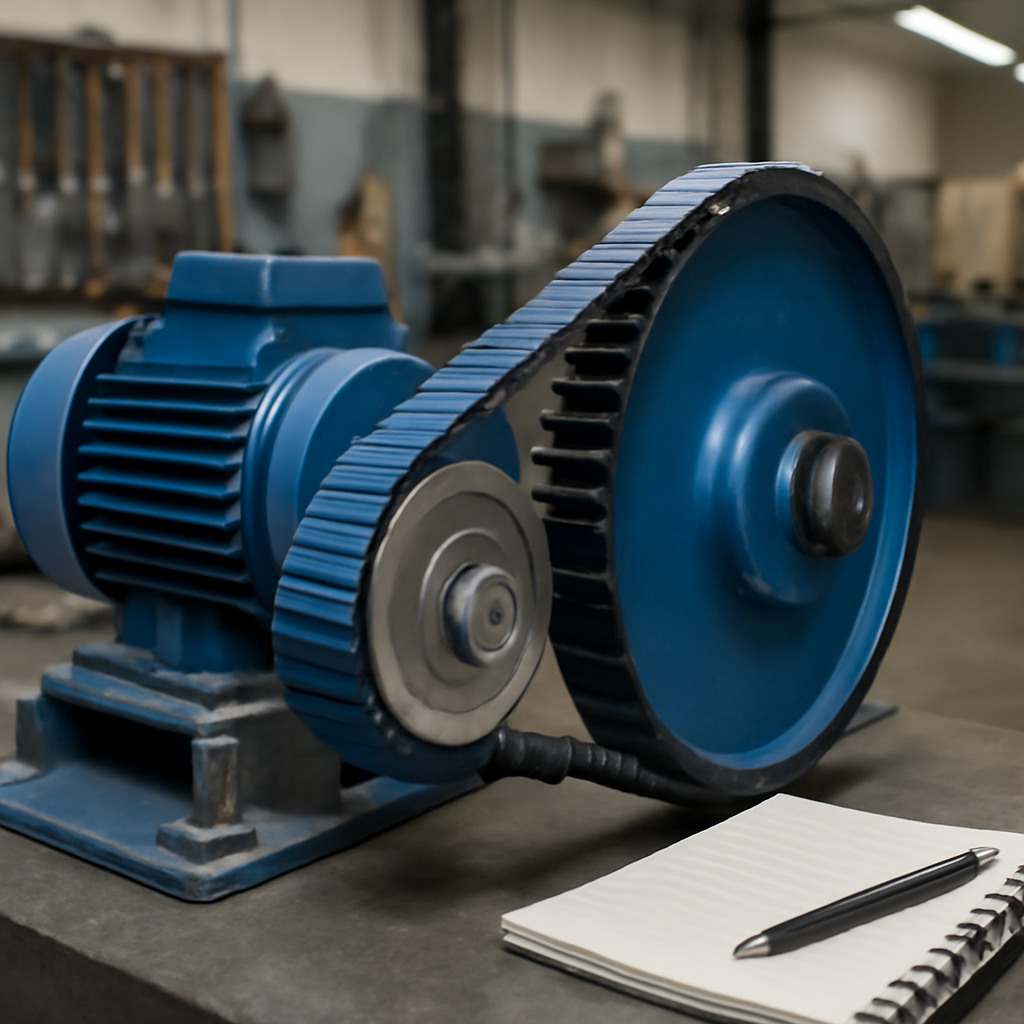
A maintenance manager running fifteen conveyor drives with cog belts has one specific question every 24 months: is the OPTIBELT Blue Power upgrade actually worth the price differential, or does the standard red-jacket range do the job just as well? The honest answer depends on load spectrum, drive geometry, and how disciplined the shop is about periodic re-tensioning. This piece pulls together field notes from a two-year re-tension programme across paper mills, food processing lines and metalworking plants, and shows where OPTIBELT Blue Power quietly pays back the extra cost.
What Blue Power actually changes versus the standard cog range
The OPTIBELT Blue Power range shipped from Höxter uses a different tension member than the standard red-jacket cog belts. The tension cord is a specifically formulated polyester compound designed to resist elongation under sustained high torque. The rubber compound in the jacket has a slightly higher carbon content, giving marginally better heat resistance. And the cog profile is machined to a tighter tolerance, which reduces the vibration signature when the belt runs at the top of its rated speed range. On paper these are small changes. In practice they add up to a belt that holds its initial tension longer, runs cooler on high-load applications, and needs re-tensioning less frequently. The question is whether those benefits justify the price premium of roughly 25 to 35 percent over a standard OPTIBELT cog belt.
Where Blue Power earns back the price on high-torque drives
The clearest payback case is a drive that runs continuously above 80 percent of its rated torque. A typical example: a paper mill press-section drive that pushes 150 kilowatts through a two-pulley cog belt system, sixteen hours a day, six days a week. On this duty cycle a standard OPTIBELT cog belt needs re-tensioning every 90 to 120 days and replacement every 18 months. A Blue Power belt on the same drive holds tension for 180 to 240 days and lasts 30 to 36 months. The math works out clearly in favour of the premium range once you factor in the labour cost of stopping the line to re-tension. Each maintenance stop on a paper machine costs somewhere between two and four thousand euros in lost production, so the belt price differential becomes marginal against the maintenance savings.
Where Blue Power does not pay back
Not every drive is a high-torque continuous application. Light-duty conveyor drives that spend 60 percent of their operating hours at less than 40 percent of rated torque do not benefit meaningfully from the Blue Power upgrade. The tension holding advantage does not show up because the belt does not see enough load to stretch the standard tension member. The heat resistance advantage does not matter because the belt runs cool anyway. On these applications the standard OPTIBELT cog range is the pragmatic choice. Buying Blue Power for a light-duty conveyor is paying for engineering the drive does not need. This is the mistake maintenance procurement teams sometimes make when standardising on one range across all applications for inventory simplicity.
The re-tension protocol that made the difference
A structured re-tension programme matters more than the belt choice. The protocol that emerged from the field notes covers three checks. First: measure belt deflection with a proper tension gauge, not by feel or by pushing with a thumb. Feel is not repeatable across technicians and gives 30 percent variance in reported tension. Second: check pulley alignment with a straightedge or a laser alignment tool before adjusting tension. A misaligned drive that gets re-tensioned only accelerates the wear on the belt sides. Third: log the tension reading and the running hours since last check. Over six months the log reveals which drives are drifting and which are stable, so the maintenance team can shift the check frequency to match actual behaviour rather than a calendar rule. Both Blue Power and standard OPTIBELT belts perform substantially better under this protocol than either type performs without it.
How OPTIBELT compares against the direct competitors in the field
OPTIBELT competes primarily with Gates and Continental in the European industrial belt market. On the specific question of cog-belt performance under sustained high load, the field data shows Blue Power comfortably ahead of the equivalent Gates PowerGrip GT4 range on paper mills and marginally ahead on food-processing lines. Against Continental Multi-V PK-series belts the comparison is closer, with Continental performing slightly better on pulley alignment tolerance and OPTIBELT better on peak load capacity. The choice between the three often comes down to which brand the plant standardised on for inventory reasons, plus service response from the local distributor. On the standard red-jacket cog range the three brands are essentially interchangeable for most applications.
Sizing and specification decisions that matter
Two specification decisions matter more than the choice between standard and Blue Power. First: pulley pitch diameter. OPTIBELT publishes the minimum recommended pulley diameters for each belt cross-section in the technical manual. Going smaller than the recommendation costs you 20 to 40 percent of the belt life because the belt cord takes a tighter bending radius than it was designed for. Second: the number of belts in a multi-belt drive. Using two smaller belts on a high-load drive instead of one larger belt increases the shock load resilience but requires matched pairs to prevent tension imbalance. OPTIBELT sells its Blue Power belts in matched sets specifically for this reason. Buying two individually cut belts and running them side by side gives you 30 percent less life than a proper matched pair, because the tension distributes unevenly.
Lead time realities in 2026
OPTIBELT has been running lead times of six to eight weeks on Blue Power specialty sizes since early 2026, up from three to four weeks pre-pandemic. Standard red-jacket cog belts remain on stock for common sizes across most European distributors, with lead times of one to two weeks for larger cross-sections. This lead-time gap matters for procurement teams building next-year inventory: if the drive fleet is trending toward Blue Power for the high-torque applications, the safety stock strategy needs to account for the six-to-eight week window. Distributors are increasingly holding matched-pair Blue Power sets on consignment for their large paper and steel mill customers, which changes the working capital math for both sides.
What buyers should specify on the next drive redesign
The pragmatic 2026 specification: standard OPTIBELT cog belts on drives below 60 percent rated torque continuous duty; Blue Power on drives above 75 percent continuous or with high peak loads; matched pairs on any drive using two or more belts side by side; disciplined re-tension protocol regardless of which range. Do not upgrade every drive to Blue Power for uniformity — the light-duty drives do not need it. Do not stay on standard cog when the load spectrum has drifted toward continuous heavy duty over the years without a corresponding drive upgrade. And plan the safety stock around the current six-to-eight week specialty lead time until OPTIBELT signals that has normalised.
Related reading on Eurobearing
- OPTIBELT V-Belts: A Complete Selection Guide
- Optibelt RBK and TruckPower Belts for Commercial Vehicles
- Strategies to Extend the Lifespan of Power Transmission Belts
- Sealing Rings and Oil Seals: Materials Used in 2026
- The Bearing Buyers Handbook 2026
Need help selecting between OPTIBELT Blue Power and standard cog belts? Our technical team supports procurement teams with drive-by-drive load analysis and matched-pair sizing. Book a free consultation.