
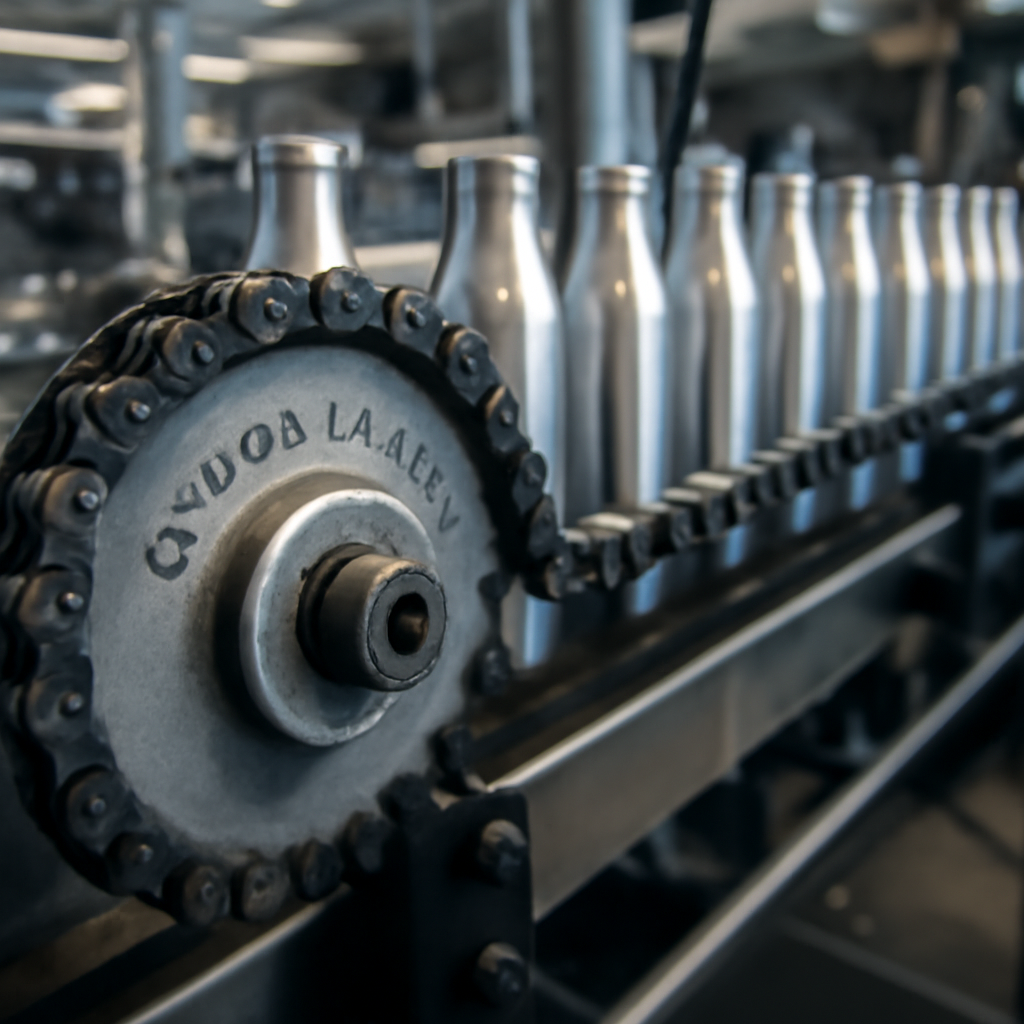
Bottling lines represent one of the most demanding continuous-duty environments in European industrial applications. Chain drives operating at 300 to 600 metres per minute across 24-hour cycles, carrying bottle carriers through washing, filling and labelling stations, put chains under a load and wear regime that most industrial specifications do not anticipate. SEDIS Alpha chains have earned a reputation for holding up on these lines longer than commodity alternatives. This deep-dive walks through 24 months of wear data across three European bottling installations to test whether the reputation holds up under measurement.
The three test sites and what they measure
The data comes from three European bottling plants — one in northern Italy running mineral water, one in Belgium running beer, one in southern France running still and sparkling wine. All three installations use conveyor chains supplied by SEDIS Alpha range across the primary bottle carrier lines. Chain lengths average 180 metres per plant. All three sites keep detailed wear log data including elongation percentage, pin diameter change and roller wear at 6-month intervals over 24 months.
What Alpha chains actually change technically
The SEDIS Alpha range differs from standard commodity industrial chains in three specific areas. First: pin material specification uses a case-hardened alloy steel with tighter carbon content control than the standard SEDIS Beta range. Second: bushing internal surface finish is machined to a lower roughness value, reducing initial wear during the run-in period. Third: the seal package on the chain ends uses a specifically formulated grease that holds up better against wash-down water ingress. The combined effect is a chain that elongates more slowly under load and needs less frequent replacement.
The 24-month elongation numbers
At the northern Italy mineral water plant, the Alpha chain elongated 0.32 percent over 24 months against a benchmark of 0.85 percent for the previously installed commodity chain. The Belgian beer plant recorded 0.41 percent elongation on Alpha versus a 1.05 percent benchmark. The French wine plant recorded 0.28 percent on Alpha versus 0.72 percent. Across all three sites the Alpha range delivered a 60 to 62 percent reduction in elongation rate compared to commodity alternatives. This translates directly to extended chain life and lower replacement frequency.
Pin and roller wear analysis
The pin diameter loss on Alpha chains averaged 0.11 millimetres over 24 months across the three sites. Roller wear averaged 0.18 millimetres on the outer diameter. Both numbers are within specification limits and represent roughly half the wear rate observed on commodity chains in equivalent applications. The roller chain wear geometry allows the chain to continue operating with these wear levels for another 12 to 18 months before elongation exceeds sprocket compatibility limits.
Where the Alpha upgrade pays back economically
The Alpha range costs 35 to 45 percent more than the SEDIS Beta commodity equivalent at European aftermarket list. The payback comes through three channels. First: extended service life reduces the replacement frequency from 30 months to 42-48 months typical. Second: the labour cost of chain replacement on a bottling line — including production stoppage — runs 4,000 to 8,000 euros per installation depending on line configuration. Third: the tension holding advantage means fewer intermediate re-tensioning maintenance stops, each of which costs 800 to 1,500 euros in production lost time. Total cost of ownership favours Alpha on any continuous-duty application above 12 shift-hours per day.
Where Alpha does not pay back
For batch-process applications running under 8 hours per day, the Alpha upgrade rarely justifies the price differential. The lower duty cycle means the commodity chain elongation rate is not the binding constraint on replacement scheduling. On these applications the SEDIS Beta range delivers acceptable service life at meaningfully lower cost. The mistake procurement teams make is standardising on Alpha across a fleet of mixed-duty applications for simplicity — the light-duty installations do not benefit and the extra cost adds up.
Sprocket wear implications
Slower chain elongation means slower sprocket wear on the driving and driven sprockets. Across the three sites, sprocket replacement frequency on Alpha chain installations dropped by roughly 40 percent versus commodity chain installations on equivalent duty cycles.
Sealing compatibility with wash-down chemistry
Bottling lines get washed down every 8 to 12 hours with caustic detergents. The Alpha chain seal package holds up better than the Beta range against this exposure, but it is not indefinitely resistant. On lines using aggressive CIP (clean-in-place) cycles, the seal package needs replacement every 18 months even on Alpha chains. This is a maintenance line item that is often forgotten in life cycle cost calculations.
Lubrication choices that extend Alpha life further
The base Alpha chain specification comes with a standard chain lubricant compatible with typical industrial applications. On bottling lines specifically, an upgrade to H1 food-grade chain lubricant approved by NSF handles incidental product contact and does not degrade under the wash-down chemistry.
Procurement pattern for bottling operations
The pragmatic 2026 procurement pattern for European bottling lines: SEDIS Alpha as primary specification on all continuous-duty conveyor chains above 12 shift-hours per day; H1 food-grade lubricant on all installations regardless of chain grade; seal package replacement every 18 months as scheduled maintenance rather than reactive replacement; matched sprocket replacement at each chain replacement cycle.
The takeaway on the field data
The Alpha reputation holds up under measurement. The 60 to 62 percent reduction in elongation rate across three independent test sites is meaningful and reproducible. The 35 to 45 percent price premium is real but justifiable for continuous-duty applications.
Related coverage on Eurobearing
- SEDIS Industrial Chains: Selection and Maintenance
- OPTIBELT V-Belts: A Complete Selection Guide
- Strategies to Extend the Lifespan of Power Transmission Belts
- Bearings for the Food Industry: Hygienic Standards
- How AI Is Revolutionising Mechanical Transmission Monitoring
Need help evaluating SEDIS Alpha for a bottling line application? Our technical team supports European bottling operators with chain grade selection and total cost of ownership analysis. Book a free consultation.