
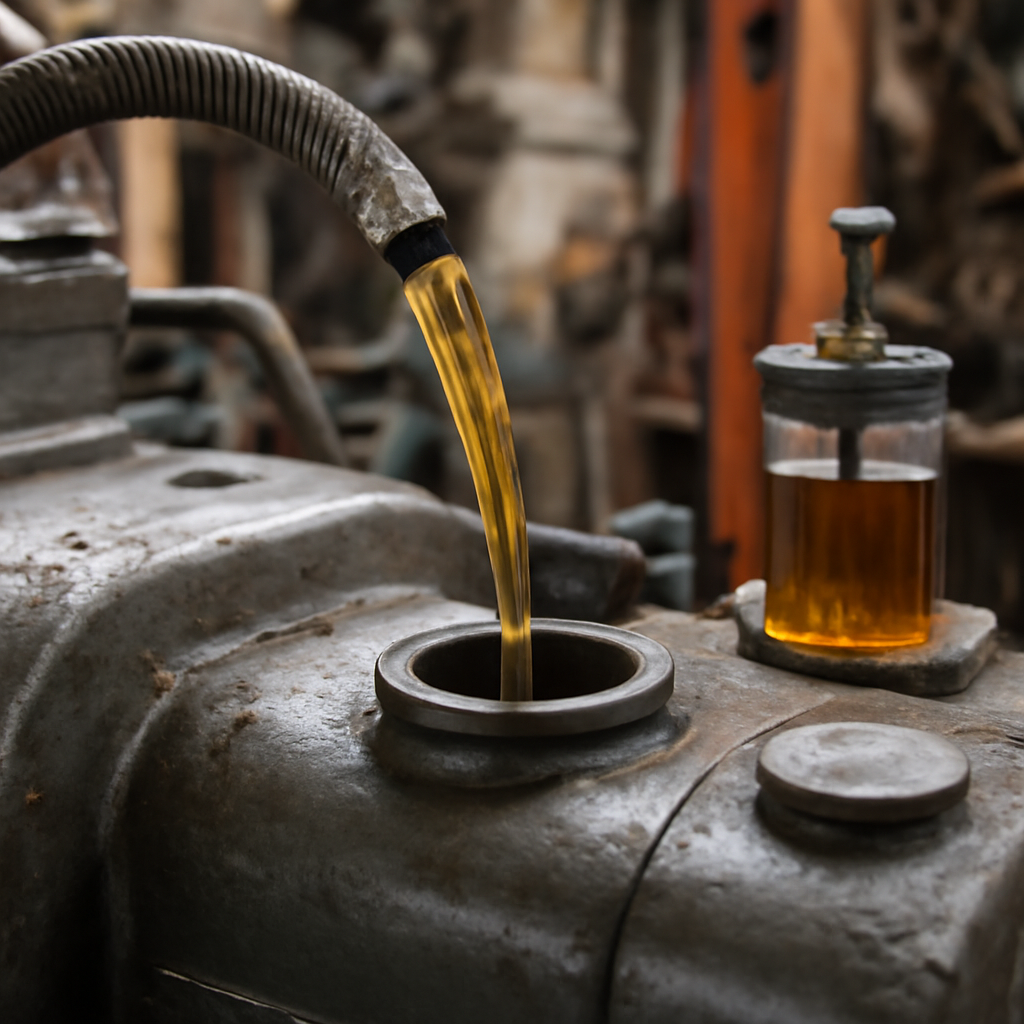
Industrial lubrication at sustained high temperature is one of the most demanding operational environments any lubricant faces. Bearings in steel mills, cement kilns, glass production, baking ovens, paper drying sections, and high-power electric motors all operate continuously at temperatures that destroy standard grease formulations within months. This guide walks through the practical best practices for industrial lubrication above 120 °C, covering grease selection, application discipline, monitoring strategies, and the operational disciplines that separate plants with multi-year service intervals from plants with quarterly failures.
1. Why high-temperature lubrication is fundamentally different
Standard NLGI 2 lithium grease — the workhorse of European industrial lubrication — is engineered for continuous operation up to 100-110 °C, with peak excursions to 130 °C. Above these temperatures, three failure modes accelerate:
- Base oil oxidation: doubles in rate for every 10 °C above the design temperature, producing acidic degradation products.
- Thickener breakdown: lithium soap softens above 130 °C continuously, eventually losing the structural property that holds the grease in place.
- Additive depletion: extreme pressure and antioxidant additives consume faster at higher temperature.
The cumulative effect: a grease specified for 12,000 hours at 70 °C delivers perhaps 500 hours at 150 °C continuously — a 24x service life reduction.
2. Synthetic base oil selection
Above 120 °C continuous operation, mineral oil base lubricants reach their thermal stability limit. The synthetic alternatives:
- Polyalphaolefin (PAO): continuous operation to 150 °C, excellent oxidation resistance, broad compatibility. The default upgrade from mineral.
- Polyalkylene glycol (PAG): high temperature performance plus water compatibility for specific applications. Compatibility caveats with elastomer seals.
- Ester synthetic: excellent high temperature performance, biodegradable variants available, but elastomer compatibility requires verification.
- Silicone: extreme temperature capability (-50 to +200 °C) but limited load capacity. Used in specialty applications.
- Perfluoropolyether (PFPE): 250 °C+ continuous, chemical inertness, but very expensive. Specialty applications only.
3. Thickener selection for high temperature
- Lithium complex: extends standard lithium to 150 °C continuous. Cost-effective upgrade.
- Polyurea: 160 °C continuous, excellent oxidation resistance, low noise characteristics. Increasingly common on electric motor applications.
- Calcium sulphonate complex: 180 °C continuous, excellent water resistance, inherent corrosion protection. The marine and aggressive-environment choice.
- Bentonite (clay): non-melting thickener for 200 °C+ applications. Specialty use.
- PTFE: 250 °C+ continuous with PFPE base. The ultimate thermal capability.
4. Application-specific recommendations
4.1 Steel mill bearings
Hot strip mill back-up roll bearings face combined high temperature, water exposure, and heavy shock load. Calcium sulphonate complex grease with PAO base oil is the European default. Re-lubrication intervals shorten dramatically; automatic lubrication systems are typical.
4.2 Cement plant kiln bearings
Kiln support rollers operate continuously at 150-200 °C external temperature with raceway temperatures higher. Specialty high-temperature greases with bentonite or polyurea thickener and PAO base oil are required. Re-lubrication intervals measured in days not months.
4.3 Paper machine drying section
Calender and dryer roll bearings face sustained 120-180 °C with steam exposure. Synthetic base grease with polyurea thickener and water-resistance additives.
4.4 Glass production
Glass furnace and forming equipment bearings reach extreme temperatures. Specialty bentonite-thickener greases or oil mist circulation systems depending on speed and access.
4.5 Electric motor bearings on hot motors
Motors above 75 kW running continuously at high ambient temperatures push bearing temperatures into the 100-150 °C range. Synthetic polyurea greases (Mobil Polyrex EM, SKF LGHP 2, Klüber Asonic) are the standard upgrade from lithium.
5. Re-lubrication interval calculation for high temperature
The general rule: re-lubrication interval halves for every 15-20 °C rise above the grease’s reference temperature. Manufacturer calculators provide more precise guidance. For practical operations:
- Below 70 °C: full calculated interval, typically 6-12 months for sealed grease bearings.
- 70-100 °C: standard interval per manufacturer calculator.
- 100-130 °C: half the standard interval.
- 130-150 °C: quarter the standard interval, automatic lubrication recommended.
- Above 150 °C: continuous lubrication (oil circulation or automatic grease dispensing) typically required.
6. Monitoring strategy for high-temperature applications
- Temperature trending: IR thermometer scans on a defined schedule. Trend deviation from baseline is the leading indicator.
- Vibration monitoring: defect frequencies appear earlier in high-temperature applications due to faster fatigue progression.
- Grease sampling and analysis: water content, metal particles, oxidation level, viscosity. For critical applications, quarterly sampling.
- Visual inspection of purged grease: colour and consistency tell the story of lubricant condition.
7. Application discipline that prevents failures
- Match grease specification to the application temperature envelope precisely. Do not default to “what was on the shelf”.
- Document the lubrication specification in the asset master data.
- Train technicians on temperature-specific re-lubrication intervals.
- Use dedicated grease tools for different grease types — cross-contamination from incompatible thickeners is a major failure mode.
- Clean grease nipple before application — high-temperature failures often trace back to contamination at re-greasing.
- Document re-greasing events in the CMMS with date, technician, quantity, and grease batch.
8. Common mistakes that cause premature failures
- Using NLGI 2 lithium grease above 120 °C continuously.
- Mixing incompatible thickeners during re-lubrication.
- Over-greasing on high-temperature bearings causes additional heat from churning.
- Skipping the periodic grease sampling and analysis on critical applications.
- Re-using grease tools across incompatible grease specifications.
- Ignoring temperature trend signals that point to lubrication failure.
9. Cost-benefit math for premium synthetic greases
Synthetic high-temperature greases cost 3-10x the price of standard lithium grease. The cost-benefit math at the bearing level converges decisively in favour of the premium specification:
- Bearing replacement cost (labour + parts + downtime): typically €500-5,000 per event.
- Extended service interval with correct grease: 5-10x longer than incorrect specification.
- Annual grease cost difference per bearing: €5-50.
- Net savings per bearing per year: €100-1,000+.
Across a fleet of hundreds of high-temperature bearings, the annual savings are substantial.
10. The 2026 supplier landscape for high-temperature greases
European industrial high-temperature lubrication suppliers include:
- Klüber Lubrication: premium German specialist, broad high-temperature range.
- Mobil Industrial: ExxonMobil’s industrial range, including Mobil Polyrex EM for motors.
- SKF: LGHP 2, LGHB 2 and specialty high-temperature greases integrated with bearing supply.
- Shell: Gadus range with high-temperature variants.
- Fuchs: Renolit high-temperature range.
- Total: Multis range with high-temperature options.
- Petro-Canada: Peerless range with high-temperature variants.
11. Integration with broader maintenance strategy
High-temperature lubrication is one element of broader maintenance reliability strategy. Integration with condition monitoring (vibration, temperature, oil/grease analysis), CMMS workflow, supplier relationships, and procurement discipline delivers compounding operational benefits. Plants that treat lubrication as a strategic capability rather than a routine task systematically outperform those treating it transactionally.
Conclusion
High-temperature industrial lubrication is one of the highest-leverage maintenance disciplines available to European industrial operations. Correct grease selection matched to the application temperature envelope, disciplined re-lubrication intervals, integrated monitoring, and supplier partnerships compound across years of operation. The cost-benefit math favours the discipline overwhelmingly; the operational cost of inadequate practice is paid in unplanned downtime that vastly exceeds the savings from cheaper grease specifications.
Related guides on Eurobearing
- Guide to Choosing Lubricants
- High-Temperature Bearings Selection
- Lubricant Selection Decision Tree
- Grease vs Oil Lubrication
- Bearing Re-Lubrication Intervals
Need help with bearing selection? Our team supports you with cross-references and lead-times.