
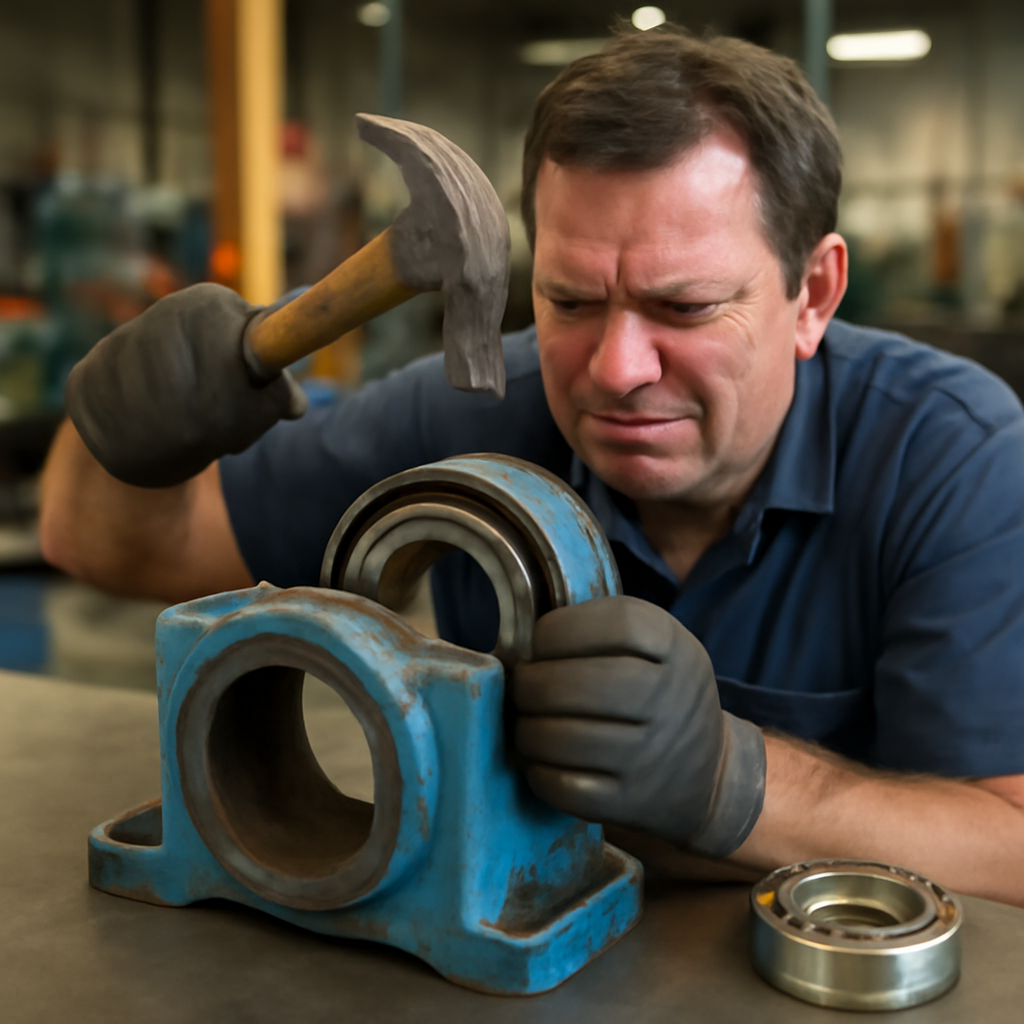
Bearing manufacturers and reliability engineers agree on something many maintenance technicians underestimate: a meaningful share of premature bearing failures starts during installation, not during service. Here are the seven mistakes that account for most of those failures.
1. Hammering directly on the bearing
A direct hammer strike on the inner or outer ring transmits shock through the rolling elements, denting the raceway at every ball or roller position. The damage is invisible immediately but produces a classic vibration signature weeks later. Fix: always use a sleeve that contacts the ring being pressed onto its mating part.
2. Pressing on the wrong ring
If you press on the outer ring while seating the bearing onto a shaft, the force goes through the rolling elements. The rule is simple: press only on the ring you are mounting. Inner ring onto shaft, press only on the inner ring. Outer ring into housing, press only on the outer ring.
3. Heating bearings above 120 °C
Induction heaters and oil baths are standard for thermal mounting. Heat the bearing to a temperature 70-80 °C above the shaft temperature (typically a final bearing temperature of 80-100 °C is enough). Above 120 °C, the bearing steel may begin to temper and lose hardness, ruining service life.
4. Skipping degreasing of the shaft
An oily shaft surface combined with an interference fit produces variable seating force and inconsistent retention. Wipe the shaft and bore clean with a lint-free cloth before any installation.
5. Incorrect interference fit
Too loose, the bearing creeps on the shaft and the ring fretts. Too tight, the bearing internal clearance is squeezed to zero and the bearing overheats. Specifications in the catalogue assume a specific shaft tolerance — verify it before machining a new shaft.
6. Mixing greases at installation
If you add grease to a factory-greased bearing, ensure the new grease is compatible with the factory fill. Mixing lithium with polyurea or with calcium-complex thickeners can cause the grease to break down within hours of operation.
7. Skipping the running-in check
After installation, run the equipment at reduced speed for 15-30 minutes while watching housing temperature and vibration. Any rapid temperature climb (more than 30 °C above ambient in 30 minutes) or abnormal noise is the moment to stop and investigate — not after a full shift of running.
The two-minute pre-installation check
Before installing any bearing, do this: rotate it by hand to confirm smooth operation, check the seal integrity, verify the part number against the BOM, and confirm the lubricant is what you expect. Most prevented failures start with this two-minute check.
The mounting tools that prevent damage
Beyond proper technique, the right mounting tools are essential for damage-free installation:
- Induction heater: the modern standard for thermal mounting. Heats the bearing uniformly with controlled temperature and includes a demagnetisation cycle at the end.
- Mounting sleeves: properly sized sleeves that transfer force only to the appropriate ring during installation. Different sleeves for different bearing sizes.
- Hydraulic mounting tools: for larger bearings or interference fits, hydraulic pressure delivers controlled force without operator strain or technique inconsistency.
- Bearing dollies and cradles: for handling large bearings without dropping or distorting.
- Cleanliness supplies: lint-free wipes, approved solvents, clean work surfaces.
For professional maintenance teams, investing in proper mounting tools costs €500-3,000 depending on the size range covered. The investment pays back through prevented bearing damage and consistent installation quality across the team.
The shaft and housing preparation that determines outcomes
Before any bearing is installed, the shaft and housing must be prepared:
- Verify dimensional tolerance — measure the shaft seat and housing bore against the bearing catalogue spec.
- Inspect surface finish — too smooth causes installation difficulty and creep risk; too rough causes premature wear.
- Check for burrs, score marks, or dimensional damage from previous service.
- Clean thoroughly — any residue on the mounting surfaces interferes with proper seating.
- Apply the manufacturer-recommended assembly lubricant where applicable.
The seating verification procedure
After installation, verify the bearing is properly seated:
- Visual inspection — the bearing face should be flush against the shaft shoulder or housing reference surface.
- Rotation check — the bearing should rotate smoothly with no notchiness.
- Axial play measurement (where applicable) — verify against the specification for the bearing type.
- Initial running check — at reduced speed for 15-30 minutes, monitor temperature and vibration.
Documentation of the installation event
For critical bearing positions, document the installation event: technician name, date, bearing part number and serial number (where applicable), shaft and housing pre-installation measurements, mounting method used, post-installation verification readings. The documentation supports warranty claims, root-cause analysis of any subsequent failures, and trend tracking across the maintenance fleet.
The training and certification dimension
Bearing installation is a skill that benefits from formal training. Manufacturer training programmes (SKF Bearing School, Schaeffler Academy, NSK Training Center) provide structured instruction on installation technique, common mistakes, and best practices. For maintenance organisations investing in installation quality, sending technicians through manufacturer training is a high-ROI capability investment.
The cost of installation-driven failures
Installation-driven bearing failures typically appear within 200-2,000 operating hours after installation — early enough to be clearly attributable to installation rather than fatigue or contamination. The cost per failure includes the replacement bearing, the labour for the repeat installation, the unplanned downtime, and the cumulative reputation cost when patterns of installation failures emerge.
For maintenance organisations, eliminating installation-driven failures through training, tools, and procedure discipline is one of the highest-leverage reliability improvements available. The cumulative savings across years of operation dwarf the investment in installation quality.
Pre-installation bearing inspection
Before installing any bearing, perform a 2-minute pre-installation check: rotate the bearing by hand to confirm smooth operation, inspect the seal integrity, verify the part number against the bill of material, confirm the lubricant matches the application requirement. Most prevented installation failures start with this two-minute check that catches mismatched, damaged, or incorrectly specified bearings before they reach the shaft.
Training and certification for the maintenance technician
The skills required for proper bearing service work benefit from formal training. Bearing manufacturer training programmes (SKF Bearing School, Schaeffler Academy, NSK Training Center) provide structured instruction. Industry certifications (ISO 18436 for vibration analysis, manufacturer-specific certifications for installation and maintenance) document the competencies that distinguish skilled technicians from those who learned on the job. For maintenance organisations, investing in technician certification is a high-ROI capability investment.
The role of standard operating procedures
Documented standard operating procedures (SOPs) standardise maintenance work across the team and shifts. SOPs cover: pre-work safety checks, equipment-specific procedure variations, required tools and materials, step-by-step work instructions, post-work verification requirements, and documentation expectations. Maintenance organisations with mature SOP discipline routinely outperform organisations relying on individual technician knowledge.
CMMS integration for closed-loop maintenance
Modern Computerised Maintenance Management Systems (CMMS) integrate work orders, parts inventory, equipment history, and condition monitoring data. The integration enables closed-loop maintenance: condition monitoring triggers work orders, work orders consume parts and labour, completed work updates equipment history, and the history informs future predictive analytics. For maintenance organisations, mature CMMS use is the operational foundation for moving from time-based to condition-based maintenance.
The trend toward predictive maintenance integration
Predictive maintenance combines condition monitoring data, AI analytics, and integrated workflow to deliver maintenance interventions just before failure rather than on fixed schedules. The 2026 affordability of IoT sensors (under $50/node) and maturity of AI platforms make predictive maintenance economically realistic for mid-size industrial plants. The deployment process is well-documented; the operational benefits are well-demonstrated; the strategic question for maintenance organisations is when and at what scale to deploy.
Cumulative cost-benefit across years of operation
The cumulative cost-benefit of disciplined maintenance practice compounds across years of operation. A maintenance organisation that consistently applies the documented best practices — bearing selection, installation, lubrication, condition monitoring, replacement scheduling — delivers measurably superior equipment reliability over a 10-year horizon compared to an organisation operating without the discipline. The cumulative savings in avoided downtime, extended equipment life, and reduced spare parts inventory typically exceed all the capability investments combined.
Practical procurement guidance for 2026
For European industrial procurement teams operating in 2026, the practical guidance distils to a few key principles. First, build multi-supplier qualification across critical SKUs — supplier substitution agility is the most valuable procurement capability through the consolidation period. Second, lock pricing on framework agreements where leverage exists — bearing list prices continue upward trajectory through H2 2026 on most ranges. Third, invest in condition monitoring capability — the technology is mature and the ROI is documented. Fourth, build cross-reference databases that support informed substitution decisions during supply disruptions.
The cumulative effect of these procurement disciplines compounds across years. Organisations that build the capability now position themselves to outperform through the industry transition; those that delay will be implementing in 2028 against competitors who already have the foundation in place. The strategic window is open through 2026; the practical actions are well-defined.
Related guides
- Common Bearing Installation Mistakes
- How to Inspect Bearings After Long Inactivity
- Bearing Maintenance: How to Keep Performance High
Need help choosing the right bearing? Our technical team can support you with selection, cross-references and lead-times.