
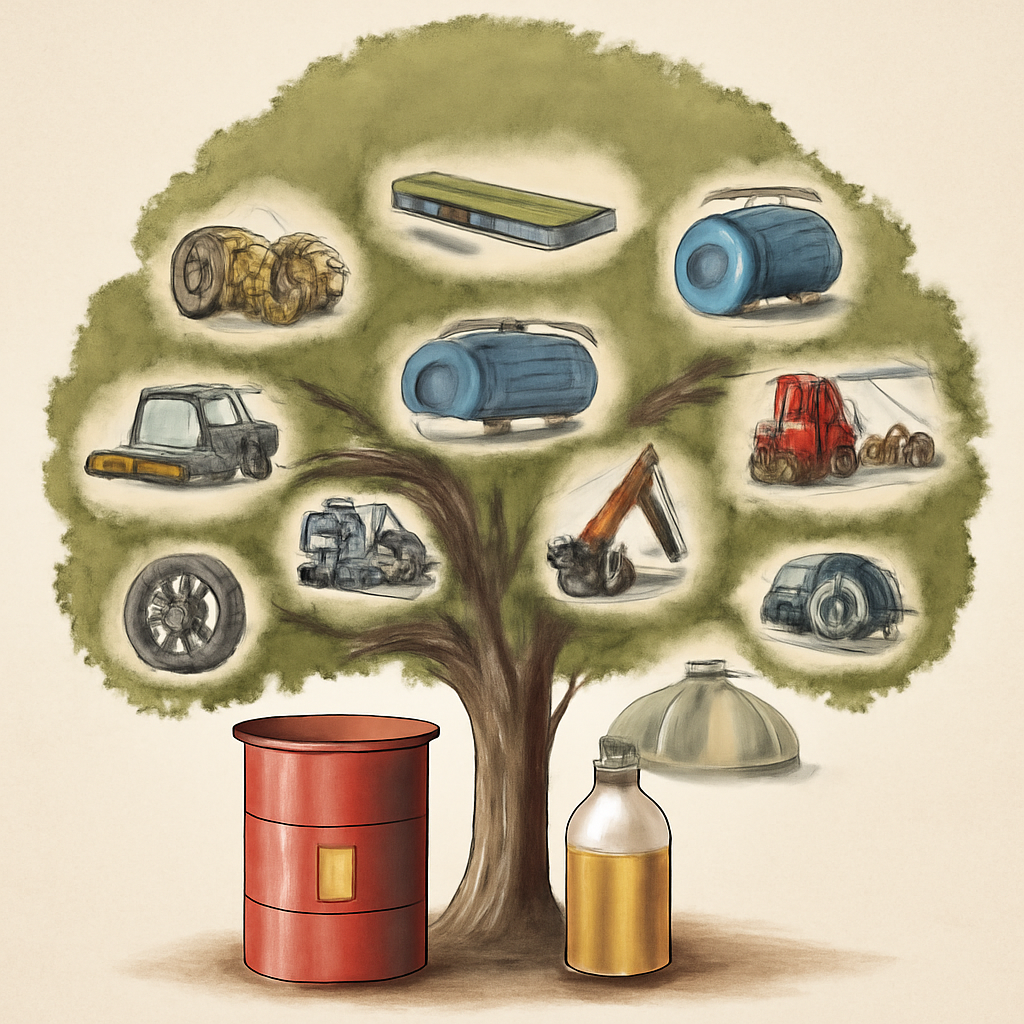
Lubricant selection is one of those decisions that sounds technical but is usually driven by guesswork or “what was on the shelf”. This guide turns the choice into a structured decision tree built around twelve scenarios that cover the vast majority of industrial bearing applications. Use it as a starting reference; refine for your specific equipment.
The four input variables
Every lubrication decision answers four questions:
- Speed: as a speed factor (n × dm where n is rpm and dm is bearing mean diameter in mm).
- Operating temperature: continuous and peak.
- Contamination level: clean, moderate, heavy, wet.
- Re-lubrication accessibility: serviceable, sealed-for-life.
Scenario 1 — General industrial motor, ≤30 kW, indoor
Standard NLGI 2 lithium grease, ISO VG 100 base oil. SKF LGMT 2, Mobilux EP 2, equivalents. Sealed (2RS) deep groove bearing, lifetime fill.
Scenario 2 — High-speed motor, ≥3000 rpm
NLGI 2 lithium or lithium-complex, ISO VG 32-46 base oil. Lower base viscosity to handle the high speed factor. Generation C-style bearings benefit from lower friction grease.
Scenario 3 — Hot gearbox, 100-150 °C continuous
Synthetic-base grease with lithium-complex or polyurea thickener, ISO VG 220-320. Or oil circulation with a synthetic gear oil. Heat dissipation usually argues for oil.
Scenario 4 — Heavy industrial pump, moderate temperature, with water exposure
Calcium-sulphonate grease, NLGI 2, EP additives. Excellent water washout resistance. SKF LGWA 2 or equivalent.
Scenario 5 — Food/beverage wash-down line
NSF H1 food-grade grease, NLGI 2. SKF LGFP 2, Mobil SHC Cibus, equivalents. Compatible with stainless inserts and aggressive caustic wash chemistry.
Scenario 6 — Cold-storage warehouse (-20 °C ambient)
Synthetic base, NLGI 1 (softer for low temperature pumpability), polyalphaolefin base. ISO VG 32-46.
Scenario 7 — Outdoor agricultural machine
NLGI 2 lithium-complex, EP additives, water-resistant. High base viscosity (ISO VG 220+). Re-greasing scheduled around seasonal maintenance.
Scenario 8 — Machine tool spindle, very high speed
Oil mist or oil-air lubrication, not grease. Highest speed factor regime. Specify per OEM lubrication system spec.
Scenario 9 — Wind turbine main bearing
Specialty wind-grade grease (Klüber Klüberlub, equivalent). Re-lubrication via automatic system at scheduled intervals.
Scenario 10 — Conveyor bearings in steel mill, hot dusty environment
NLGI 2 lithium-complex with solid additives (graphite, MoS2). Brass cage bearing, FKM seals. Frequent re-greasing.
Scenario 11 — Pharmaceutical reactor, intermittent operation
Synthetic-base, NLGI 2, FDA-grade. Low extreme-pressure additive level to avoid product contamination risk.
Scenario 12 — Robotic joint, low-speed cyclical motion
Low-noise, low-particulate grease. Sealed bearing, lifetime fill. Vendor-specific grease for harmonic drives.
Avoiding the common pitfalls
- Mixing thickeners: lithium with polyurea, lithium with calcium-complex can soften and drain.
- Wrong base oil viscosity: too high for the speed = friction overheating; too low for the load = insufficient film.
- Wrong thickener for temperature: lithium degrades above 130 °C; polyurea handles 150 °C+.
- Over-filling: 30-50% of bearing free space, not 100%.
- Using EP grease where not needed: EP additives can interact with copper-containing components.
The cross-reference shortcut
Most major lubricant manufacturers publish cross-reference tables: SKF DialSelect, Shell LubeMatch, Mobil Equivalents, Klüber Selection. Use them as a starting point; verify against your specific equipment OEM recommendation.
Conclusion
Lubricant selection is a system decision driven by speed, temperature, contamination and access. The twelve scenarios above cover the majority of industrial cases. For anything outside the standard envelope — very high speed, extreme temperature, aggressive chemistry — engage the lubricant supplier’s application engineering team early.
The integrated technology layers in modern bearing applications
Modern bearing applications operate within an integrated technology ecosystem: bearing hardware, condition monitoring sensors, cloud analytics platforms, CMMS work order integration, and ERP procurement integration. For end-users adopting this integrated approach, the technology stack delivers value beyond any single component. The bearing supplier ecosystem in 2026 increasingly provides integrated solutions rather than discrete components.
The market signal for sustained growth
Multiple independent market signals point to sustained bearing industry growth through the end of the decade. The market size forecast (from $151.8B in 2026 to $301B by 2033, a 9.8% CAGR) reflects structural drivers operating in parallel: EV adoption acceleration, wind energy capacity expansion, industrial robotics growth, linear motion market expansion, and smart bearing technology maturation. For procurement teams, the implications are: bearing list prices likely continue upward trajectory, supplier strategic moves continue to reshape the landscape, and reliability technology investment continues to deliver documented ROI.
The strategic procurement priorities
For European industrial procurement leadership in 2026, the strategic priorities distil to: supplier substitution agility, framework pricing locks where leverage exists, condition monitoring capability investment, smart bearing qualification on critical applications, and master data discipline that supports informed substitution decisions. These five priorities compound across years of execution and position the procurement organisation for the post-consolidation industry structure.
Looking ahead to 2027-2030
The next 3-5 years will see continued bearing industry evolution: NSK + NTN integration completing and reshaping competitive dynamics, SKF Automotive spin-off mechanics clarified, Schaeffler humanoid robotics commercialisation, condition monitoring platform maturation across major manufacturers, and end-user expectations evolving toward integrated reliability solutions. For European industrial customers, positioning the procurement strategy for this evolution now — rather than reacting in 2028 — is the strategic foundation for competitive operational performance through the coming decade.
The smart bearing transition impact
Beyond standard procurement considerations, the smart bearing transition reshapes the broader supplier relationship. Smart bearings come with platform commitments (which analytics platform supports the sensors), software licensing implications (cloud platform subscriptions), and integration requirements (CMMS, ERP connections). For procurement teams, the smart bearing decision involves more than the bearing — it involves the broader reliability ecosystem.
The companies positioning early on smart bearing platforms capture multi-year operational advantage. The technology is mature enough for deployment on critical applications today; the economics are clear; the strategic question is platform selection and deployment pace rather than whether to deploy. For European industrial customers, engaging with the major manufacturer smart bearing roadmaps during 2026 positions the organisation for the 2027-2028 industry structure.
The 2026 reliability investment thesis
For European industrial customers in 2026, the broader reliability investment thesis is decisive. The combination of affordable IoT sensors (under $50 per node, an 85% cost reduction since 2019), mature AI analytics platforms, documented ROI cases (6-18 month payback in mid-size plants), and supplier ecosystem support makes condition monitoring deployment economically realistic for virtually any plant with critical rotating equipment. The cumulative effect across years of deployment is meaningful: 30-50% reduction in unplanned downtime, 15-25% reduction in maintenance labour, and extended equipment service life.
For procurement leadership specifically, the reliability investment changes the supplier relationship dynamic. Bearing supply becomes part of an integrated reliability conversation rather than a transactional component supply. Engineering services, condition monitoring platforms, training programmes, and roadmap visibility all flow from strategic supplier relationships. The companies building these relationships now position themselves for the post-2028 industry structure where smart bearings and integrated reliability solutions become standard rather than premium.
What the next 18 months will tell us
The next 18 months will clarify several major industry questions. NSK + NTN antitrust filings progress through Q3-Q4 2026 will reveal the regulatory burden and possible remedies. SKF Automotive spin-off mechanics will be confirmed, with implications for both the SKF industrial businesses and the new standalone automotive entity. Schaeffler Yinchuan capacity ramp will reach steady-state output, affecting standard catalogue lead times and pricing dynamics. EU industrial demand recovery will be tested through H2 2026 and into 2027.
For organisations operating in this environment, active engagement with these developments — through industry events, supplier conversations, and trade press monitoring — supports informed strategic decisions. The bearing industry in 2026-2027 is not on autopilot; the strategic decisions made during this period set competitive positioning for years to come.
The reliability ecosystem in 2026
For European industrial customers, the bearing supply relationship in 2026 increasingly extends beyond transactional component supply into a broader reliability ecosystem. Engineering consultation, condition monitoring platform integration, training programmes, and access to product roadmap information all flow from strategic supplier relationships. Building these relationships with preferred manufacturers — while maintaining qualified alternatives for supply resilience — is the foundation for navigating the industry consolidation period through 2027-2028.
Looking ahead through 2030
The bearing industry continues structural evolution through the rest of the decade, driven by EV adoption acceleration, wind energy expansion, industrial robotics growth, humanoid robotics commercialisation, and smart bearing technology maturation. The market projection from $151.8B in 2026 to $301B by 2033 reflects these structural drivers operating in parallel. For European industrial customers, positioning the procurement strategy for this evolution now, rather than reacting in 2028, is the strategic foundation for competitive operational performance through the coming decade.
Final note for 2026 procurement
The cumulative effect of disciplined procurement practice — supplier substitution agility, framework pricing locks, condition monitoring capability, smart bearing qualification, and master data discipline — compounds across years of execution. Organisations that build this capability now position themselves to outperform through the bearing industry consolidation period; the strategic window for proactive positioning is open through 2026 with diminishing returns thereafter.
Related guides
- Guide to Choosing Lubricants
- Grease vs Oil Lubrication
- Bearing Maintenance Long-Term
- Choosing the Right Bearing for High-Temperature
- SKF Bearing Maintenance and Lubrication
Need help with bearing selection? Our team supports you with cross-references and lead-times.