
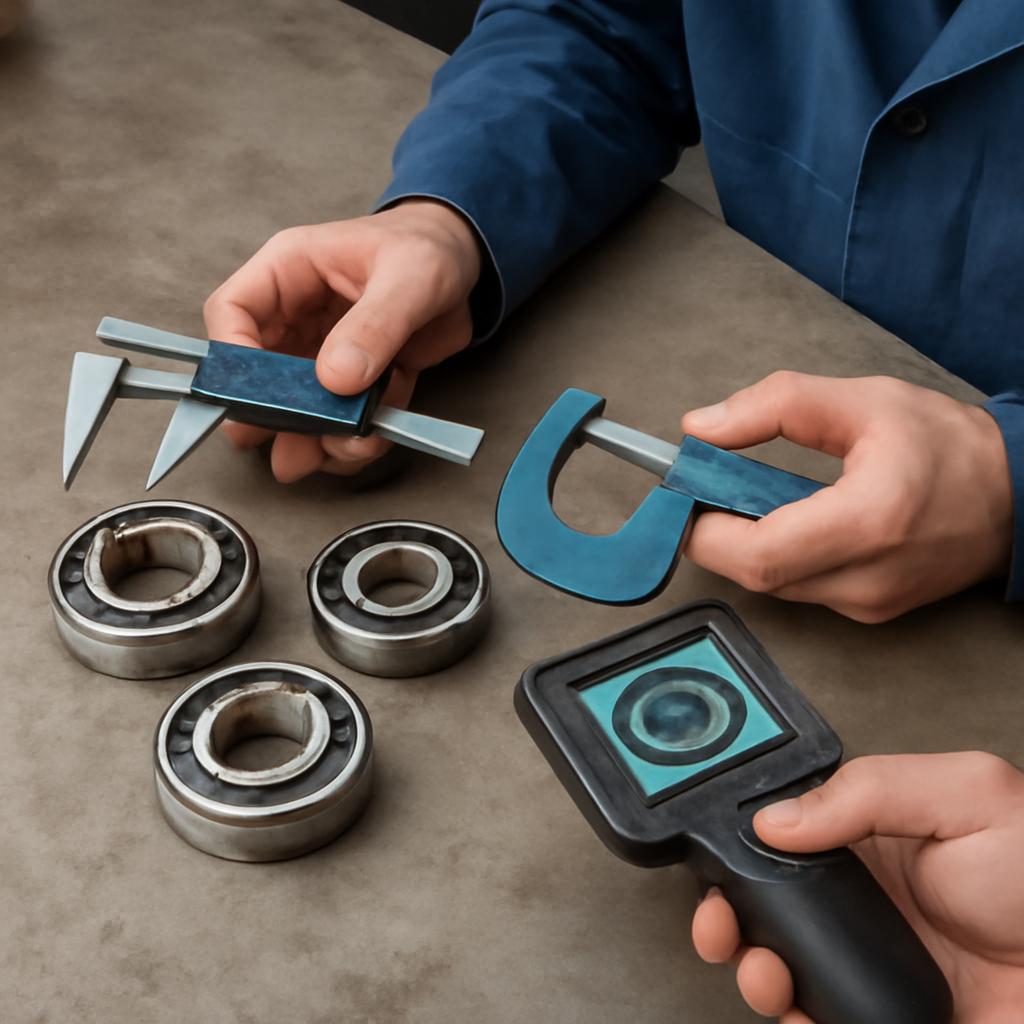
A bearing in your hand. Markings worn off. No catalogue at hand. The asset cannot run until the right replacement is ordered, and ordering the wrong one costs another day. Three reliable methods will get you to the right designation in under 5 minutes — using only basic tools every maintenance technician has access to.
Method 1: Direct measurement against standard sizes
The most reliable approach. Measure three dimensions:
- d (inner diameter / bore): with callipers across the bore at multiple positions.
- D (outer diameter): with callipers across the outer ring at multiple positions.
- B (width): along the axis between the two faces.
Cross-reference d × D × B against the standard series tables:
- 6000 series (light): bore 10 mm with OD 26 mm, width 8 mm.
- 6200 series (medium): bore 10 mm with OD 30 mm, width 9 mm.
- 6300 series (heavy): bore 10 mm with OD 35 mm, width 11 mm.
- 6400 series (extra heavy): bore 10 mm with OD 42 mm, width 13 mm.
The bore-to-OD ratio identifies the series; the absolute bore identifies the size code.
Method 2: Visual identification of bearing type
Observable features distinguish bearing types:
- Deep groove ball bearing: balls visible through the cage windows, single row of balls.
- Angular contact ball bearing: asymmetric appearance, balls visible but raceway tilted.
- Double-row angular contact: two rows of balls visible.
- Spherical roller bearing: two rows of barrel-shaped rollers visible, outer raceway visibly spherical.
- Cylindrical roller bearing: single row of cylindrical rollers, raceway flanges visible.
- Tapered roller bearing: cone-shaped rollers, outer ring conical.
- Needle roller bearing: many small needle-shaped rollers, narrow profile.
- Self-aligning ball bearing: two rows of balls on common spherical raceway.
Combined with the measurement, type identification narrows the candidate range significantly.
Method 3: Cross-reference apps
Most major manufacturers offer mobile apps that include:
- Dimensional cross-reference tables.
- Photo recognition (some apps).
- Cross-brand equivalent lookup.
- Available stock checking with local distributors.
SKF Bearing Select, Schaeffler medias, NSK Bearing Doctor are widely used. Authentication apps (SKF Authenticate) verify genuine vs counterfeit bearings.
4. The shaft and housing context
If the bearing came out of an asset you have access to, additional clues:
- Shaft diameter (matches the bearing bore tolerance).
- Housing bore (matches the bearing OD tolerance).
- Spacing in the housing (gives the width).
- Adjacent components (provide context on bearing type).
5. Decoding partial markings
Even worn markings often reveal:
- The first digits of the bearing designation (giving series).
- The last two digits (giving size code).
- Manufacturer trademark or logo.
Use a magnifying glass and good lighting; sometimes etching is visible that the naked eye misses.
6. Common identification mistakes
- Reading the dimensions inaccurately — verify with a second measurement.
- Confusing series (6200 vs 6300) — the OD ratio is the key discriminator.
- Missing the bearing type — check the geometry carefully.
- Ordering by visual similarity without verifying dimensions.
7. The verification step before ordering
Once you have a candidate designation:
- Cross-check against the application — does the designation make sense for the duty?
- Verify availability at your distributor.
- Confirm seal type and clearance class.
- If possible, photograph the original bearing for records.
Conclusion
Bearing identification in the field is a craft skill that combines dimensional measurement, visual type recognition, and digital tools. With practice the three methods together resolve most cases in under 5 minutes. The cumulative time saved across years of maintenance work makes the skill investment a clear winner.
The European bearing industry 2026 landscape
The European bearing industry in 2026 enters one of the most active strategic transformation periods in three decades. The NSK + NTN MoU (12 May 2026, target closing October 2027), SKF Automotive spin-off preparation, Schaeffler Yinchuan capacity doubling, and SKF G-Tech Instruments acquisition (March 2026) collectively reshape the supplier landscape. The industry market projection from $151.8B (2026) to $301B (2033) reflects structural drivers operating in parallel: EV adoption acceleration, wind energy capacity expansion, industrial robotics growth, and smart bearing technology maturation.
For European industrial procurement teams, the practical implications converge on five operational priorities. Multi-supplier qualification across critical SKUs supports substitution agility through consolidation. Framework agreement renegotiation captures pricing leverage during the competitive window. Condition monitoring deployment delivers 6-18 month payback ROI on mid-size plant deployments. Smart bearing qualification positions for the 2028+ industry structure. Master data discipline supports informed substitution decisions during supply disruptions.
The smart bearing and condition monitoring transition
The bearing industry’s transition from component supply to integrated reliability platform delivery represents the defining strategic shift of the decade. Every major manufacturer (SKF Insight, Schaeffler OPTIME, NSK SAT, NTN smart bearing platforms) has built or acquired platform capability. The integrated offering combines instrumented bearings, cloud analytics, AI-based anomaly detection, prescriptive workflow integration, and reliability services. For European industrial customers, qualifying smart bearings on critical applications during 2026 positions the organisation for the post-2028 industry structure where smart bearings become standard rather than premium.
Industry surveys converge on 65% of maintenance teams planning AI adoption by year-end 2026 — a documented adoption signal that the industry transition is real and accelerating. For procurement and reliability leadership, the strategic question is no longer whether to deploy but how fast, at what scale, and on which platform.
Raw material costs and tariff dynamics
Bearing pricing dynamics in 2026 reflect converging cost drivers. US steel tariffs at 50% (in force since June 2025) reshape global trade flows, with Asian bearing exporters redirecting volume into Europe and other markets. Bearing-grade alloy premiums continue widening. EU regulatory developments (CBAM transitional phase, REACH SVHC updates, steel safeguards review activity) add complexity to import economics.
For procurement teams, the practical response combines tactical and strategic actions: lock pricing on critical SKU framework agreements during the H2 2026 window; build steel-cost adjustment mechanisms into multi-year contracts; verify customs classifications carefully on cross-border purchases; document supplier origin certifications for preferential trade agreement benefits; build inventory depth on critical references where carrying cost favours stock vs expected H2 2026 price step.
The European bearing industry 2026 strategic landscape
The European bearing industry in 2026 enters one of the most active strategic transformation periods in three decades. NSK + NTN MoU (12 May 2026, target closing October 2027), SKF Automotive spin-off preparation, Schaeffler Yinchuan capacity doubling, and SKF G-Tech Instruments acquisition (March 2026) collectively reshape the supplier landscape. The industry market projection from $151.8B (2026) to $301B (2033) reflects structural drivers operating in parallel: EV adoption acceleration, wind energy capacity expansion, industrial robotics growth, and smart bearing technology maturation.
For European industrial procurement teams, the practical implications converge on five operational priorities: multi-supplier qualification supports substitution agility through consolidation; framework agreement renegotiation captures pricing leverage during the competitive window; condition monitoring deployment delivers 6-18 month payback ROI on mid-size plant deployments; smart bearing qualification positions for the 2028+ industry structure; master data discipline supports informed substitution decisions during supply disruptions.
Smart bearing and condition monitoring transition
The bearing industry’s transition from component supply to integrated reliability platform delivery represents the defining strategic shift of the decade. Every major manufacturer (SKF Insight, Schaeffler OPTIME, NSK SAT, NTN smart bearing platforms) has built or acquired platform capability. The integrated offering combines instrumented bearings, cloud analytics, AI-based anomaly detection, prescriptive workflow integration, and reliability services. For European industrial customers, qualifying smart bearings on critical applications during 2026 positions the organisation for the post-2028 industry structure where smart bearings become standard.
Industry surveys converge on 65% of maintenance teams planning AI adoption by year-end 2026 — a documented adoption signal that the industry transition is real and accelerating. For procurement and reliability leadership, the strategic question is no longer whether to deploy but how fast, at what scale, and on which platform.
Raw material costs and pricing trajectory
Bearing pricing dynamics in 2026 reflect converging cost drivers. US steel tariffs at 50% (in force since June 2025) reshape global trade flows. Bearing-grade alloy premiums continue widening. EU regulatory developments (CBAM, REACH SVHC updates, steel safeguards) add complexity to import economics. For procurement teams, the practical posture is active engagement: lock pricing on top-50 SKUs in framework agreements; build steel-cost adjustment mechanisms; verify customs classifications; document supplier origin certifications; build inventory depth on critical references where carrying cost favours stock vs expected price step.
The H2 2026 procurement action list
For European industrial procurement leadership in H2 2026, the action list converges on five operational priorities. First, multi-supplier qualification across critical SKUs supports substitution agility through the NSK + NTN consolidation period. Second, framework agreement renegotiation captures pricing leverage during the competitive window before the integration closes. Third, condition monitoring deployment delivers documented 6-18 month payback on typical mid-size plant deployments. Fourth, smart bearing qualification on critical applications positions the organisation for the post-2028 industry structure. Fifth, master data discipline supports informed substitution decisions during supply disruptions.
The cumulative effect of disciplined execution across these priorities compounds across years. Organisations that build the capability now position themselves for the post-consolidation industry structure; those that delay will be implementing in 2028 against competitors who already have the foundation in place. The strategic window for proactive positioning is open through 2026 with diminishing returns thereafter.
Related guides
- How to Read FAG Designations
- Top 6 Bearing Brands
- Counterfeit Bearings
- AB-TOOLS Hand Tools
- Bearing Installation 7 Mistakes
Need help with bearing selection? Our team supports you with cross-references and lead-times.