
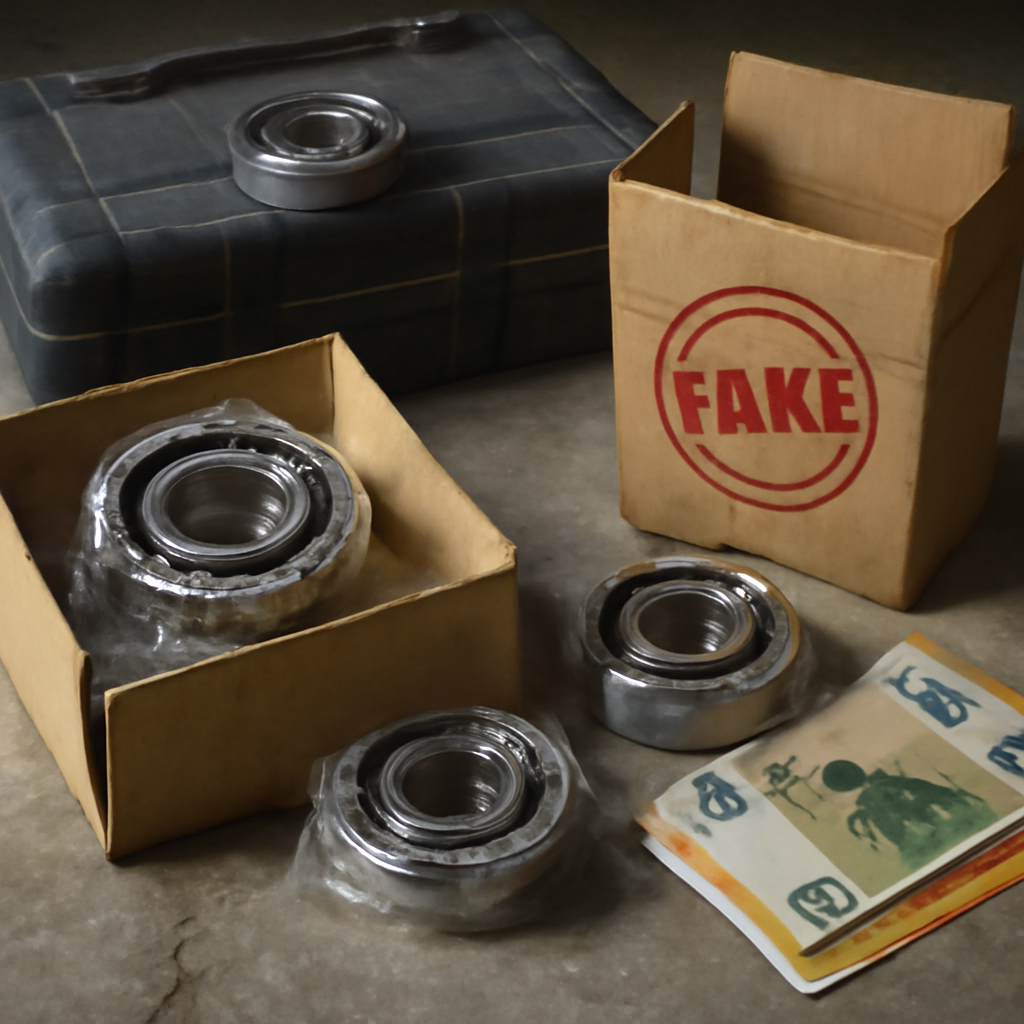
Counterfeit bearings — bearings sold under a major brand name (SKF, FAG, NSK, NTN, TIMKEN) but actually manufactured outside the brand’s quality system, often to inferior specification — cost European industry hundreds of millions of euros annually in equipment failures, warranty disputes, and safety incidents. The cost is largely hidden because counterfeit bearings often only fail prematurely, not catastrophically, and the failure is attributed to “bad luck” rather than counterfeit. This guide walks through the real cost and the practical defences.
1. The scale of the problem
The World Bearing Association estimates that 5-10% of branded bearings traded globally are counterfeit. In some categories — particularly automotive aftermarket and low-tier industrial distribution — the share is higher. European industry is a significant market for counterfeit product because of its high industrial activity and substantial aftermarket demand.
2. Where counterfeit bearings come from
- Manufacturing in jurisdictions with weak IP enforcement.
- Sold through informal distribution channels, online marketplaces, and undocumented importers.
- Packaged and branded to closely resemble genuine product.
- Sometimes sold knowingly by distributors; sometimes the distributor is itself deceived.
3. The real cost components
3.1 Premature failure
Counterfeit bearings rarely meet calculated L10 service life. A motor that should run trouble-free for 5 years may experience bearing failure at 18 months. The maintenance cost is the bearing replacement; the larger cost is the unplanned downtime.
3.2 Equipment damage
A bearing that fails catastrophically can damage shafts, housings and adjacent components. Repair costs can be 10-50× the cost of the bearing.
3.3 Safety incidents
In safety-critical applications (cranes, lifts, vehicles, aerospace), counterfeit bearing failure can cause incidents with consequences far exceeding equipment cost.
3.4 Warranty disputes
OEM warranty programmes typically exclude counterfeit components. Equipment owners who install counterfeit bearings forfeit warranty coverage on the surrounding components.
3.5 Insurance implications
Some industrial insurance policies have specific exclusions for failures traced to counterfeit components.
4. How to identify counterfeit bearings
- Packaging quality: counterfeit packaging often has printing inconsistencies, wrong colours, or low-quality print.
- Internal markings: genuine bearings have specific laser etching patterns; counterfeits often have visible variations or incomplete markings.
- Weight: counterfeit bearings sometimes use different alloys, producing slight weight differences.
- Surface finish: genuine bearings have a characteristic finish on raceways and rolling elements that experienced inspectors can identify.
- Cage construction: counterfeit cages often have visible quality differences.
- Authentication tools: SKF, Schaeffler and others have authentication apps that verify packaging codes against manufacturer databases.
5. The defences
- Source bearings only from authorised distributors. Maintain documented supply chain.
- Use manufacturer authentication apps where available.
- Be sceptical of pricing significantly below market — if the deal seems too good, it usually is.
- Inspect packaging and bearing visually for known counterfeit indicators.
- For critical assemblies, request manufacturer batch traceability.
- Report suspected counterfeits to the brand and the World Bearing Association.
6. The economics of authenticity
The price difference between genuine and counterfeit bearings is typically 20-40%. The total-cost difference, when premature failure and equipment damage are factored in, is overwhelmingly in favour of genuine product. The “savings” from counterfeit purchase are usually paid back many times over in failure costs.
7. What the industry is doing
- World Bearing Association anti-counterfeit campaigns and authentication standards.
- Manufacturer authentication apps and serialised packaging.
- Customs enforcement actions in major importing jurisdictions.
- Legal action against repeat counterfeit sellers.
Conclusion
Counterfeit bearings are an invisible but substantial cost across European industry. The practical defences — authorised distribution sourcing, manufacturer authentication, inspection discipline — are not complicated but require active practice. Procurement teams that build these defences avoid the hidden cost; those that do not pay it without ever knowing where the cost came from.
The European bearing industry 2026 landscape
The European bearing industry in 2026 enters one of the most active strategic transformation periods in three decades. The NSK + NTN MoU (12 May 2026, target closing October 2027), SKF Automotive spin-off preparation, Schaeffler Yinchuan capacity doubling, and SKF G-Tech Instruments acquisition (March 2026) collectively reshape the supplier landscape. The industry market projection from $151.8B (2026) to $301B (2033) reflects structural drivers operating in parallel: EV adoption acceleration, wind energy capacity expansion, industrial robotics growth, and smart bearing technology maturation.
For European industrial procurement teams, the practical implications converge on five operational priorities. Multi-supplier qualification across critical SKUs supports substitution agility through consolidation. Framework agreement renegotiation captures pricing leverage during the competitive window. Condition monitoring deployment delivers 6-18 month payback ROI on mid-size plant deployments. Smart bearing qualification positions for the 2028+ industry structure. Master data discipline supports informed substitution decisions during supply disruptions.
The smart bearing and condition monitoring transition
The bearing industry’s transition from component supply to integrated reliability platform delivery represents the defining strategic shift of the decade. Every major manufacturer (SKF Insight, Schaeffler OPTIME, NSK SAT, NTN smart bearing platforms) has built or acquired platform capability. The integrated offering combines instrumented bearings, cloud analytics, AI-based anomaly detection, prescriptive workflow integration, and reliability services. For European industrial customers, qualifying smart bearings on critical applications during 2026 positions the organisation for the post-2028 industry structure where smart bearings become standard rather than premium.
Industry surveys converge on 65% of maintenance teams planning AI adoption by year-end 2026 — a documented adoption signal that the industry transition is real and accelerating. For procurement and reliability leadership, the strategic question is no longer whether to deploy but how fast, at what scale, and on which platform.
Raw material costs and tariff dynamics
Bearing pricing dynamics in 2026 reflect converging cost drivers. US steel tariffs at 50% (in force since June 2025) reshape global trade flows, with Asian bearing exporters redirecting volume into Europe and other markets. Bearing-grade alloy premiums continue widening. EU regulatory developments (CBAM transitional phase, REACH SVHC updates, steel safeguards review activity) add complexity to import economics.
For procurement teams, the practical response combines tactical and strategic actions: lock pricing on critical SKU framework agreements during the H2 2026 window; build steel-cost adjustment mechanisms into multi-year contracts; verify customs classifications carefully on cross-border purchases; document supplier origin certifications for preferential trade agreement benefits; build inventory depth on critical references where carrying cost favours stock vs expected H2 2026 price step.
The European bearing industry 2026 strategic landscape
The European bearing industry in 2026 enters one of the most active strategic transformation periods in three decades. NSK + NTN MoU (12 May 2026, target closing October 2027), SKF Automotive spin-off preparation, Schaeffler Yinchuan capacity doubling, and SKF G-Tech Instruments acquisition (March 2026) collectively reshape the supplier landscape. The industry market projection from $151.8B (2026) to $301B (2033) reflects structural drivers operating in parallel: EV adoption acceleration, wind energy capacity expansion, industrial robotics growth, and smart bearing technology maturation.
For European industrial procurement teams, the practical implications converge on five operational priorities: multi-supplier qualification supports substitution agility through consolidation; framework agreement renegotiation captures pricing leverage during the competitive window; condition monitoring deployment delivers 6-18 month payback ROI on mid-size plant deployments; smart bearing qualification positions for the 2028+ industry structure; master data discipline supports informed substitution decisions during supply disruptions.
Smart bearing and condition monitoring transition
The bearing industry’s transition from component supply to integrated reliability platform delivery represents the defining strategic shift of the decade. Every major manufacturer (SKF Insight, Schaeffler OPTIME, NSK SAT, NTN smart bearing platforms) has built or acquired platform capability. The integrated offering combines instrumented bearings, cloud analytics, AI-based anomaly detection, prescriptive workflow integration, and reliability services. For European industrial customers, qualifying smart bearings on critical applications during 2026 positions the organisation for the post-2028 industry structure where smart bearings become standard.
Industry surveys converge on 65% of maintenance teams planning AI adoption by year-end 2026 — a documented adoption signal that the industry transition is real and accelerating. For procurement and reliability leadership, the strategic question is no longer whether to deploy but how fast, at what scale, and on which platform.
Raw material costs and pricing trajectory
Bearing pricing dynamics in 2026 reflect converging cost drivers. US steel tariffs at 50% (in force since June 2025) reshape global trade flows. Bearing-grade alloy premiums continue widening. EU regulatory developments (CBAM, REACH SVHC updates, steel safeguards) add complexity to import economics. For procurement teams, the practical posture is active engagement: lock pricing on top-50 SKUs in framework agreements; build steel-cost adjustment mechanisms; verify customs classifications; document supplier origin certifications; build inventory depth on critical references where carrying cost favours stock vs expected price step.
The H2 2026 procurement action list
For European industrial procurement leadership in H2 2026, the action list converges on five operational priorities. First, multi-supplier qualification across critical SKUs supports substitution agility through the NSK + NTN consolidation period. Second, framework agreement renegotiation captures pricing leverage during the competitive window before the integration closes. Third, condition monitoring deployment delivers documented 6-18 month payback on typical mid-size plant deployments. Fourth, smart bearing qualification on critical applications positions the organisation for the post-2028 industry structure. Fifth, master data discipline supports informed substitution decisions during supply disruptions.
The cumulative effect of disciplined execution across these priorities compounds across years. Organisations that build the capability now position themselves for the post-consolidation industry structure; those that delay will be implementing in 2028 against competitors who already have the foundation in place. The strategic window for proactive positioning is open through 2026 with diminishing returns thereafter.
Related guides
- Bearing Failure Modes Guide
- Top 6 Bearing Brands
- Bearing Buyers Handbook 2026
- EU Distributors Stockpiling
- How to Inspect Bearing After 24 Months
Need help with bearing selection? Our team supports you with cross-references and lead-times.