
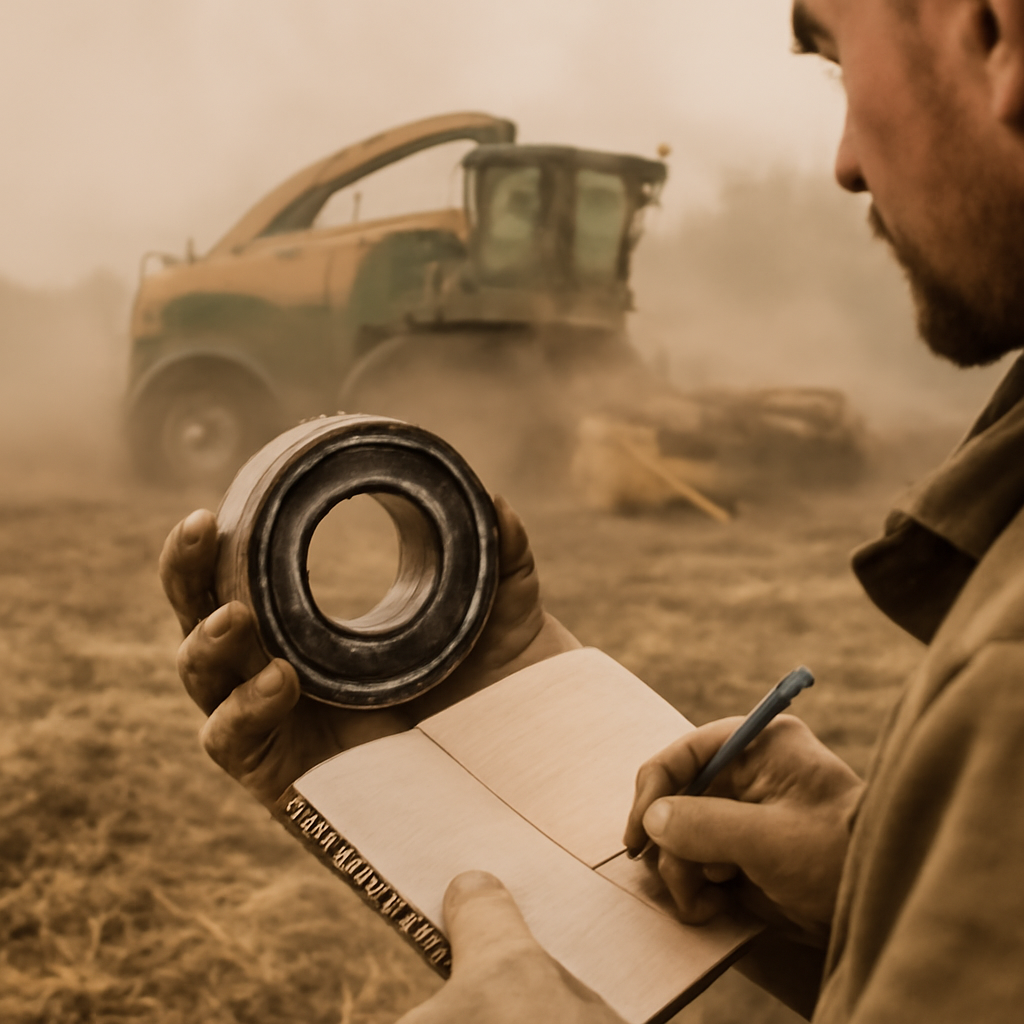
Contract silage crews across northern Italy and Bavaria say the same thing about forage harvester bearings: the parts that fail first are not the header bearings anyone thinks about, they are the small tucked-away drive bearings in the cutting drum and the fan housing. Two seasons of field notes from three separate rebuild campaigns reveal a consistent failure pattern that has less to do with load and more to do with how dust migrates through the machine at eight to ten tonnes per hour of green material. This piece pulls together those notes so distributors handling agricultural aftermarket can advise farmers on what to stock and why.
Why forage harvester bearings fail differently from combine bearings
A combine harvester runs on dry grain and dry straw for six to eight weeks in high summer. A forage harvester runs on wet grass and wet maize, often for twelve to sixteen weeks between the first cut of spring and the last cut of autumn. The moisture content of the material changes the failure spectrum completely. Wet material carries fine soil particles that stick to bearing seals and slowly migrate past them into the grease. The chopper drum spinning at 1,100 RPM generates vibration signatures that shake material into every open joint. And the heat generated by the compaction of green material against the cutter head warms up the surrounding bearings by 15 to 25 degrees above ambient, which accelerates grease breakdown. All three effects combine to shorten bearing life in specific locations that a combine harvester never sees.
The three failure locations that dominate warranty returns
Field data from a Bavarian dealership tracking 40 forage harvesters over two seasons shows three failure locations account for roughly 70 percent of bearing replacements. First: the cutter drum shaft bearings, particularly on the non-drive side where lubrication is harder to maintain. Second: the blower fan bearings, which see high radial load from unbalanced fan wear plus continuous fine-material contamination. Third: the feed roller bearings, which take shock loads every time a stone or a hard stem enters the intake. Each of these locations has its own preferred bearing type in the aftermarket, and none of them is the standard 6205 the farm workshop tends to stock. Understanding the three locations changes what a distributor should have on the parts shelf during silage season.
Sealing choices that matter more than bearing choice
The bearing type at each of these three locations is often less important than the seal package. Cutter drum bearings need a labyrinth seal plus a lip seal in series — a single contact seal wears out from the abrasive dust within a hundred hours. Blower fan bearings need double-lip contact seals with a garter spring, because the fine material otherwise flakes through the primary lip. Feed roller bearings actually benefit from a light clearance seal rather than a tight contact seal, because the shock loads deform tight seals and start pumping air and moisture in and out of the bearing cavity. Getting the seal package right at each location extends bearing life dramatically. Getting it wrong means replacing the bearing every season regardless of what brand or grade you specified.
Grease specification for the wet-material environment
Standard EP2 lithium grease works for maybe a hundred operating hours on a forage harvester before the moisture ingress overwhelms it. The pragmatic upgrade is a lithium complex grease with an NLGI grade of 2 and a base oil viscosity around 220 cSt at 40 degrees. This holds up better under moisture and gives a wider service temperature window. For the cutter drum bearings specifically, some Bavarian workshops have shifted to a SKF LGWM 2 lithium complex specifically formulated for wet environments, and report bearing life increases of 40 to 60 percent versus generic EP2. The grease upgrade costs perhaps 15 to 20 euros per bearing per season. The labour saved on unscheduled bearing changes during harvest justifies the spend easily.
What the farm workshop should stock during silage season
A working parts list for a mid-sized contract silage business, based on the failure pattern above, includes eight to ten bearings per harvester per season. That breaks down roughly as: four cutter drum shaft bearings with the labyrinth-plus-lip seal package; two blower fan bearings with double-lip contact seals; two to four feed roller bearings with light clearance seals; plus a small stock of common 6205, 6207 and 6208 sizes for miscellaneous replacements. Multiplying this by a fleet of five to eight machines gives roughly 50 to 80 bearings per season for a mid-sized contractor. Distributors who understand this pattern can offer a pre-season stocking program that saves the farmer emergency shipping fees during the two-week windows when a downed harvester costs several thousand euros a day in lost cutting.
Where CORTECO seals fit into the picture
The CORTECO shaft seal range covers most of the seal replacements that go with the bearing changes on forage harvesters. The advantage is code compatibility with the original German and Italian OEM specifications: Krone, Claas, John Deere, Fendt and New Holland forage harvesters all use seal codes that CORTECO catalogues under standard aftermarket designations. Distributors carrying CORTECO alongside the bearings can serve the seal replacement as part of the same order, which matters when the seal is what actually failed and the bearing was collateral damage. The parts list for a well-prepared forage harvester rebuild kit combines bearing and CORTECO seal in the same SKU line.
Timing the pre-season inspection to catch damage early
The single most useful maintenance discipline is a pre-season bearing inspection three to four weeks before the first cut. Rotate each of the three critical locations by hand and listen for grinding or roughness. Check the seal condition visually for cracking or leakage. Grease each bearing to the point of light purge. Any bearing that shows roughness on rotation gets replaced before the season starts, not during. This catches maybe 40 percent of the bearings that would fail during the season if left alone. The labour cost is low — an experienced technician does the full pre-season check on a forage harvester in three to four hours. The value is the avoided downtime during the harvest window.
The pattern distributors should build their aftermarket around
Serving the silage contractor market well is less about carrying the widest range and more about understanding the failure pattern the machines actually exhibit. Stock the specific bearings and seal packages that fail. Offer the pre-season kit with matched bearings and seals for each critical location. Position the CORTECO seal alongside the bearing rather than as a separate part. Push the grease upgrade to lithium complex where the customer is currently using standard EP2. These moves position the distributor as a specialist rather than a generic parts warehouse, and they build the kind of repeat business that survives price competition from online catalogues.
Related coverage on Eurobearing
- Applications of NTN Bearings in the Agricultural Sector
- NTN Bearings for Agricultural Equipment: Selection and Maintenance
- Bearings for the Food Industry: Hygienic Standards
- Bearing Storage Best Practices in Hot and Humid Months
- How to Choose the Right Grease for Marine Bearings
Need help stocking a forage harvester pre-season kit? Our technical team supports agricultural distributors with bearing and seal package sizing for European silage contractors. Book a free consultation.