
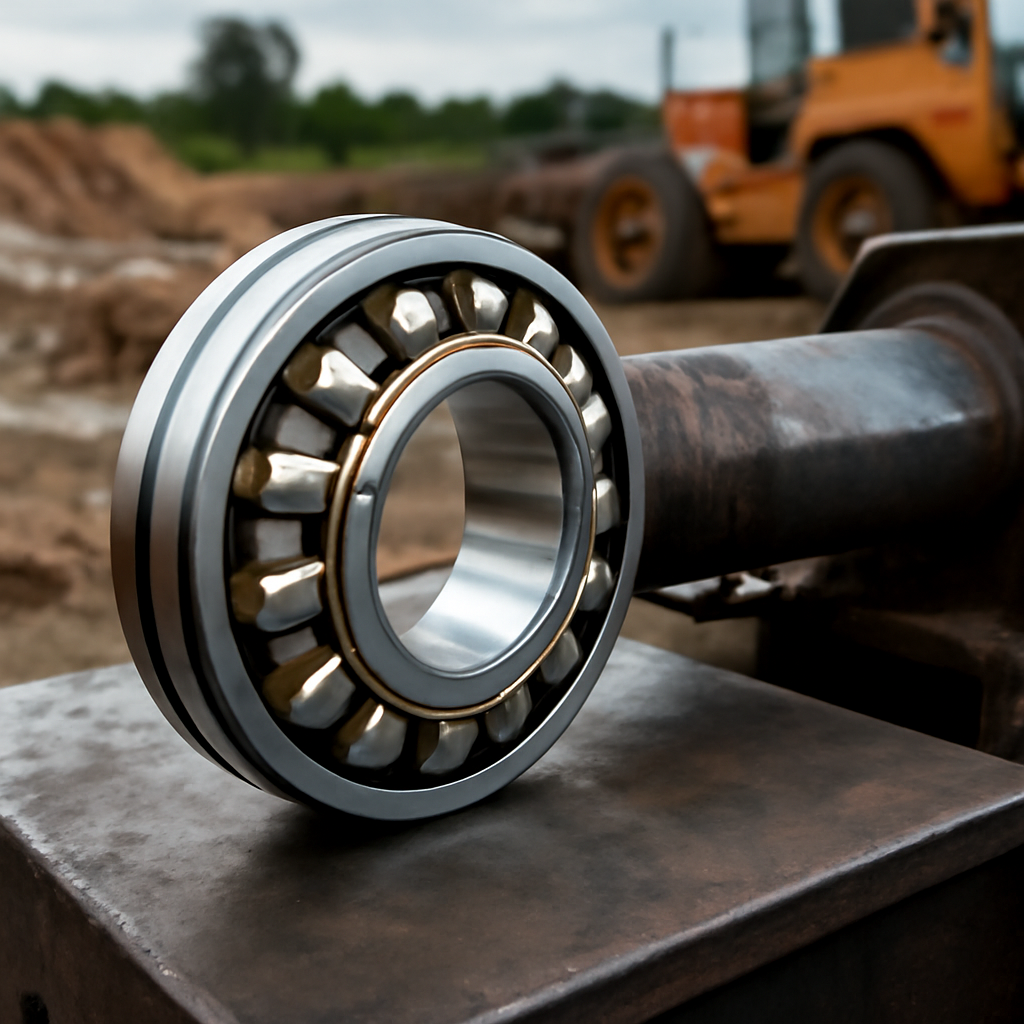
A distribution rep serving cement plants and quarries gets the same question every few months: “Should we spec a 22212 or a 22213 for this vibrating screen?” On paper the answer looks straightforward — check the load rating and pick the bigger bearing. In practice the choice between the two spherical roller bearing sizes involves shaft speed limitations, cage design differences, and installation constraints that are not obvious from a catalogue lookup. This piece walks through the field cases where the 22212 actually wins against its larger sibling, and where the extra 5 millimetres of bore diameter genuinely matter.
Where the 22212 and 22213 sit in the range
The 22212 has a 60 millimetre bore, 110 millimetre outside diameter, 28 millimetre width. The 22213 has 65 millimetre bore, 120 millimetre outside diameter, 31 millimetre width. Both are double-row spherical roller bearings designed to tolerate substantial misalignment between shaft and housing. Basic dynamic load ratings differ by roughly 15 percent, with the 22213 carrying more. That looks like a clear win for the larger bearing until you factor in shaft speed. The 22212 permits about 8 percent higher shaft speed than the 22213 at equivalent grease-lubricated running temperatures, because the smaller pitch diameter reduces the centrifugal loading on the rollers.
Cases where the 22212 quietly outperforms
Three field cases stand out. First: quarry conveyor drive pulleys running at 350 to 500 RPM. The 22212 handles the load spectrum and gives higher shaft-speed margin for occasional overload conditions. Second: cement mill kiln support bearings on smaller diameter shells, where the shaft speed sits at the upper end of what the 22213 can tolerate with grease lubrication. Third: high-speed centrifugal fans on cement plant exhaust systems where vibration isolation matters — the 22212 has a marginally better vibration signature at high speed because the roller mass is lower. In each of these cases the extra load capacity of the 22213 is not being used, and the shaft speed margin of the 22212 is what actually matters.
Cases where the 22213 is the correct answer
The 22213 wins clearly when the application is genuinely load-limited rather than speed-limited. Vibrating screens with heavy stroke and moderate speed. Rolling mill drive shafts. Crusher primary shaft bearings. The extra load capacity translates to L10 life increases of 40 to 50 percent under identical shaft speed. If the shaft speed is well below the 22213 limit and the load is close to the 22212 dynamic rating, the choice is easy. The mistake is picking the 22213 by habit for applications where the 22212 would run cooler and last longer.
The cage design detail that catches designers
Both bearings ship in multiple cage variants. The steel cage — designated by the CA suffix — handles the highest loads but has the lowest permissible speed. The brass cage — the MB suffix — takes more speed and slightly less peak load. The polyamide cage — TN suffix — runs the coolest and quietest but has an upper temperature limit around 120°C. For cement mill and quarry applications, the CA steel cage is almost always the right specification. For textile machinery and food-processing spherical rollers, the polyamide cage often wins on noise and vibration. Do not treat “22212” as a single specification — the cage suffix matters as much as the base designation in some applications.
Sealing and lubrication considerations
Both the 22212 and 22213 are open bearings by default, relying on housing seals for contamination protection. Sealed versions exist but are less common. In dusty environments — cement, quarry, biomass — the housing needs a proper labyrinth or contact seal package. DICHTOMATIK catalogues the standard seal sizes that mate with the SNL and SAF housings used with these bearings. Lubrication choice matters more with the 22212 running near its speed limit than with the 22213 running well below its speed limit. High-speed applications need a lower base-oil viscosity grease to reduce churning losses, typically a 100 to 220 cSt grade. Low-speed heavy-load applications benefit from a 460 cSt base-oil grade for improved film thickness.
Cross-brand equivalents and cost implications
The 22212 and 22213 are available from every major spherical roller bearing supplier. SKF, TIMKEN, FAG, NSK and NADELLA all catalogue these sizes with essentially identical geometry. The performance differences between brands come from steel cleanliness — Explorer, X-life, SPEXX — and from cage manufacturing precision. Price differentials of 30 to 60 percent exist between premium ranges and standard ranges. For most cement and quarry applications the standard range from any major brand delivers acceptable life. Premium ranges pay back only where the operational cost of a bearing failure is very high — kiln shells, primary crushers, mining drum shafts. Do not upgrade for uniformity when the application does not need it.
The procurement pattern that works
For distributors serving industrial customers with mixed bearing needs, the practical stocking strategy is: 22212 with CA steel cage as the general-purpose spherical roller for medium load applications; 22213 with CA steel cage stocked in smaller quantity for the confirmed heavy-load applications; polyamide cage variants ordered on request rather than kept on shelf; matched housing seals from CORTECO or DICHTOMATIK stocked alongside for the aftermarket seal-plus-bearing service. This inventory mix covers 80 percent of the volume from cement, quarry and general industrial customers and keeps the working capital reasonable.
What buyers should ask before specifying
Three questions matter more than the catalogue lookup. What is the actual shaft speed range including startup and shutdown? What is the peak load during upset conditions like a stone entering a crusher or a belt slipping? What is the misalignment tolerance the housing will actually deliver — measured or assumed? Answer those three and the choice between 22212 and 22213 falls out naturally. Skip them and you end up with the same specification everyone else uses, which is fine for average applications but leaves performance on the table where the operating envelope pushes on either speed or load.
22212 and 22213 spherical roller bearings on Eurobearing
Below are the direct product references for the 22212 and 22213 sizes covered in this article, available in stock in both SKF and FAG variants.
- 22212 SKF variants: 22212 EK/C3 · 22212 EK/C4 · 22212 EK
- 22212 FAG variants: 22212-K-M-C3 · 22212-K-M · 22212-C4
- 22213 SKF variants: 22213 EK · 22213 E/C3 · 22213 EK/C4
- 22213 FAG variants: 22213-K-M-C3 · 22213-M-C3 · 22213-C3
Related coverage on Eurobearing
- Spherical Roller Bearings: Heavy-Load Applications Explained
- Complete Guide to Cylindrical Roller Bearings
- Bearing Cages: Steel vs Polyamide vs Brass Trade-offs
- How to Inspect Bearings After Long Inactivity
- Bearing Failure Modes: A Visual Identification Guide
Need help choosing between 22212 and 22213 for a specific application? Our technical team supports European engineers with load and speed analysis for spherical roller selection. Book a free consultation.