
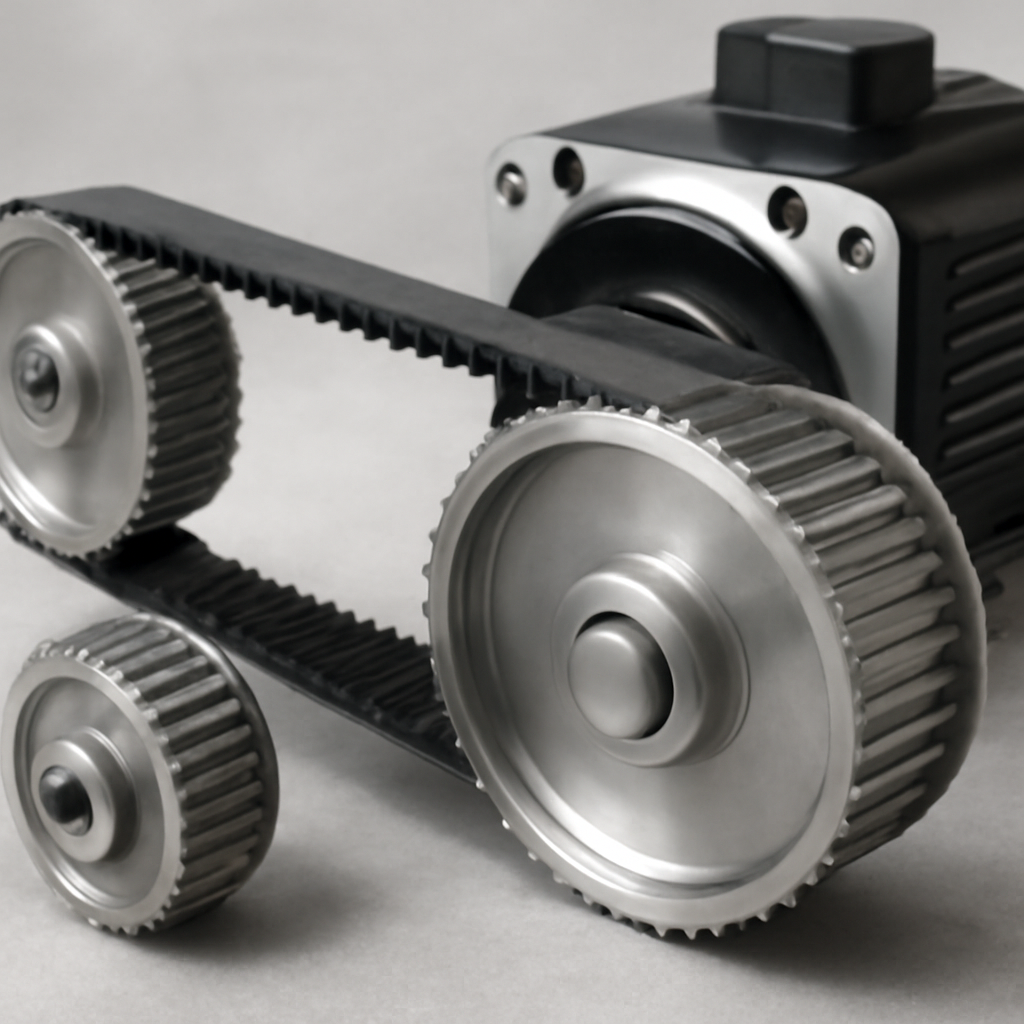
Timing belt pulley profile selection for servo-driven equipment is a technical decision that shapes both motion accuracy and pulley wear characteristics. Modern servo drives allow tight positioning control that older stepper drives could not achieve, and this creates specification implications for the timing belt pulley profile choice. This piece walks through the profile decision framework that matters on European servo-driven applications.
The timing belt profile categories
Standard timing belt profiles include HTD (High Torque Drive), GT (variants including 3M, 5M, 8M, 14M), AT (metric trapezoidal), MXL, XL, L, H and specialty polyurethane profiles. Each profile has specific tooth geometry that determines load capacity, backlash characteristics and running noise. The timing belt profile choice depends on application requirements more than on distributor preference.
Where servo-driven equipment changes the calculation
Servo-driven equipment can achieve positioning accuracy that requires low backlash from the timing belt drive train. Traditional trapezoidal AT profiles have inherent backlash characteristics that limit positioning accuracy. Modern curvilinear tooth profiles (GT, HTD) deliver lower backlash and better meshing at the load transitions that servo positioning generates. On applications requiring positioning accuracy below 0.1 millimetres, the profile choice affects achievable performance.
The GT profile advantages
GT profiles use curvilinear tooth geometry that distributes load across multiple teeth in mesh rather than concentrating on the leading tooth. This produces roughly 30 percent higher load capacity than equivalent HTD profiles and meaningfully lower backlash. On servo positioning applications where the load direction reverses frequently, GT profile pulleys reduce the positioning error that would otherwise accumulate through backlash on each reversal.
The HTD profile persistence
Despite the GT advantages, HTD profiles remain widely used because of installed base and OEM specification incumbency. Many European servo-driven applications specify HTD profiles from historical OEM design decisions rather than from current technical optimization. Retrofit applications typically maintain the HTD specification to match the existing belt inventory. Do not push GT retrofit without customer benefit justification.
The AT profile applications
Metric AT profiles serve applications where consistent European specification matters. AT5 and AT10 profiles are common on smaller servo-driven applications. AT20 handles higher load applications. The trapezoidal geometry provides adequate performance on applications where the servo positioning tolerances are relatively wide.
Pulley material considerations
Timing belt pulleys come in aluminum, steel and cast iron construction. Aluminum delivers lower mass and better acceleration characteristics for servo applications. Steel delivers higher load capacity for heavier applications. Cast iron delivers economy for lower-cycle applications. The material choice depends on cycle rate and load rather than on generic preference.
The flange and hub configuration
Pulley flanges prevent belt tracking off during operation. Servo applications with frequent direction reversal or high acceleration benefit from double-flanged pulleys on at least one pulley of each drive pair. The hub configuration — plain bore, taper bore, keyway — depends on the shaft attachment method. Getting these details right on the specification prevents installation problems.
The OPTIBELT timing pulley range
OPTIBELT covers standard HTD and GT profile pulleys for European industrial applications. Cross-brand equivalency to Continental and Gates pulleys is clean on standard profiles. For specialty profiles or specific hub configurations, direct OPTIBELT ordering may be required. The distributor stocking pattern for European aftermarket concentrates on common HTD and GT sizes.
The takeaway for procurement teams
Timing belt pulley profile selection on servo-driven equipment matters more than on constant-speed applications. Match the profile to positioning accuracy requirements. Consider GT profile for critical positioning applications. Maintain HTD specification on retrofit installations unless customer benefit justifies change. Match pulley material and configuration to cycle rate and shaft attachment requirements. The specification details matter more than the brand choice.
Related coverage on Eurobearing
- OPTIBELT V-Belts Guide
- OPTIBELT Blue Power
- Classic vs Cogged Decision
- Extend Belt Lifespan
- AI Transmission Monitoring
Need help with timing belt pulley profile selection? Our team supports European servo-driven equipment aftermarket. Book a free consultation.