
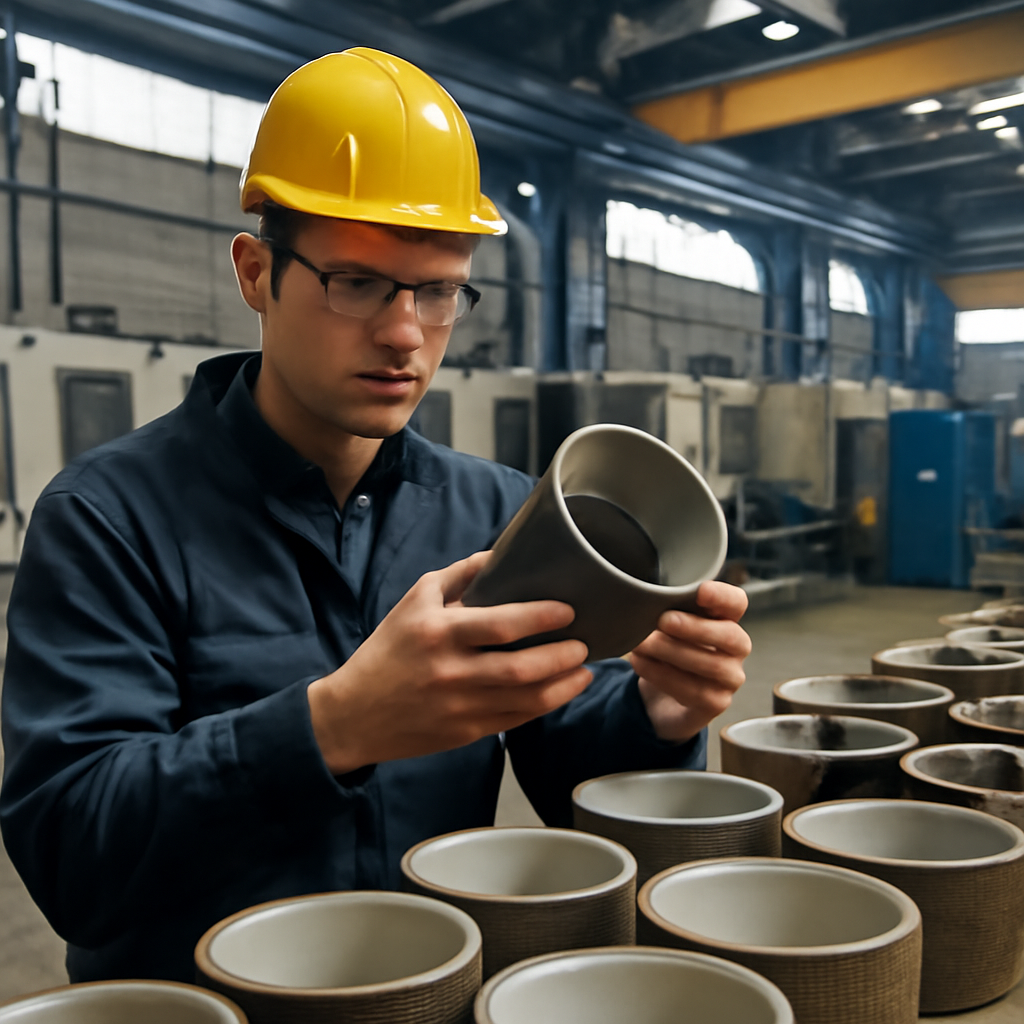
Technymon, the Bergamo-based sliding bearing specialist founded in 1975, has used an interview published on 7 July 2026 to detail the expansion of its Fritex® range of self-lubricating composite bearings and the scale-up of its Indian manufacturing operation. The story matters beyond one company: it is a clear signal that self-lubricating composite bearings are moving from niche substitution to a mainstream option in high-load, low-speed and oscillating applications where rolling bearings and greased bushings have traditionally been specified by default.
The facts
Technymon sits in Italy’s so-called “PTFE Valley” and has built nearly five decades of expertise in multilayer sliding bearings and tribological materials. The Fritex® family covers three product groups: fiber-wound composite bearings (the FW Series), metal-backed composite bushings (the CR Series), and engineered PTFE-based tribological fabrics produced in-house. The FW Series uses filament-wound construction, in which high-strength fibers are impregnated with thermosetting resins and wound under controlled conditions to create an anisotropic structure optimised for load distribution and wear resistance.
Varun Sood, Co-CEO of Technymon GBT, who leads the Indian manufacturing operation, told Bearing News that the Indian facility serves both domestic demand and export markets while following the engineering standards and quality systems established in Italy. The stated performance claims for the range are high static and dynamic load capacity, resistance to shock, vibration and contamination, corrosion resistance and chemical stability, a wide operating temperature window, and maintenance-free operation with no external lubrication. Target applications include construction machinery pivot points, hydraulic systems, offshore equipment, railways and agriculture. Technymon emphasises that producing the tribological fabrics in-house gives it control of the full material system from fiber structure to finished bearing.
Market implication
The commercial logic behind composite bearings has been strengthened by exactly the cost pressures now hitting the European market. Every rolling-element bearing sold in Europe is a steel product, and steel is where the pain is: the EU Steel Overcapacity Regulation that took effect on 1 July 2026 cut duty-free tariff quotas sharply and doubled the out-of-quota duty to 50%, while CBAM Phase 2 added embedded-carbon reporting on the same date. Bearing-grade alloy premiums have been widening independently of that. Composite bearings do not escape input-cost inflation, but their cost structure is dominated by polymers, resins and fibers rather than through-hardened bearing steel — a different exposure, and in the current environment a useful hedge in the bill of materials.
The stronger argument, though, is lifecycle rather than unit price. In oscillating and low-speed applications — excavator pivots, hydraulic cylinder eyes, linkage joints, agricultural implements — rolling bearings often fail not from fatigue but from false brinelling, contamination and inadequate re-lubrication. A self-lubricating composite bushing removes the grease point entirely. On a machine with dozens of lubrication points, each one deleted is a maintenance interval shortened, a failure mode removed and a contamination path closed. For OEMs designing for total cost of ownership, and for maintenance teams fighting to reduce planned downtime, that arithmetic increasingly favours composites even when the component price is comparable or higher.
The caution is that composites are not a drop-in replacement. Pressure-velocity limits, thermal behaviour, misalignment tolerance and housing fit all differ from a metallic bushing or a rolling bearing. Substituting on the basis of bore and OD alone is how these projects fail.
Procurement box: what buyers should do
- Action 1: Audit your installed base for oscillating and low-speed, high-load positions that are currently greased. These are the highest-return candidates for composite substitution, not high-speed rotating positions.
- Action 2: Request the PV (pressure–velocity) curve, temperature range and dynamic load rating for any composite bearing under evaluation, and compare against your actual duty cycle, not the nameplate.
- Action 3: Cost the change on lifecycle, not unit price: include eliminated lubrication labour, grease consumption, contamination-related failures and downtime.
- Action 4: Check housing tolerance and fit requirements before ordering. Composite bushings are often press-fit with different interference specifications than steel equivalents.
- Action 5: Pilot on one machine or one line for a full maintenance cycle before rolling out across the fleet, and instrument the trial so you have data, not impressions.
Looking ahead
Composite and self-lubricating plain bearings should keep taking share through 2027, driven less by innovation for its own sake than by three converging pressures: steel cost and carbon compliance on the input side, maintenance labour scarcity on the operating side, and OEM appetite for maintenance-free designs on the specification side. Expect the major manufacturers to respond — Schaeffler, SKF and the specialist plain-bearing houses all have composite and polymer lines they have historically marketed quietly. The competitive question for 2027 is whether the Italian and German specialists that own the material science can hold their technical lead as volumes rise and the majors push scale into the category.
Source
Related on Eurobearing
- Why bearing-grade steel alloy premiums keep widening
- CBAM Phase 2 steel and the bearing supply chain
- EU steel safeguard 2026/1384: what bearing buyers face in Q3
- Nadella needle roller bearings: where the specialist beats mainstream
- Digital twins in bearing selection: hype versus what buyers should ask
Need help with bearing selection? Contact our technical team for a free consultation.