
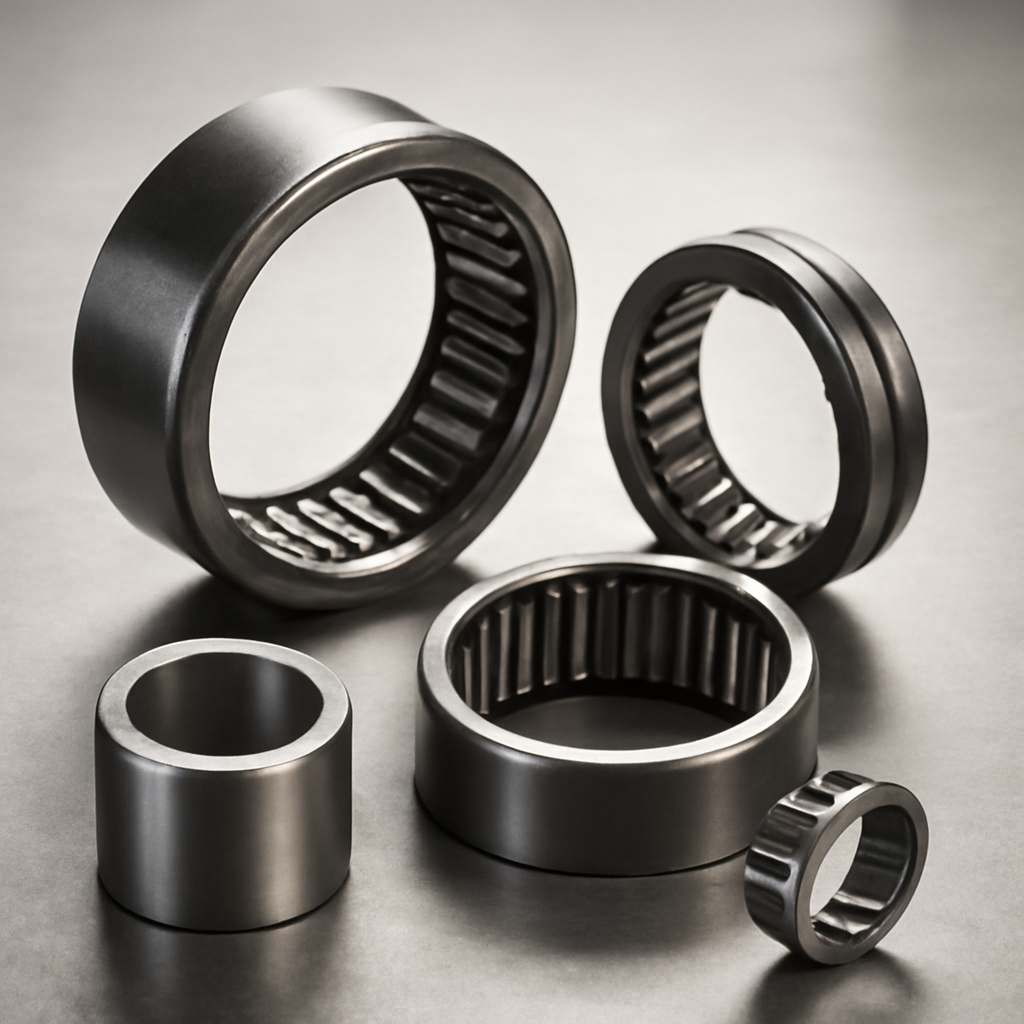
NADELLA needle roller bearings occupy a corner of the European aftermarket that the mainstream brands have never contested cleanly. The French specialist has spent decades building its reputation on precision needle designs for European transmissions, machine tool spindles and printing machinery, and that history shows up in the way its catalogue is shaped. When a needle specification lands on your desk, the real decision is rarely NADELLA against an equivalent needle bearing from a general-purpose maker. It is NADELLA against a substantially cheaper commodity needle from an unbranded source, or against a substantially more expensive precision option from INA. Understanding which of those two comparisons you are actually in is what makes the specification straightforward.
What NADELLA actually makes
NADELLA concentrates on three needle categories rather than spreading itself across a full bearing catalogue. Drawn-cup needle bearings cover the space-constrained industrial and automotive applications where a thin-walled outer shell is the only way to fit a rolling element into the available radial envelope. Needle roller and cage assemblies, supplied without rings, serve high-speed transmission designs where the shaft and housing themselves are hardened and ground to act as raceways. Precision needle bearings round out the range for European machine tool spindle work. The bore coverage runs from around 3 millimetres up to roughly 120 millimetres, which is deliberately narrower than a generalist catalogue and precisely why the tolerances hold.
Where NADELLA competes against INA
On drawn-cup needle bearings for automotive and light industrial transmission work, the technical performance of the two brands is effectively equivalent — both meet the European OEM specifications that these applications are written against, and neither will surprise you on the bench. What separates them is price. Across the European aftermarket, NADELLA typically lands 5 to 12 percent below the equivalent INA reference on drawn-cup designations, and the gap tends to widen on the mid-volume sizes rather than the fast movers. For a distributor serving French, Italian and Spanish transmission rebuild customers, that is margin available without a technical compromise you have to defend later. It is the single most reliable place NADELLA wins.
Where NADELLA outperforms commodity needle bearings
The comparison inverts completely at the bottom of the market. Against unbranded commodity needles, NADELLA is the expensive option, and it earns that premium only in applications where precision genuinely governs. A needle roller bearing carries its load across a long, slender contact line, which makes it unusually sensitive to variation in needle diameter — far more so than a ball bearing is to variation in ball diameter. Machine tool spindles demanding P4 precision grade, transmission bearings turning above 8,000 RPM, and printing press cylinder positions all sit in that sensitive band. Put a commodity needle set into any of them and the failure arrives as uneven wear long before the calculated life is anywhere near exhausted.
What differentiates NADELLA technically
The technical case comes down to needle diameter tolerance, and the numbers are less dramatic than their consequences. NADELLA holds needle diameter to roughly 2 microns across a set, where commodity alternatives commonly run 3 to 5 microns. That sounds like a rounding error until you follow it through the load path. In a needle set, the largest needles in the population carry a disproportionate share of the load, because the smaller ones simply do not make full contact until the assembly deflects. Tightening the spread across the set flattens that distribution, and a flatter distribution translates directly into longer life at the same nominal load. The relevant tolerance framework is ISO 286, and the precision grade you specify has to be matched by the housing and shaft you fit it into.
The application categories where NADELLA sits by default
Three application families generate the large majority of European NADELLA aftermarket demand, and recognising them saves a cross-referencing exercise. The first is automotive and light commercial transmission rebuild against French and Italian OEM specifications, where NADELLA was frequently the original fitment and the rebuild simply follows it. The second is European machine tool spindle work, where the precision needle geometry was designed into the machine and the machine builder’s manual names the bearing outright. The third is printing press cylinder bearings, where a specific NADELLA drawn-cup geometry has been the industry reference for so long that the alternatives are all described in relation to it. If a job sits in one of those three families, the specification has already been made for you.
Cross-brand equivalency and specification decisions
Cross-referencing needs a different level of care depending on which part of the range you are in. For drawn-cup needle bearings, mapping a NADELLA reference to an INA equivalent is straightforward on dimensions but demands a check on tolerance grade, because a dimensional match at a looser grade is not the same bearing. For needle roller and cage assemblies, verify the cage material before you substitute — a polyamide cage and a steel cage behave differently on temperature and on lubricant compatibility, and the assemblies frequently differ there while sharing dimensions. For precision spindle designations, substitution is rarely appropriate at all. Quote the original NADELLA reference, or budget for spindle rework and the downtime that comes with it.
Procurement pattern for the specialty needle segment
The stocking logic follows the demand shape rather than the catalogue. A distributor serving European transmission rebuild and machine tool aftermarket should hold the top twenty drawn-cup sizes on the shelf, because that is where the price advantage converts into volume and where customers expect same-day availability. Needle roller and cage assemblies are better held in matched pairs against the common transmission applications your customers actually run, rather than as loose singles. Precision spindle designations should not be stocked speculatively at all — they are long-tail, high-value and highly specific, and the right pattern is order-in-response-to-quote with a clear lead time communicated up front. Holding them on shelf ties up capital in references that may sit for years.
What buyers most often get wrong
The recurring mistake is treating a drawn-cup needle bearing as a drop-in commodity because the dimensions matched in a cross-reference table. Drawn-cup shells are thin, and the finished bore of the bearing is only established once it has been pressed into its housing — which means the housing bore tolerance is part of the bearing specification, not an afterthought. Press a precision drawn-cup into an oversized or out-of-round housing and you have thrown away the tolerance you paid for, whichever brand is stamped on the shell. The second recurring mistake is ignoring the raceway requirement on cage-and-roller assemblies. Those assemblies have no rings, so the shaft and housing surfaces are the raceways, and they must be hardened to roughly 58 HRC and ground to the specified finish. A rebuilt shaft that was turned but never hardened will destroy a perfectly good needle set within weeks, and the bearing will be blamed for it.
The takeaway for European buyers
NADELLA is not a general-purpose substitute for INA across a needle roller catalogue, and treating it as one leads to disappointment in both directions. It is a specification incumbent in a defined set of application categories, where it offers a real price advantage on drawn-cup bearings and a real technical advantage on machine tool designs. Identify which comparison you are in — NADELLA against a premium precision alternative, or NADELLA against a commodity needle — and the correct answer usually declares itself without a spreadsheet.
Related coverage on Eurobearing
- FAG vs INA: Two Schaeffler Brands Compared
- INA Roller Bearings: Innovation and Precision
- INA Bearings in Machine Tools
- How Aerospace Tolerances Apply to Industrial Bearings
- Bearing Cross-Reference Software: What Actually Works
Need help cross-referencing a NADELLA needle designation? Our team supports European transmission and machine tool aftermarket buyers with equivalency checks. Book a free consultation.