
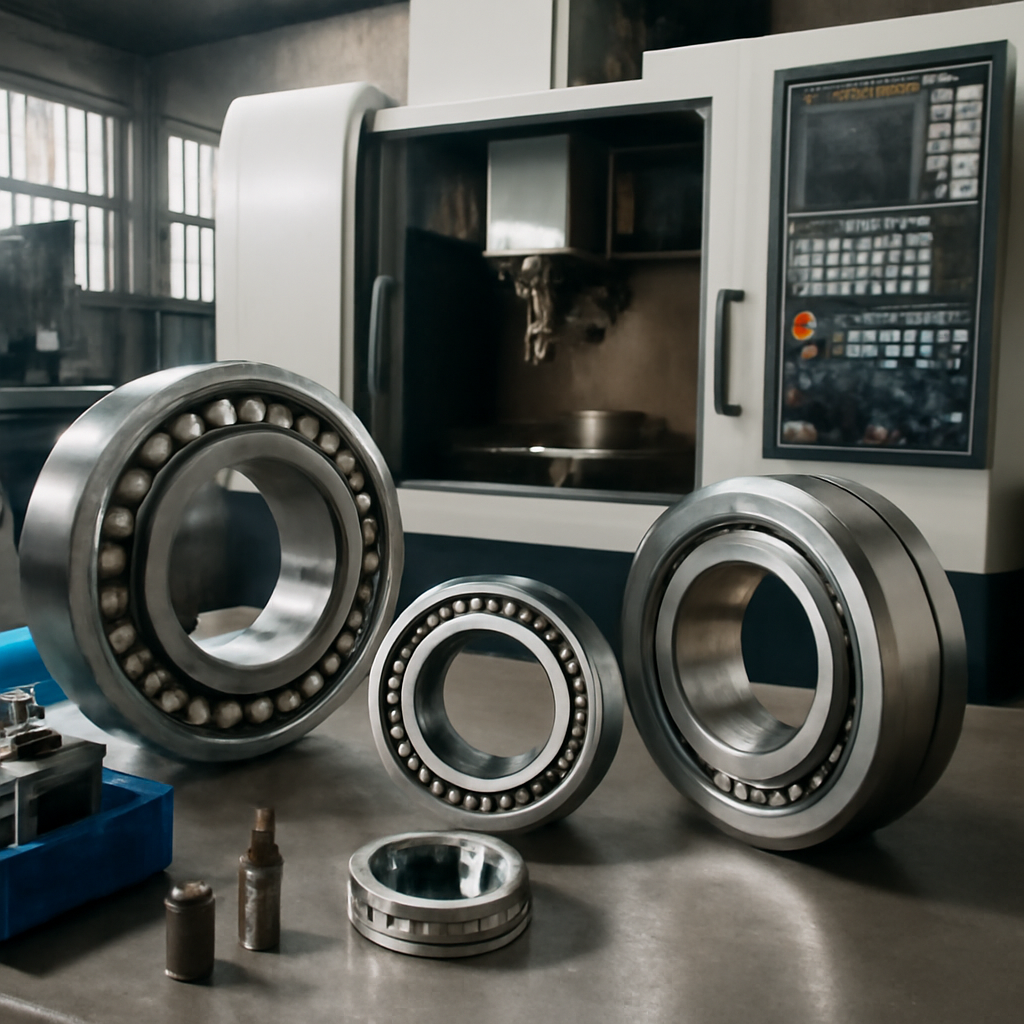
INA bearings are everywhere in modern machine tool design — from precision spindle pre-load packs to compact needle bearings in indexing mechanisms to cam followers in tool turret drives. The product range is engineered specifically for machine tool requirements: high precision, high stiffness, low vibration, and the long calculated service life that justifies premium machine pricing. This guide walks through the main application categories.
1. Spindle bearings
The most critical bearings in any machine tool. INA’s spindle bearing range covers:
- High-precision angular contact ball bearings: for machining centre spindles below 18,000 rpm. P4 and P2 tolerance classes available.
- Hybrid spindle bearings: ceramic balls for high-speed grinding and high-precision turning spindles.
- Cylindrical roller bearings for spindles: NN double-row designs for very high radial load applications.
- Pre-loaded matched sets: bearings sold in matched pairs or sets with calibrated preload for direct installation.
2. Indexing and turret bearings
- Crossed-roller bearings: provide stiff axial-radial-tilt support in compact envelope.
- Slewing rings: for tool turrets and large indexing mechanisms.
- Yoke-type cam follower bearings (NUKR): for cam-driven indexing.
3. Linear motion in machine tools
INA supplies linear bearings for machine tool axes:
- Profiled rail guideways: heavy-duty for moderate precision; ground accuracy class for higher precision.
- Recirculating ball monorail guideways: standard for general CNC machine tool axes.
- Recirculating roller monorail: for the highest stiffness and load capacity.
4. Ball screw support bearings
- Angular contact thrust bearings (ZKLN, ZKLF): integrated bearing-housing units for ball screw end-fixings.
- High-precision matched pairs: for the leading screw position of high-precision axes.
5. Auxiliary mechanisms
- Needle bearings in tool changers: compact, durable.
- Cam followers in tool selection: track rollers and yoke followers.
- Drawn cup needle bearings in compact actuators: very compact radial envelope.
6. Coolant and chip handling
Bearings in coolant pumps, chip conveyors, and swarf handling face wet contaminated conditions. INA stainless variants and heavy-duty sealed options cover these positions.
7. Why INA in machine tools specifically
- Tight tolerances: INA’s manufacturing controls deliver consistent precision batch-to-batch.
- Application engineering: Schaeffler’s machine tool engineering support is industry-leading.
- Matched sets and integrated units: simplify machine builder assembly.
- X-life enhanced range: extended fatigue life on critical positions.
- Cross-portfolio compatibility: easy to combine INA bearings with FAG products from the same Schaeffler portfolio.
8. Lubrication and maintenance
Machine tool spindles often use oil-mist or oil-air lubrication for the highest speeds. INA documentation covers lubrication system requirements in detail. Lower-speed machine tool axes use grease lubrication with extended re-lubrication intervals.
9. Cross-reference with NSK, THK, SKF
INA machine tool bearings cross-reference functionally with NSK Super-precision, THK precision, and SKF Super-precision ranges. Direct cross-substitution requires verification of preload, tolerance class and matched set ordering codes.
10. The 2026 context
- Schaeffler’s machine tool bearing business continues investment in high-speed spindle technology.
- Smart spindle bearings with integrated sensors emerging on premium machine tool builds.
- Capacity at INA dedicated facilities maintained for engineering-class production.
Conclusion
INA bearings are the natural specification across modern machine tool design — from spindles to linear motion to auxiliary mechanisms. The combination of engineering depth, application support, and portfolio breadth makes them a default choice for European machine tool builders. For OEM and aftermarket buyers, INA remains the brand to start with when specifying machine tool bearing positions.
The European bearing industry 2026 landscape
The European bearing industry in 2026 enters one of the most active strategic transformation periods in three decades. The NSK + NTN MoU (12 May 2026, target closing October 2027), SKF Automotive spin-off preparation, Schaeffler Yinchuan capacity doubling, and SKF G-Tech Instruments acquisition (March 2026) collectively reshape the supplier landscape. The industry market projection from $151.8B (2026) to $301B (2033) reflects structural drivers operating in parallel: EV adoption acceleration, wind energy capacity expansion, industrial robotics growth, and smart bearing technology maturation.
For European industrial procurement teams, the practical implications converge on five operational priorities. Multi-supplier qualification across critical SKUs supports substitution agility through consolidation. Framework agreement renegotiation captures pricing leverage during the competitive window. Condition monitoring deployment delivers 6-18 month payback ROI on mid-size plant deployments. Smart bearing qualification positions for the 2028+ industry structure. Master data discipline supports informed substitution decisions during supply disruptions.
The smart bearing and condition monitoring transition
The bearing industry’s transition from component supply to integrated reliability platform delivery represents the defining strategic shift of the decade. Every major manufacturer (SKF Insight, Schaeffler OPTIME, NSK SAT, NTN smart bearing platforms) has built or acquired platform capability. The integrated offering combines instrumented bearings, cloud analytics, AI-based anomaly detection, prescriptive workflow integration, and reliability services. For European industrial customers, qualifying smart bearings on critical applications during 2026 positions the organisation for the post-2028 industry structure where smart bearings become standard rather than premium.
Industry surveys converge on 65% of maintenance teams planning AI adoption by year-end 2026 — a documented adoption signal that the industry transition is real and accelerating. For procurement and reliability leadership, the strategic question is no longer whether to deploy but how fast, at what scale, and on which platform.
Raw material costs and tariff dynamics
Bearing pricing dynamics in 2026 reflect converging cost drivers. US steel tariffs at 50% (in force since June 2025) reshape global trade flows, with Asian bearing exporters redirecting volume into Europe and other markets. Bearing-grade alloy premiums continue widening. EU regulatory developments (CBAM transitional phase, REACH SVHC updates, steel safeguards review activity) add complexity to import economics.
For procurement teams, the practical response combines tactical and strategic actions: lock pricing on critical SKU framework agreements during the H2 2026 window; build steel-cost adjustment mechanisms into multi-year contracts; verify customs classifications carefully on cross-border purchases; document supplier origin certifications for preferential trade agreement benefits; build inventory depth on critical references where carrying cost favours stock vs expected H2 2026 price step.
The European bearing industry 2026 strategic landscape
The European bearing industry in 2026 enters one of the most active strategic transformation periods in three decades. NSK + NTN MoU (12 May 2026, target closing October 2027), SKF Automotive spin-off preparation, Schaeffler Yinchuan capacity doubling, and SKF G-Tech Instruments acquisition (March 2026) collectively reshape the supplier landscape. The industry market projection from $151.8B (2026) to $301B (2033) reflects structural drivers operating in parallel: EV adoption acceleration, wind energy capacity expansion, industrial robotics growth, and smart bearing technology maturation.
For European industrial procurement teams, the practical implications converge on five operational priorities: multi-supplier qualification supports substitution agility through consolidation; framework agreement renegotiation captures pricing leverage during the competitive window; condition monitoring deployment delivers 6-18 month payback ROI on mid-size plant deployments; smart bearing qualification positions for the 2028+ industry structure; master data discipline supports informed substitution decisions during supply disruptions.
Smart bearing and condition monitoring transition
The bearing industry’s transition from component supply to integrated reliability platform delivery represents the defining strategic shift of the decade. Every major manufacturer (SKF Insight, Schaeffler OPTIME, NSK SAT, NTN smart bearing platforms) has built or acquired platform capability. The integrated offering combines instrumented bearings, cloud analytics, AI-based anomaly detection, prescriptive workflow integration, and reliability services. For European industrial customers, qualifying smart bearings on critical applications during 2026 positions the organisation for the post-2028 industry structure where smart bearings become standard.
Industry surveys converge on 65% of maintenance teams planning AI adoption by year-end 2026 — a documented adoption signal that the industry transition is real and accelerating. For procurement and reliability leadership, the strategic question is no longer whether to deploy but how fast, at what scale, and on which platform.
Raw material costs and pricing trajectory
Bearing pricing dynamics in 2026 reflect converging cost drivers. US steel tariffs at 50% (in force since June 2025) reshape global trade flows. Bearing-grade alloy premiums continue widening. EU regulatory developments (CBAM, REACH SVHC updates, steel safeguards) add complexity to import economics. For procurement teams, the practical posture is active engagement: lock pricing on top-50 SKUs in framework agreements; build steel-cost adjustment mechanisms; verify customs classifications; document supplier origin certifications; build inventory depth on critical references where carrying cost favours stock vs expected price step.
The H2 2026 procurement action list
For European industrial procurement leadership in H2 2026, the action list converges on five operational priorities. First, multi-supplier qualification across critical SKUs supports substitution agility through the NSK + NTN consolidation period. Second, framework agreement renegotiation captures pricing leverage during the competitive window before the integration closes. Third, condition monitoring deployment delivers documented 6-18 month payback on typical mid-size plant deployments. Fourth, smart bearing qualification on critical applications positions the organisation for the post-2028 industry structure. Fifth, master data discipline supports informed substitution decisions during supply disruptions.
The cumulative effect of disciplined execution across these priorities compounds across years. Organisations that build the capability now position themselves for the post-consolidation industry structure; those that delay will be implementing in 2028 against competitors who already have the foundation in place. The strategic window for proactive positioning is open through 2026 with diminishing returns thereafter.
Related guides
- INA Roller Bearings 2026
- INA in Machine Tools (legacy)
- Angular Contact Bearings
- INA Stainless Award
- THK Linear Bearings
Need help with bearing selection? Our team supports you with cross-references and lead-times.