
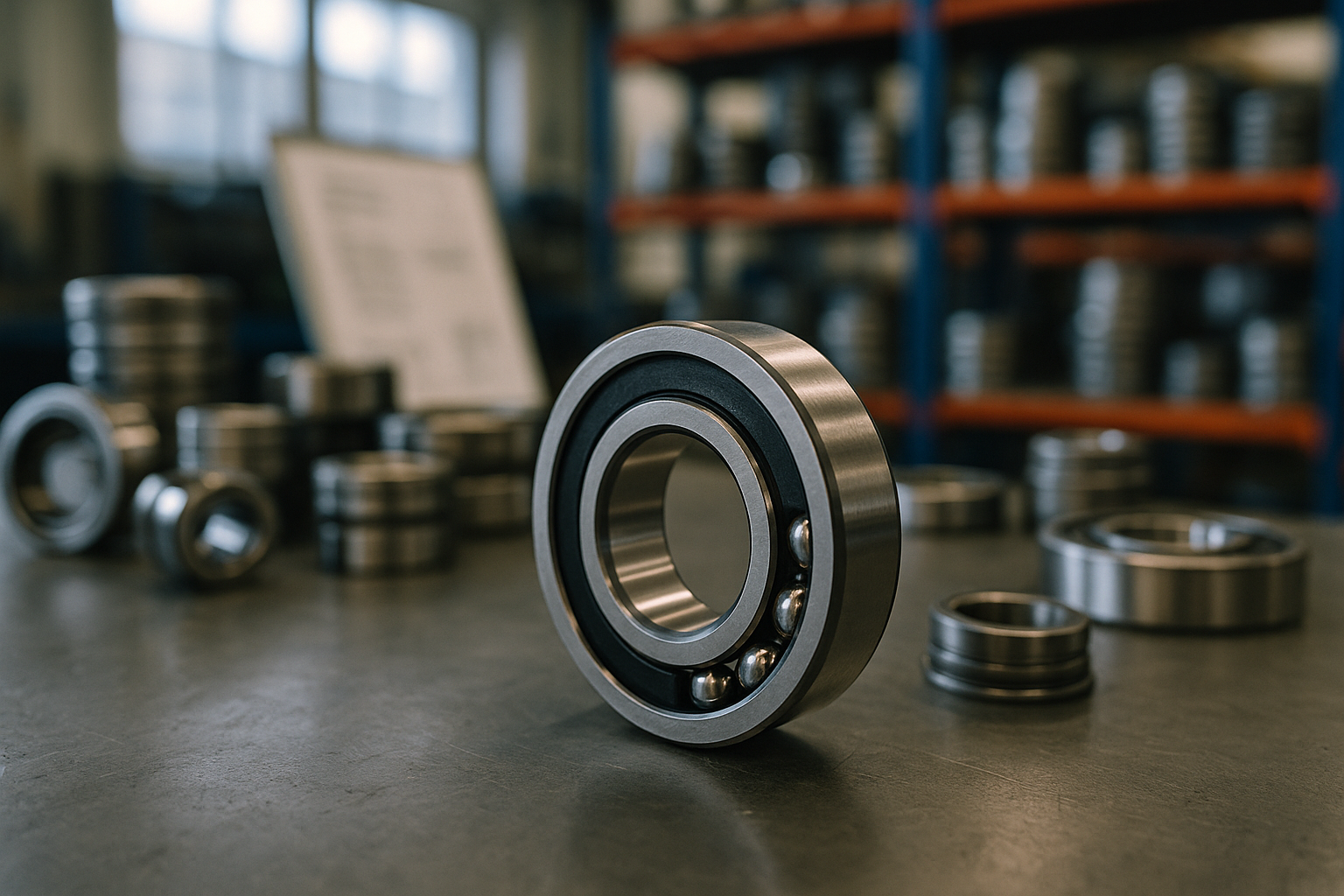
Every bearing distributor’s warehouse contains a shelf that nobody can justify. Perhaps it holds three variants of a discontinued spherical roller kept because a customer who left in 2019 once needed them, or forty units of a seal that was superseded two catalogue revisions ago. A bearing SKU rationalisation project is the periodic act of walking those shelves with the transaction data in hand and deciding, item by item, what the business is actually paying to store. Done properly every eighteen to twenty-four months, it typically removes fifteen to twenty-five percent of line items and releases capital and space into the specifications that are genuinely moving.
Why the SKU count grows on its own
Nobody decides to accumulate dead stock. It arrives through entirely reasonable individual decisions: a customer-specific item stocked to win an account that later moved, duplicate specifications inherited when the business added a second brand, a special order where the customer took four of the six units, a variant retained because someone remembers being caught short once. Each decision made sense in isolation and none of them are ever revisited, because no routine exists for revisiting them. The count only goes one way until somebody deliberately reverses it, which is why this needs to be a scheduled project rather than an intention.
The data you need before you start arguing about individual items
Twenty-four months of transaction history at line-item level, showing units moved, number of separate transactions, number of distinct customers, gross margin contribution and current inventory value. Most distribution ERP systems will produce this, though it often needs cleaning where part numbers have changed or where the same physical item exists under two codes. Do this extraction and cleaning before the first review meeting. Projects that begin with a room full of people and no reliable numbers descend into anecdote within twenty minutes, and the loudest opinion wins rather than the best evidence.
Velocity segmentation tells you where to look
Sort by units moved and the familiar distribution appears: roughly the top fifth of items accounts for something like seventy percent of volume, the next thirty percent for twenty, and the bottom half for the remaining ten. That bottom half is where the project lives. The fast-moving head of the curve mostly needs more investment rather than less — stock-outs there cost real business — while the long tail needs individual justification. Framing it this way also keeps the project constructive rather than purely subtractive: the money released from the tail has somewhere useful to go, and the fast-moving specifications in categories like deep groove ball bearings and taper roller bearings are usually where it belongs.
Five questions that settle most individual cases
For each slow-moving item, ask: how many separate transactions in twenty-four months, and is it fewer than three? How many distinct customers, and is it only one? Does a faster-moving item cross-reference as an acceptable substitute? Is this item safety-critical or emergency-supply, where availability matters more than turnover? And does it support a brand relationship whose depth has commercial value beyond this line? Three or more answers pointing towards elimination usually means elimination. The fourth and fifth questions are the ones that save you from a purely arithmetic decision that damages a customer relationship, and they are the reason this cannot be automated.
Cross-brand duplication is the easiest win available
Where the same specification sits on the shelf under two brands and both turn slowly, consolidating to one releases capital without reducing what you can supply. Decide on margin and on customer preference rather than on habit, and be honest about which brand the account actually asks for. Multi-brand supply is genuinely valuable on the moving specifications — it gives you pricing flexibility and supply security where those things matter — but carrying two dormant versions of the same item is simply paying twice for the same capability. The decoding work that makes equivalence obvious is worth having to hand; our distributor cheat sheet for reading SKF suffixes covers the part of that job people most often get wrong.
Telling customers before they find out
Any item you eliminate that a real customer has bought needs a conversation before the shelf is cleared, not after they order. Offer the cross-reference, give a notice period, and ask whether the specification is genuinely essential to them — occasionally the answer reveals a use case worth keeping the item for, and occasionally it reveals that they have been ordering it out of habit too. Handled this way, rationalisation strengthens the relationship because it looks like attention. Handled silently, it produces a stock-out on an item the customer had every reason to expect, and the goodwill lost exceeds the carrying cost saved.
Obsolete stock and the write-down nobody wants to sign
Some of what you find will have no future demand at all — superseded designs, discontinued ranges, items whose application has disappeared. The carrying cost of holding these indefinitely exceeds what secondary-market liquidation will return, and the space they occupy has an opportunity cost that never appears on any report. The write-down is unpleasant precisely because it makes a loss visible that was previously just sitting quietly on the balance sheet, but the loss already happened. The decision in front of you is only whether to keep paying rent on it.
Running it without it stalling
Allow eight to twelve weeks with a named owner: three weeks of data preparation, three of category-by-category review, three of customer and supplier communication, and the rest for physical reconfiguration and disposal. Part-time ownership is the most reliable way to produce a project that reaches week six and quietly stops. Afterwards, track whether eliminated items generate enquiries, whether the reinvested capital improved turnover where it went, and whether picking productivity moved — the follow-up both validates the decisions and builds the case for doing it again on schedule rather than when the warehouse becomes unbearable. Distributors reading the broader stocking picture will find the seasonal context in our note on stockpiling patterns before Q4.
Planning an SKU rationalisation project? Our team supports European bearing distributors on inventory segmentation, cross-reference consolidation and stocking strategy. Book a free consultation.