
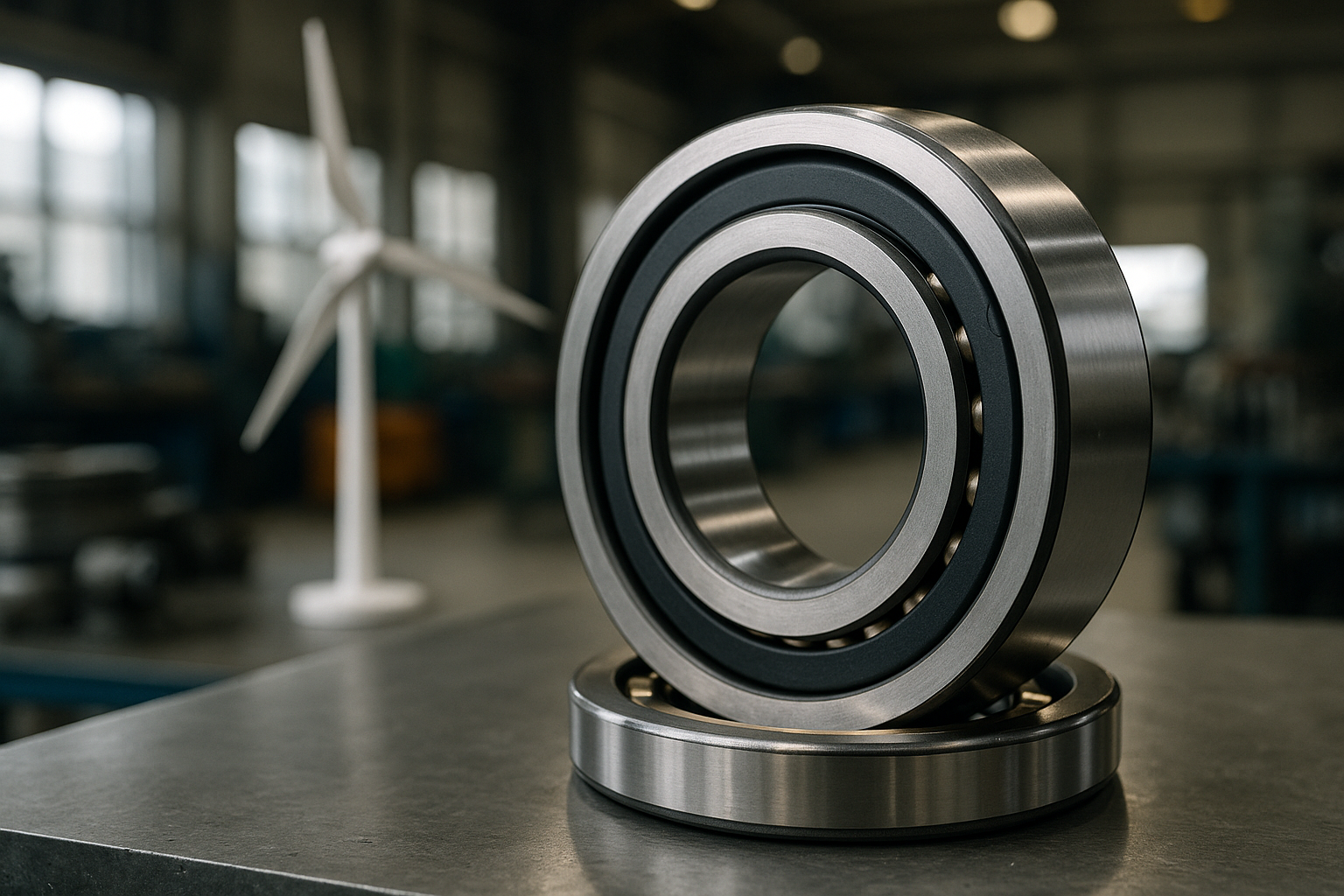
Spain installed its first serious tranche of wind capacity in the early 2000s, which means a large part of the national fleet is now passing through the fifteen-to-twenty-year window where gearboxes come apart and main shafts get inspected properly for the first time. That demographic fact, more than any policy announcement, is what is reshaping Spanish bearing distribution right now. The aftermarket that grew up serving machine shops in Bilbao and food plants in Valencia is being asked for large-diameter bearings on lead times measured in weeks, delivered to a hillside in Aragón, by customers whose cost of downtime is calculated in megawatt hours.
Why wind demand behaves unlike any other industrial account
Most industrial bearing demand is reactive and small: something fails, a replacement goes out, the line restarts. Wind demand is the opposite on both counts. Replacements are planned years ahead against overhaul schedules, the units involved are physically large and expensive, and the consequence of a stock-out is not an inconvenienced maintenance manager but a turbine standing still while a crane is on hire. A distributor who treats this like conventional aftermarket — quote on request, order on confirmation, deliver when it arrives — will lose the account to whoever engages with the overhaul calendar instead. The planning horizon is the opportunity, because a fleet operator who tells you what they will need in fourteen months is effectively handing you their forecast.
The four positions and what each one demands
Main shaft bearings carry very high loads at very low speeds with twenty-year design lives, which puts them in a different engineering universe from anything in general industry. Gearbox bearings run fast, fail most often, and account for the bulk of aftermarket volume. Pitch and yaw bearings turn slowly through partial rotations under complex combined loading, a duty that punishes any specification chosen on radial load alone. Generator bearings face electrical current passing through the raceway, which produces the fluting damage pattern that hybrid ceramic elements exist to prevent. Four positions, four genuinely different specification problems, and a distributor who cannot tell them apart in a technical conversation will not be trusted with the order. The slewing-type units in particular have their own economics, covered in our piece on when premium slewing bearings pay.
Supply is the constraint, not price
Large-diameter roller bearings for wind service come from a short list of manufacturers with the capacity to make them, and that list has not grown as fast as installed capacity has. The practical consequence for a Spanish distributor is that the competitive advantage lies in securing allocation and lead-time visibility rather than in shaving margin. Customers in this sector will pay for certainty and are notably unimpressed by a keen price against a vague delivery date. The current state of order books and where the bottlenecks sit is tracked in our note on the large roller bearing bottleneck in renewables and in the September 2026 European wind order book, both of which describe a market where availability is the scarce commodity.
Geography decides who can actually serve the fleet
Spanish wind capacity concentrates in Aragón, Galicia, Castilla y León and Castilla-La Mancha, none of which is close to the traditional industrial distribution centres. Serving these sites means either regional stock, a logistics arrangement that can move heavy units quickly, or a partnership with local service contractors who already have people on the ground. Distributors who have built that reach find the position defensible, because the alternative for the customer is a national supplier with a longer response time. Those who try to serve the fleet from a single central warehouse discover that the freight cost and the delay eat the margin that made the business look attractive.
What the service technician actually needs from you
The person who will fit the bearing is working at height, in a nacelle, with a weather window and a lift booked. What helps them is a kit rather than a part: the bearing, the correct seals, the mounting hardware, the installation data, and a phone number that answers when something on site does not match the drawing. What does not help is a correctly priced bearing in a box with no documentation. Distributors who assemble replacement kits for specific turbine models and keep the technical data attached to them become the default supplier, because they remove work from a customer whose scarcest resource is time in the nacelle.
Multi-brand is a supply strategy, not a negotiating tactic
Depending on a single manufacturer for wind-sector supply concentrates exactly the risk that matters here: allocation. Qualifying equivalent specifications across SKF, TIMKEN and FAG in advance means that when one manufacturer’s lead time stretches, the order can move rather than wait. The pricing flexibility that comes with it is real but secondary; the supply security is the point. This requires the technical work of establishing equivalence to be done before the urgent enquiry arrives, which is precisely the work that distinguishes a distributor with an engineering function from one with a catalogue. Alongside the large units, the ancillary demand across the spherical roller and taper roller categories is steady and worth stocking properly.
What this means for a Spanish distributor deciding whether to commit
Wind is not an easy adjacent market to enter casually. It demands technical depth across four distinct position types, allocation relationships with a small number of manufacturers, regional logistics into remote sites, kit assembly rather than part supply, and the patience to work against overhaul calendars that pay out eighteen months later. What it offers in return is a growing installed base with predictable, plannable, high-value replacement demand and customers who value reliability over price. Distributors who have made the commitment are finding it defensible precisely because it is hard; the ones treating it as a catalogue extension are quoting and losing.
Considering how to position your distribution for wind sector demand? Our team works with European distributors on segment entry, allocation strategy and technical qualification. Book a free consultation.