
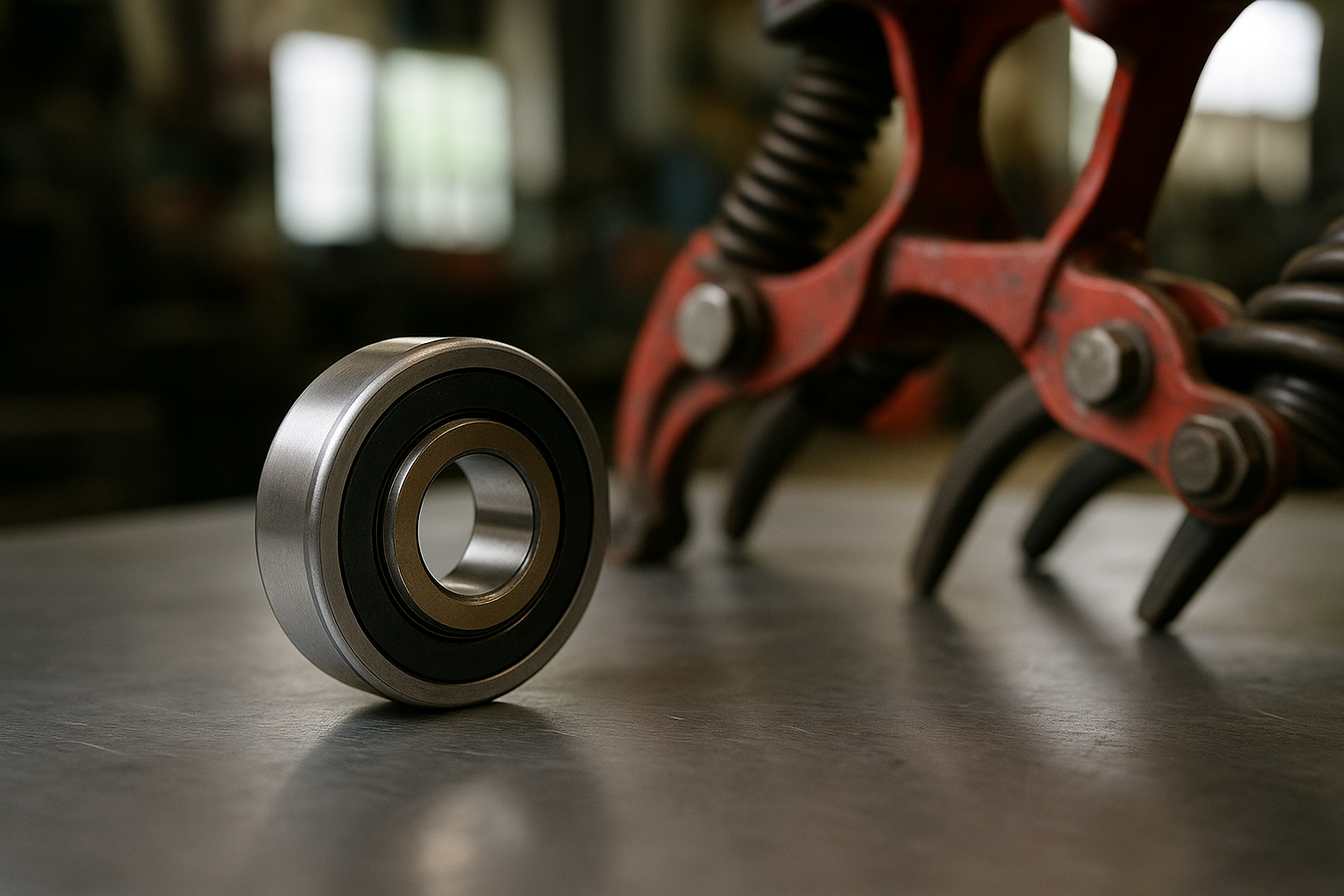
A seed drill is worth perhaps eighty thousand euros and the part that most often stops it costs eleven. Seed drill bearings sit on disc coulters and press wheels, turning slowly under modest load, and on any reasonable engineering assessment they should be the least of a farmer’s concerns. In practice they are the component that halts a planting campaign at the exact moment the soil is right and the forecast has three dry days in it, because the operating environment they live in has almost nothing in common with the clean industrial duty their catalogue rating assumes.
Why a small bearing in soil is a hard application
The disc coulter bearing runs a few centimetres from the ground with soil, moisture, fertiliser residue and crop debris in permanent contact with its seal face. Every stone the disc rides over transmits an impact through the bearing, and every wet field pushes water against a seal that was designed to keep out dust. Chemical exposure from starter fertiliser attacks elastomer seal materials directly. None of this appears in the load calculation, which is why bearings selected on load rating alone routinely need replacement after three to six hundred hours while the same specification would run for years on a clean indoor shaft. Contamination, not fatigue, is what kills them.
The coulter position is where the failures concentrate
If you are going to inspect one thing before the campaign, inspect the coulter bearings. They see the worst of the contamination, the worst of the impact loading and the most water, and they account for the large majority of in-field seed drill failures. Press wheel and closing wheel bearings sit in a marginally kinder environment and fail less often. Knowing this concentration lets you spend inspection time and spare budget where the risk actually is rather than spreading both evenly across a machine that does not need it. The same logic applies across agricultural equipment generally, and the pattern is documented in our field notes on bearings that survive dust.
What to specify, and why the cheap option costs more here
The specification that survives this duty has heavy-duty contact seals rather than shields, corrosion-resistant or stainless execution where the chemical exposure is real, and enough dynamic capacity to absorb impact loading rather than merely carry the static load. Sealed units from the deep groove ball bearing range in the relevant sizes cover most coulter positions, and insert bearings in housed units cover the rest — the aftermarket standards for that style are set out in our piece on insert and Y-bearings in agricultural transmissions. The price difference between a shielded bearing and a properly sealed one is a few euros per unit and perhaps two hundred across the machine, which is less than an hour of lost planting.
The pre-season inspection that prevents most of it
Before the campaign opens, turn every accessible bearing by hand and feel for roughness, notchiness or binding. Look at each seal for splitting, displacement or packed debris. Check for corrosion streaking, which indicates water has been sitting where it should not. Complete the greasing schedule on the points the manufacturer specifies, using the correct specification rather than whatever is on the shelf. This takes an afternoon on a typical drill and catches something like two thirds of the bearings that would otherwise have failed mid-campaign — which is a better return than any other hour of maintenance you will spend that season.
Spares on the farm, not at the dealer
Hold a complete set of coulter and wheel bearings, matching seals and the retaining hardware on site before the first day of drilling. The whole set costs less than a single lost day and removes the dependency on a dealer who may be equally busy with everyone else in the district during exactly the same fortnight. Note the actual specifications currently fitted rather than trusting the manual, because previous repairs have a way of introducing substitutions nobody recorded, and discovering the mismatch with the drill in the field is the worst possible moment.
Reading the warning signs while you are still drilling
A bearing that is going to fail generally announces it for several days first. An infrared thermometer reading on accessible housings at the end of each day takes ten minutes and gives you a temperature trend; anything running well above its neighbours warrants a look. Operators who know the machine hear a change in the noise or feel a new vibration through the seat before any instrument reports it, which is why telling them what to listen for is worth more than the thermometer. Once a bearing is showing clear degradation, plan the replacement within two or three working days — the difference between a planned change during an evening and a seized bearing in a wet field is typically a day of the campaign.
The winter job that removes next spring’s problem
After the campaign, go over the drill again and note every bearing that survived but looks tired. Replace those during the winter, when parts are available, the workshop is warm and nothing depends on finishing today. This single habit converts the entire category from an emergency into a maintenance line item, and it is the main thing that separates farms which lose days to seed drill bearings from farms which do not. The same seasonal discipline applied to harvest equipment is covered in our notes on the straw chopper position on the combine, which faces an even harsher version of the same problem.
Need the right bearing specifications for your drill before the campaign? Our team supports European agricultural operations with seasonal bearing programmes and spare kits. Book a free consultation.