
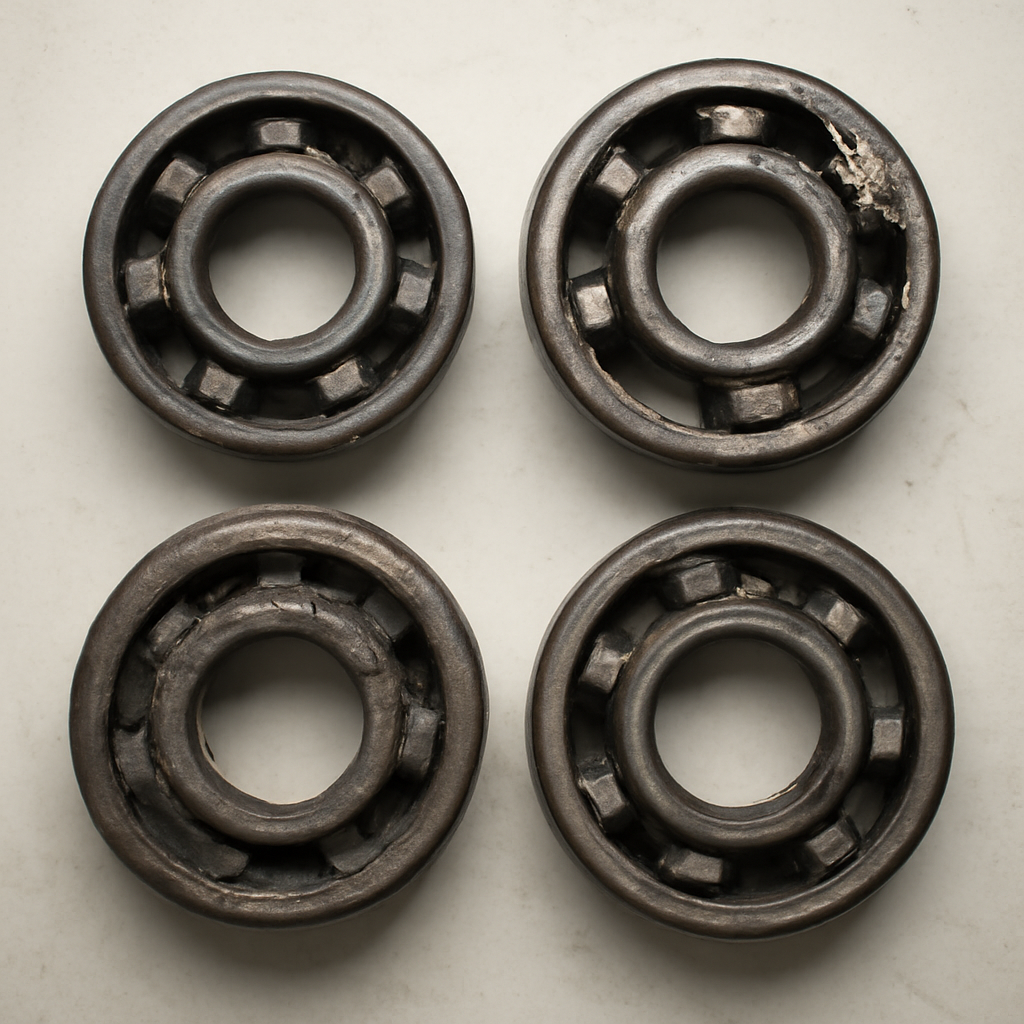
Every bearing failure mode leaves a recognisable signature on the raceways, rolling elements, and cage. The trained eye can identify the root cause from the visual evidence in minutes. This is the practical visual identification guide for the twelve most common bearing failure patterns — what to look for, what each pattern means, and what to do about it.
1. Surface fatigue (spalling, flaking)
Pitted or flaked area on the raceway, typically elliptical or circular. The classical end-of-life failure for a bearing that has reached its calculated L10 — material removal from rolling contact fatigue. Root cause: simply running long enough. Action: planned replacement; verify L10 calculation was appropriate for actual duty.
2. Brinelling
Round indentations on the raceway spaced exactly at rolling element pitch. Caused by static overload — a load applied to the stationary bearing exceeded the static load rating. Common cause: hammering during installation, shock load from a dropped assembly, or fitting under excessive press load. Action: replace bearing; train installers on correct procedure.
3. False brinelling
Similar pattern to true brinelling but with characteristic discoloration (often rust). Caused by small-amplitude vibration of a stationary bearing — common during transit, storage, or extended downtime. Action: replace bearing; protect stored bearings against vibration; rotate stored shafts periodically.
4. EDM erosion (fluting)
Washboard or fluting pattern of parallel grooves across the raceway. Caused by electrical current arcing across the bearing — characteristic on inverter-driven motors without insulation. Action: replace bearing with insulated variant (Insocoat) or hybrid ceramic ball; verify motor grounding.
5. Adhesive wear (smearing, scoring)
Metal-to-metal damage on raceways or rolling elements, often with material transfer. Caused by lubrication starvation — insufficient grease, wrong base oil viscosity, or grease degradation. Action: review lubrication interval and grease specification; replace bearing.
6. Abrasive wear
Generalised matte appearance on raceway surfaces. Caused by hard particle contamination — dust, sand, grit ingress through failed seals. Action: replace bearing and seals; improve sealing strategy; consider upgrading from shield to contact seal.
7. Corrosion
Rust spots, pitting, or generalised oxidation. Caused by moisture ingress through failed seals or aggressive chemistry (acidic wash-down). Action: replace bearing and seals; consider stainless variant for wash-down applications.
8. Misalignment damage
Wear pattern concentrated on one side of the raceway, sometimes with diagonal markings. Caused by shaft misalignment generating parasitic loads. Action: replace bearing; perform laser alignment; check for soft-foot in the foundation.
9. Overheating (discoloration)
Blue or straw-coloured rings tell a story: blue indicates ~300 °C+, straw colour indicates 200-250 °C. Causes: lubrication failure, over-greasing, excessive preload, or duty cycle exceeded. Action: investigate root cause systematically before replacing the next bearing.
10. Cage fracture
Broken cage segments with rolling elements potentially scattered. Caused by shock loading, vibration beyond rated, lubrication failure, or end-of-life fatigue. Action: replace bearing; investigate duty profile.
11. Etching (chemical attack)
Discoloration of raceways without mechanical damage. Caused by chemical attack from incorrect lubricant additive package, water-contaminated grease, or aggressive environmental chemistry. Action: review lubricant compatibility with environment; replace bearing and grease.
12. White Etching Crack (WEC)
Subsurface micro-cracks visible only under metallographic examination, manifesting as raceway spalling. Significant cause of premature wind turbine main bearing failure. Root cause complex — combination of dynamic loading, hydrogen ingress, and microstructural factors. Action: requires manufacturer engineering response; selection of upgraded bearing material and surface treatment.
The systematic failure analysis procedure
- Photograph the bearing as removed.
- Note the position (drive end, non-drive end) and orientation.
- Inspect raceways under good light; magnification helps.
- Note rolling element condition.
- Check cage integrity.
- Sample the grease; note colour, consistency, contamination.
- Cross-reference visual patterns to the failure mode catalogue.
- Investigate root cause based on the failure mode identified.
- Document for future reference and trend tracking.
Conclusion
Bearing failure analysis is one of the highest-leverage reliability activities. Every failed bearing carries the diagnostic evidence of what killed it — and reading that evidence prevents the next failure. Build the discipline into your maintenance routine; the payback compounds over time.
Industry consolidation effects in 2026
The bearing industry consolidation period is reshaping the European supplier landscape. The NSK and NTN Memorandum of Understanding (signed 12 May 2026, target closing October 2027) creates a combined entity that will challenge SKF and Schaeffler for the global #1 position. SKF’s separation of its Automotive business under a new three-segment structure (Bearing Solutions, Specialized Industrial Solutions, Automotive) sharpens segment focus. Schaeffler’s Yinchuan capacity expansion doubles standard catalogue capacity, normalising lead times that have been intermittently long since 2022. SKF’s G-Tech Instruments acquisition (March 2026) deepens condition monitoring capability.
For European industrial customers, these dynamics translate into specific operational implications. Multi-supplier qualification becomes more important across critical SKUs. Framework agreement negotiations should incorporate the consolidation context with substitution provisions and SKU continuity guarantees. Pricing leverage exists during the competitive window before NSK + NTN integration closes; framework agreements signed during 2026 lock favourable terms through the transition period.
Smart bearing platforms and procurement implications
The smart bearing transition is reshaping the broader supplier relationship. Every major manufacturer (SKF Insight, Schaeffler OPTIME, NSK SAT, NTN smart bearing platforms) has built or acquired platform capability. The integrated offering combines instrumented bearings, cloud analytics, AI-based anomaly detection, prescriptive workflow integration, and integrated services. For procurement leadership, the smart bearing decision involves more than the bearing — it involves the broader reliability ecosystem.
For European industrial customers, qualifying smart bearings on critical applications during 2026 positions the organisation for the post-2028 industry structure where smart bearings become standard rather than premium. The decision criteria expand beyond bearing specification and pricing to include platform capability, integration with existing CMMS and ERP, data ownership terms, and roadmap visibility.
Condition monitoring economic case
The deployment economics for IoT-based condition monitoring in 2026 are particularly favourable. Sensor hardware costs (under $50 per node) have collapsed 85% since 2019. Cloud platforms have matured into turnkey SaaS offerings. AI analytics adds capability that human analysts alone cannot match. Documented payback periods converge on 6-18 months for typical European mid-size industrial plant deployments.
For a typical mid-size plant with 50-100 critical assets, deployment cost runs €15,000-30,000 first-year capex plus €10,000-20,000 annual recurring. Documented savings: 30-50% reduction in unplanned downtime, typically valued at €100,000-500,000 annually. The capital justification is straightforward; the organisational change to operate alongside the technology is the actual implementation challenge.
The strategic procurement posture
For European industrial procurement leadership in 2026, the strategic posture distils to active engagement rather than passive reaction. Build supplier substitution agility across critical SKUs. Lock framework pricing where leverage exists during the competitive window. Invest in condition monitoring capability that delivers documented ROI. Qualify smart bearings on critical applications. Build master data discipline that supports informed substitution decisions during supply disruptions.
The cumulative effect of these procurement disciplines compounds across years. Organisations that build the capability now position themselves to outperform through the industry transition; those that delay will be implementing in 2028 against competitors who already have the foundation in place. The strategic window for proactive positioning is open through 2026 with diminishing returns thereafter.
Strategic procurement actions for H2 2026
For European industrial procurement teams in 2026, the practical action list during H2 2026 distils to several converging priorities. First, multi-supplier qualification on critical SKUs supports substitution agility through the consolidation period. The combined NSK + NTN entity will reshape supply dynamics post-2027; building qualified alternatives now provides operational protection regardless of how the integration unfolds. Second, framework agreement renegotiation captures pricing leverage that exists during the competitive window before consolidation closes. Multi-year locks on standard catalogue ranges deliver predictable cost discipline.
Third, condition monitoring deployment delivers documented ROI within 6-18 months for typical European mid-size industrial plants. The technology has matured; the economic case is clear; the implementation pathway is well-understood. Fourth, smart bearing qualification on critical applications positions the organisation for the post-2028 industry structure where smart bearings become standard. Fifth, master data discipline (clean bearing reference data, accurate cross-references, documented engineering equivalence) supports informed substitution decisions during the consolidation period.
The 2026 supplier ecosystem dynamics
The European bearing supplier ecosystem in 2026 is undergoing one of the most active restructuring periods in three decades. SKF’s restructuring around three reporting segments (Bearing Solutions, Specialized Industrial Solutions, Automotive) sharpens strategic focus. Schaeffler’s Yinchuan capacity expansion doubles standard catalogue capacity. NSK and NTN are integrating under a joint holding company target closing October 2027. JTEKT (Koyo) faces strategic positioning pressure from the broader consolidation. TIMKEN continues independent strategic direction in heavy industrial.
For European industrial customers operating in this environment, the supplier landscape that emerges in 2027-2028 will be materially different from 2025. Procurement strategy needs to evolve in parallel: multi-supplier qualification with engineering equivalence, framework provisions that anticipate consolidation effects, smart bearing platform commitments aligned with long-term reliability strategy, and condition monitoring infrastructure that supports data-driven supplier engagement. The investments made during 2026 set the procurement foundation for the coming decade.
Related guides
- How to Detect Bearing Wear
- Common Installation Mistakes
- Misalignment Diagnosis
- How to Address Bearing Overheating
- Bearing Removal
Need help with bearing selection? Our team supports you with cross-references and lead-times.