
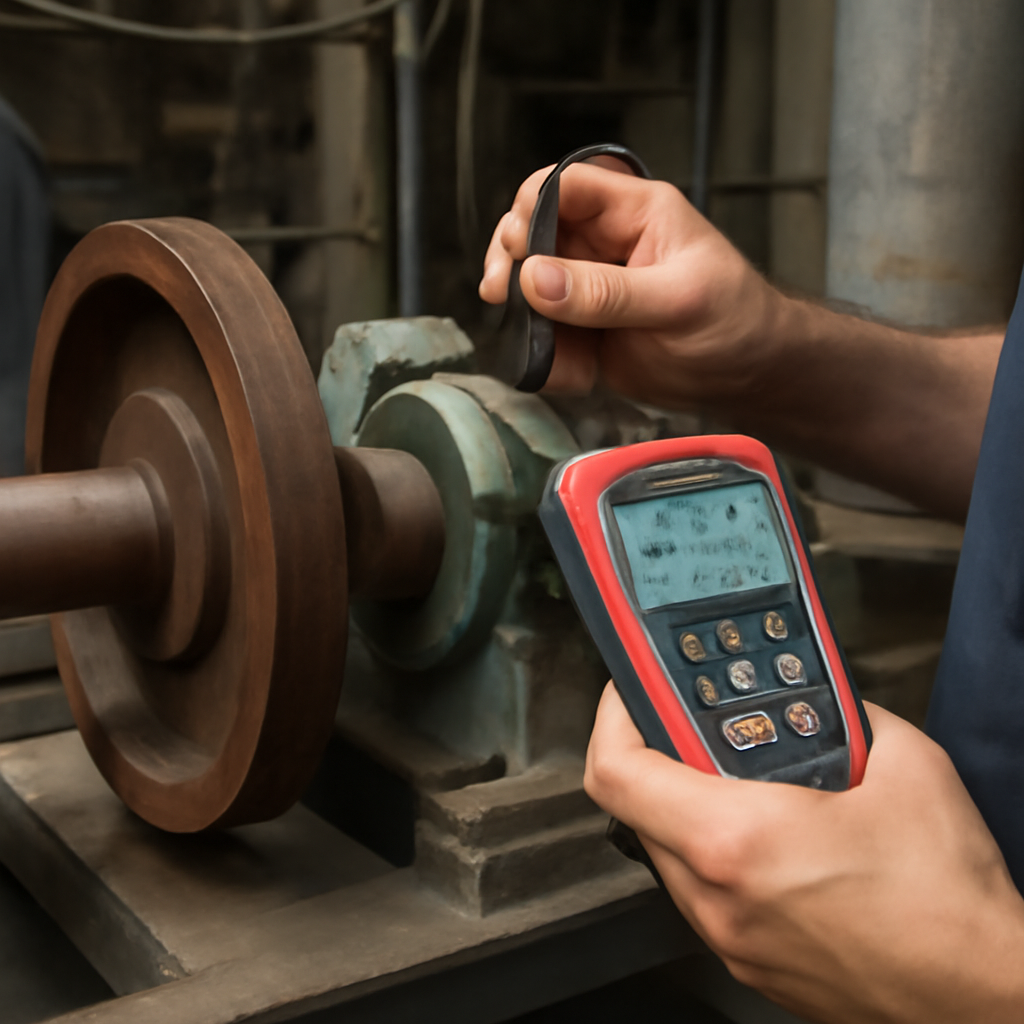
Field diagnosis of a failing bearing should be fast, structured and repeatable. Most issues fall into a small number of patterns that can be identified in under ten minutes with a stethoscope, an IR thermometer, and a vibration meter. Here is the protocol.
Minute 0-1: Visual
- Walk around the asset. Look for oil leakage, grease migration, discoloration of the housing, signs of recent overheating.
- Check the bearing housing fasteners — loose or missing bolts are a real cause of seemingly mysterious failures.
- Look at the coupling: signs of wear, broken bolts, scoring on hubs point at misalignment.
Minute 1-3: Audible
With a chassis-mounted mechanical stethoscope or ultrasonic stick on the housing:
- Smooth uniform hum → bearing is healthy.
- Intermittent ticking → likely localised raceway defect (Stage 2-3).
- Continuous gritty noise → contamination ingress or advanced wear (Stage 4).
- Squeal or scream → lubrication starvation or severe overload.
- Knocking → cage damage or rolling element failure (late stage).
Minute 3-5: Thermal
IR thermometer scan of the housing:
- Establish or recall the healthy baseline.
- Any sustained 10 °C rise above baseline is significant.
- Map the temperature gradient across the housing — asymmetric (one end hotter) points at misalignment or skewed loading.
Minute 5-8: Vibration
Handheld vibration meter, radial and axial readings on the housing:
- Overall RMS reading: compare to baseline. Doubling = significant degradation.
- If FFT available: look for peaks at the bearing defect frequencies (BPFO, BPFI, BSF, FTF).
- 2× shaft speed peaks → misalignment.
- 1× shaft speed peaks → unbalance.
- Sidebands around defect frequencies → advanced raceway defect.
Minute 8-10: Decision
Based on the readings, the action falls into one of four categories:
- No action: baseline normal, no signs of distress. Continue monitoring.
- Lubricate: noise + temperature elevated but no defect frequencies. Re-grease and re-check in 30 minutes.
- Align or rebalance: 2× or 1× peaks elevated. Schedule corrective action.
- Replace: defect frequencies present, broadband noise rising, temperature trending up. Plan replacement at the next available outage.
Field stethoscope cheat sheet
- Healthy bearing: faint, uniform hiss.
- Early outer race defect: faint periodic click at BPFO frequency.
- Early inner race defect: similar to outer race but modulated by shaft rotation.
- Cage defect: low-frequency thumping at FTF.
- Severe damage: continuous broadband noise.
The cheap toolkit
For under €500 you can equip a maintenance technician with the full diagnostic capability:
- Mechanical or electronic stethoscope: €30-80.
- IR thermometer: €40-100.
- Handheld vibration meter (overall RMS): €150-400.
- Optional FFT-capable meter: €600-1200.
The 2026 enabler: AI assist
Several condition monitoring platforms now offer mobile apps where a technician records 30 seconds of vibration, the cloud-based AI processes it and returns a diagnosis with severity rating in under a minute. The 10-minute protocol is becoming a 2-minute protocol for plants that deploy these tools.
Conclusion
Most bearing diagnoses do not need a vibration engineer with a $20,000 analyser. The 10-minute protocol, executed consistently with €500 of tools, catches the vast majority of issues early enough to plan rather than react. Make it part of the maintenance routine.
The 2026 reliability investment thesis
For European industrial customers in 2026, the broader reliability investment thesis is decisive. The combination of affordable IoT sensors (under $50 per node, an 85% cost reduction since 2019), mature AI analytics platforms, documented ROI cases (6-18 month payback in mid-size plants), and supplier ecosystem support makes condition monitoring deployment economically realistic for virtually any plant with critical rotating equipment. The cumulative effect across years of deployment is meaningful: 30-50% reduction in unplanned downtime, 15-25% reduction in maintenance labour, and extended equipment service life.
For procurement leadership specifically, the reliability investment changes the supplier relationship dynamic. Bearing supply becomes part of an integrated reliability conversation rather than a transactional component supply. Engineering services, condition monitoring platforms, training programmes, and roadmap visibility all flow from strategic supplier relationships. The companies building these relationships now position themselves for the post-2028 industry structure where smart bearings and integrated reliability solutions become standard rather than premium.
What the next 18 months will tell us
The next 18 months will clarify several major industry questions. NSK + NTN antitrust filings progress through Q3-Q4 2026 will reveal the regulatory burden and possible remedies. SKF Automotive spin-off mechanics will be confirmed, with implications for both the SKF industrial businesses and the new standalone automotive entity. Schaeffler Yinchuan capacity ramp will reach steady-state output, affecting standard catalogue lead times and pricing dynamics. EU industrial demand recovery will be tested through H2 2026 and into 2027.
For organisations operating in this environment, active engagement with these developments — through industry events, supplier conversations, and trade press monitoring — supports informed strategic decisions. The bearing industry in 2026-2027 is not on autopilot; the strategic decisions made during this period set competitive positioning for years to come.
Industry consolidation effects on the European market
The European bearing market in 2026 is experiencing one of the most active consolidation periods in three decades. NSK and NTN signed a Memorandum of Understanding on 12 May 2026 to integrate by October 2027, creating a combined entity that will challenge SKF and Schaeffler for the global #1 position. SKF announced and is operationally preparing the separation of its Automotive business under a new three-segment structure (Bearing Solutions, Specialized Industrial Solutions, Automotive). Schaeffler completed major capacity expansion at its Yinchuan (China) facility, doubling manufacturing capacity for high-volume FAG deep groove ball bearings. SKF acquired G-Tech Instruments in March 2026, deepening condition monitoring capability.
For European industrial customers, these consolidation effects translate into specific operational implications. Lead times on standard catalogue ranges should normalise through H2 2026 as the Yinchuan capacity reaches steady-state output. Framework agreement negotiations should incorporate the consolidation context, with provisions for SKU continuity, substitution rights, and engineering support continuity through the transition period. Multi-supplier qualification becomes more important as the industry restructures around fewer larger entities.
Raw material costs and pricing dynamics
Bearing pricing dynamics in 2026 reflect several converging cost drivers. US steel tariffs at 50% (in force since June 2025) reshape global trade flows, with Asian bearing exporters redirecting volume away from the US into Europe and other markets. Bearing-grade alloy premiums continue to widen as demand for cleaner steel chemistry grows faster than supply. EU regulatory developments (CBAM, REACH SVHC updates, steel safeguards) add complexity to import economics.
For procurement teams, the practical posture is active engagement with these dynamics. Lock pricing on top-50 SKUs in framework agreements where leverage exists. Build steel-cost adjustment mechanisms into multi-year contracts rather than fixed pricing. Verify customs classifications carefully — the difference between an HS code that captures CBAM and one that does not can be material. Document supplier origin certifications for preferential trade agreement benefits.
The smart bearing transition and procurement implications
The bearing industry’s transition from component supply to integrated reliability platform delivery represents the defining strategic shift of the decade. Every major manufacturer (SKF Insight, Schaeffler OPTIME, NSK SAT, NTN smart bearing platforms) has built or acquired platform capability. The integrated offering combines instrumented bearings, cloud analytics, AI-based anomaly detection, prescriptive workflow integration, and integrated services.
For procurement leadership, the smart bearing transition reshapes the supplier evaluation criteria. Beyond bearing specifications and pricing, evaluation now includes platform capability, integration with existing CMMS and ERP systems, data ownership and portability terms, and ongoing software roadmap visibility. The platform commitment is multi-year — selecting a smart bearing platform is more consequential than selecting a bearing brand because the platform decision is harder to reverse.
Condition monitoring deployment economics in 2026
The deployment economics for IoT-based condition monitoring in 2026 are particularly favourable for European mid-size industrial plants. Sensor hardware costs have collapsed (under $50 per node, 85% reduction since 2019). Cloud platforms have matured into turnkey SaaS offerings with predictable subscription pricing. AI analytics layer adds capability that human analysts alone cannot match. Documented payback periods converge on 6-18 months for typical deployments.
For a mid-size plant with 50-100 critical assets, deployment economics typically run: €15,000-30,000 first-year capex for sensors, gateways, and integration; €10,000-20,000 annual recurring for cloud platform and ongoing services. Total 5-year cost: €55,000-130,000. Documented savings: 30-50% reduction in unplanned downtime, typically valued at €100,000-500,000 annually. The capital justification is straightforward; the organisational change to operate alongside the technology is the actual implementation challenge.
Looking ahead through 2030
The bearing industry continues structural evolution through the rest of the decade, driven by EV adoption acceleration, wind energy expansion, industrial robotics growth, humanoid robotics commercialisation, and smart bearing technology maturation. The market projection from $151.8B in 2026 to $301B by 2033 reflects these structural drivers operating in parallel. For European industrial customers, positioning the procurement strategy for this evolution now, rather than reacting in 2028, is the strategic foundation for competitive operational performance through the coming decade.
Final note for 2026 procurement
The cumulative effect of disciplined procurement practice — supplier substitution agility, framework pricing locks, condition monitoring capability, smart bearing qualification, and master data discipline — compounds across years of execution. Organisations that build this capability now position themselves to outperform through the bearing industry consolidation period; the strategic window for proactive positioning is open through 2026 with diminishing returns thereafter.
Related guides
- How to Detect Bearing Wear
- How to Address Bearing Overheating
- Misalignment Diagnosis
- AI Replacing Manual Vibration Analysis
- IoT Vibration Sensors Under $50
Need help with bearing selection? Our team supports you with cross-references and lead-times.