
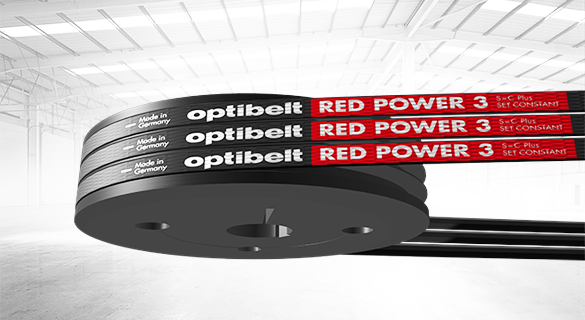
In the world of industry and automation, choosing the right power transmission belts is essential to ensure high performance, energy efficiency, and reduced maintenance costs. OPTIBELT, a leader in the sector, is synonymous with reliability and durability, offering power transmission solutions for a wide range of industrial and automotive applications.
In this article, we will explore the advantages of OPTIBELT belts, their main applications, and why they are the best choice for your business.
Why Choose OPTIBELT Belts?
OPTIBELT transmission belts are designed with high-quality materials and cutting-edge technologies, offering numerous advantages:
✅ Maximum reliability – Withstand extreme operating conditions, ensuring consistent performance over time.
✅ Superior durability – Innovative materials reduce wear and extend the service life of the belts.
✅ Energy efficiency – Optimize power transmission, reducing waste and consumption.
✅ Low maintenance – High-quality construction reduces the need for frequent replacements, lowering operational costs.
OPTIBELT belts are designed to tackle complex industrial challenges and ensure flawless operation even under high mechanical stress conditions.
Types of OPTIBELT Belts and Their Applications
OPTIBELT offers a wide range of belts for various industrial applications. Here are the main categories:
1. V-Belts
OPTIBELT V-belts are known for their wear resistance and efficient power transmission. They are used in sectors such as:
🔹 Manufacturing industry
🔹 Automotive
🔹 Transport and material handling systems
2. Timing Belts (Synchronous Belts)
OPTIBELT timing belts offer precise, slip-free power transmission. Ideal for:
🔹 CNC machines and tools
🔹 Automation systems
🔹 Pharmaceutical and food industry
3. Poly-V Belts
Poly-V belts combine the flexibility of V-belts with the strength of timing belts. They are ideal for:
🔹 Compressors and pumps
🔹 HVAC systems
🔹 Agricultural and construction machinery
4. Custom-Made Special Belts
OPTIBELT also offers custom solutions, designed to meet specific industry needs, ensuring maximum performance and reliability.
Competitive Advantages of OPTIBELT Belts
1. High-Performance Materials
OPTIBELT belts are made from advanced rubber compounds, fiberglass or steel cords, and wear-resistant coatings, ensuring a longer lifespan compared to standard products.
2. Resistance to Extreme Conditions
These belts are designed to operate in harsh environments, with high temperatures, aggressive chemicals, and heavy loads.
3. Stable Performance Over Time
Thanks to precise construction and rigorous quality controls, OPTIBELT belts maintain consistent performance, reducing unexpected failures.
4. Reduced Maintenance Costs
Long service life and high wear resistance mean fewer machine downtimes and lower replacement costs.
Industrial Applications of OPTIBELT Belts
OPTIBELT transmission belts are used in numerous industries, including:
🔹 Automotive industry – For engines, alternators, and cooling systems.
🔹 Manufacturing sector – For conveyor belts, precision machinery, and pumps.
🔹 Agriculture and construction – For tractors, harvesters, and irrigation systems.
🔹 Energy and industrial plants – For turbines, generators, and compressors.
Thanks to their versatility and excellent performance, OPTIBELT belts are a benchmark for those seeking reliability and long-term durability.
Conclusion
OPTIBELT belts are the ideal solution for those seeking quality, efficiency, and longevity in power transmission applications. Whether you operate in the industrial, automotive, or agricultural sector, relying on OPTIBELT means ensuring maximum reliability for your equipment.
🔧 Want to improve your power transmission system’s performance?
📲 Visit our website to discover the full range of OPTIBELT belts and find the perfect solution for your business!
Related Reading
- CRAFT Ball Bearings: A Cost-Effective Standard
- SKF Y-Bearings (Insert Bearings): Selection Guide
- THK Linear Bearings: Premium Choice or Overkill?
- Bosch Rexroth Linear Motion Systems Overview 2026
- Loctite Threadlockers: Industrial Use Guide 2026
Need help with bearing selection?
Our Euro Bearing technical team helps engineers and maintenance managers choose the right bearing, seal or linear component for each application — from automotive transmissions to agricultural machinery and industrial robotics. Tell us your operating conditions (load, speed, temperature, environment) and we will recommend the optimal solution from our catalogue of premium European bearings.
Contact our technical office → or browse the full product range.
Where OPTIBELT Fits in the Power Transmission Landscape
Belt drives remain one of the most economical ways to transmit power between parallel shafts. They tolerate small misalignments, damp shock loads, need no lubrication, and — unlike a chain or a gear train — they fail gracefully and audibly rather than catastrophically. OPTIBELT has built its reputation in this segment on two things: consistent manufacturing tolerances, which is what actually determines whether a set of belts shares load evenly, and a product range broad enough to cover almost every industrial drive from a small fan to a heavy crusher.
For a maintenance engineer, the practical consequence is straightforward. A belt that holds its length tolerance can be replaced as part of a matched set without re-tensioning the whole drive; a belt whose cord is properly bonded to the rubber body does not delaminate under shock; and a compound that resists heat and ozone keeps its elasticity through the summer. These are unglamorous properties, and they are exactly what determines whether the drive runs for five years or five months.
The Main Belt Families and When to Use Them
Classical and narrow V-belts. The workhorse of industrial drives. Narrow-section wedge belts (SPZ, SPA, SPB, SPC) transmit substantially more power than classical sections of comparable width, because the deeper wedge shape increases the contact area against the pulley flanks. For most new installations, narrow section is the correct default.
Cogged (raw-edge) V-belts. The notched underside allows a much smaller minimum pulley diameter and runs cooler, because the belt flexes with less internal heat generation. Choose these for compact drives and high-speed applications.
Banded / joined belts. Several V-belts joined by a common backing. The right choice where the drive is subject to shock loads or pulsation that would otherwise make individual belts jump out of their grooves.
Timing (synchronous) belts. Where the drive must maintain an exact phase relationship — pumps, conveyors with indexing, printing, packaging — a toothed belt eliminates slip entirely. Modern high-performance profiles carry loads that once required a chain, without the lubrication and the noise.
Ribbed (Poly-V) belts. A thin, flexible belt with multiple longitudinal ribs. Excellent for high-speed, small-diameter drives, and for serpentine layouts with multiple driven components.
Flat and special belts. Niche but valuable where very high speeds or very small pulleys are involved.
Getting the Drive Right: Tension, Alignment, Pulleys
More belts are killed by installation than by wear. Three variables dominate.
Tension is the first. An under-tensioned belt slips, and slip generates heat that cooks the rubber and glazes the flanks — the belt then slips more, and the drive spirals into failure. An over-tensioned belt destroys the bearings on both shafts, and radically shortens their fatigue life. The correct approach is to measure, not to judge by feel: a frequency (sonic) tension meter reads the natural frequency of the belt span and converts it directly into tension, and it takes seconds. Re-check the tension after the first 24 to 48 hours of running, when the belts have seated.
Alignment is the second. Angular or parallel misalignment of the pulleys forces the belt to run against one flank, wearing it asymmetrically and generating heat and noise. A laser alignment tool for pulleys costs little and pays for itself immediately. The mechanism is the same one that destroys bearings — see our article on how to address misalignment, because a misaligned belt drive is loading the shaft bearings abnormally as well.
Pulley condition is the third and the most frequently ignored. A worn groove lets the belt sit too deep, reducing the contact area against the flanks and causing slip no amount of tension will fix. Check grooves with a profile gauge at every belt change; fitting new belts to worn pulleys wastes both.
Diagnosing a Failing Belt
- Glazed, shiny flanks: slip. Check tension and pulley wear.
- Cracking on the underside: heat, age, or a pulley below the minimum diameter for that section.
- Asymmetric flank wear: misalignment.
- Cord protruding / delamination: shock load, or a foreign object in the drive.
- Belt turnover in the groove: misalignment, worn grooves, or excessive vibration.
- Squeal on start-up: insufficient tension.
Because the belt drive and the bearings it loads are a single mechanical system, belt inspection belongs in the same routine as bearing inspection. Our guide to preventive inspections sets out how to structure it, and a hot bearing on a belt-driven shaft is often the first sign that the belt tension is wrong — see bearing overheating.
Practical Selection Checklist
- Define transmitted power, driver and driven speeds, and the service factor for the duty (shock loads matter more than nominal power).
- Select the belt section from the power/speed chart, then verify that neither pulley falls below the minimum recommended diameter for that section.
- Check the centre distance and the arc of contact on the smaller pulley — below about 120° you lose grip fast.
- Choose the profile family: cogged for compact drives, banded for shock, synchronous where slip is unacceptable.
- Specify a tension meter and an alignment tool as part of the installation, not as an afterthought.
Euro Bearing supplies the full OPTIBELT range alongside bearings, seals and linear components, which means a single drive can be specified, sourced and cross-referenced from one supplier — pulleys, belts, bearings and seals together.
Need help with bearing selection? Our team supports you with cross-references and lead-times. Contact our specialists →