
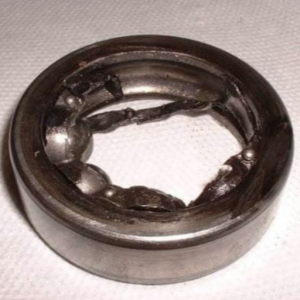
One of the main issues affecting bearings is overheating. This problem, as one might expect, is primarily caused by prolonged exposure to an external heat source or insufficient heat dissipation. Additionally, excessive bearing overheating can result from inadequate lubrication or the absence of an effective cooling process for these components.
But what happens when bearings “suffer” from excessive heat? And what can be done to prevent damage to the entire system?
What Happens When Bearings Overheat
When bearings become excessively overheated, a range of consequences can arise. Not all of these will occur with the same frequency, as much depends on the severity of the factor causing the overheating and the specific characteristics of the bearing.
Given the potential risks posed by an overheated bearing, it is essential to familiarize yourself with the possible outcomes. One of the most noticeable signs is the discoloration of the outer rings, rolling elements, and cages. This color change is a key indicator of overheating and can range from yellow to orange, red, or even blue, depending on the intensity of the heat exposure.
As intuitive as it may seem, changes in external appearance are not the only consequences of overheating. Bearings exposed to temperatures beyond their tolerance limits—often above 200°C—can experience reduced hardness and load capacity, leading to a higher risk of premature failure. In extreme cases, overheating may even cause deformation of the bearing.
The lubricant used with the bearing is also at risk. Excessive heat can degrade or destroy the lubricant, further compounding the problem.
What to Do If You Suspect Bearing Overheating
If bearing overheating is suspected, the best practice is to halt the operation of the system where the bearings are installed and have it inspected by an expert technician. The consultant will perform both stationary and dynamic checks to determine whether the bearing is indeed overheating. They will then identify the source of the excessive heat affecting the component.
Once the root cause of the overheating is identified, efforts should be made to eliminate it and improve heat dissipation. This is crucial not only to prevent further damage to the bearings but also to protect the entire system in which they operate.
If the bearings have already been damaged by overheating, there’s no need to worry. At Cuscinetti & Componenti, you’ll find high-quality products from the best brands for any type of system. With fast delivery, unbeatable prices, and our renowned pre- and post-sales support, we’re here to help. What are you waiting for?
Related Reading
- How to Prevent Bearing Contamination in High-Intensity Production
- Bearing Failure Modes: A Visual Identification Guide
- Bearing Removal Without Damage: Tools You Actually Need
- How to Diagnose a Failing Bearing in Under 10 Minutes
- Bearing Damage: Misalignment Diagnosis and Practical Remedies
Need help with bearing selection?
Our Euro Bearing technical team helps engineers and maintenance managers choose the right bearing, seal or linear component for each application — from automotive transmissions to agricultural machinery and industrial robotics. Tell us your operating conditions (load, speed, temperature, environment) and we will recommend the optimal solution from our catalogue of premium European bearings.
Contact our technical office → or browse the full product range.
What “Too Hot” Actually Means for a Bearing
Every rolling bearing generates heat. Rolling friction, sliding at the cage contacts, churning of the lubricant and seal friction all convert a small fraction of the transmitted power into thermal energy. In a healthy installation this heat is carried away by the shaft, the housing and the lubricant, and the bearing settles at a stable operating temperature — typically 30 to 50 °C above ambient for a well-designed industrial application. Overheating is therefore not an absolute temperature but a deviation: a bearing that has always run at 65 °C and now runs at 90 °C is telling you something, even though 90 °C is not, in itself, a catastrophic value.
The reason temperature matters so much is that it attacks the bearing on three fronts at once. It collapses the viscosity of the lubricant, thinning the elastohydrodynamic film that separates rolling elements from raceways. It accelerates oxidation of the grease, shortening its useful life roughly by half for every 10 to 15 °C of additional temperature. And above roughly 120 °C it begins to affect the dimensional stability and hardness of standard through-hardened bearing steel, unless the rings have been specially heat-stabilised. Once the lubricant film breaks down, metal-to-metal contact begins and the failure becomes self-accelerating: more friction, more heat, less film, more friction.
The Five Root Causes You Will Actually Find
1. Lubrication faults. This is the largest single category. Too little grease starves the contact; too much grease causes churning and a dramatic rise in temperature — a classic mistake after a relubrication. The wrong base oil viscosity for the speed and load, or a grease that has already oxidised past its service life, produces the same result. Our guides on grease lubrication for bearings and how oil lubrication works cover the selection and interval logic in detail.
2. Excessive preload or an incorrect fit. A bearing mounted with too much interference, or a housing that has closed up on the outer ring because of thermal expansion, removes the internal clearance the bearing needs to operate. The rolling elements are squeezed, friction rises and the temperature climbs until the bearing seizes. This is a design and mounting problem, and it is the reason internal clearance classes (C3, C4) exist for hot applications.
3. Misalignment. A misaligned bearing concentrates the load on a fraction of the raceway and runs measurably hotter than its healthy twin. If you have an asymmetric temperature reading between the drive-end and non-drive-end bearing of the same machine, read our article on how to address misalignment before you touch the lubricant.
4. Overload and over-speed. Running a bearing beyond its dynamic load rating, or above the reference speed for the selected lubricant, produces heat that no amount of grease will remove. So does an unbalanced rotor, a belt tensioned far beyond specification, or a process fault that loads the machine abnormally.
5. Contamination and inadequate sealing. Abrasive particles increase friction directly and destroy the lubricant film indirectly. Water contamination is worse still, because it strips the additive package and promotes corrosion. The seal is the bearing’s first line of defence; our overview of sealing ring and oil seal materials explains how to match the seal to the environment.
A Diagnostic Routine That Works in the Field
Do not start by adding grease — that is the single most common way to make an overheating bearing worse. Start by establishing the baseline: what did this bearing run at when the machine was healthy? Then take an infrared survey of both bearings on the shaft and of the housing itself; an asymmetric profile points to alignment or fit, a symmetric rise points to lubrication, load or speed.
Next, run a vibration measurement. High-frequency envelope or acceleration-enveloping signatures reveal whether the raceways are already damaged, while a dominant 2X axial component points back to misalignment. Sample the lubricant if the machine is oil-lubricated: viscosity, water content, oxidation and particle count will usually name the culprit outright. Only when the mechanical and lubrication evidence has been collected should you intervene — and then intervene on one variable at a time, so you can tell which change worked.
Corrective and Preventive Measures
- Re-specify the lubricant for the actual operating temperature and speed factor, not the one on the original drawing. For sustained high temperatures, consider synthetic base oils and heat-stabilised bearing steel.
- Correct the grease quantity. As a rule of thumb, fill the bearing cavity fully but the housing only 30–50 % for medium speeds, and less for high speeds.
- Re-check internal clearance. Move to C3 or C4 where the temperature difference between inner and outer ring is significant.
- Improve heat removal — cooling fins, oil circulation, or a housing with better thermal conductivity — before you accept a permanently hot bearing.
- Trend the temperature rather than alarm on an absolute threshold. A rising trend is actionable weeks before an alarm would trip.
Where the application is genuinely hot by nature — furnaces, kilns, hot-gas fans, foundry equipment — the answer is component selection rather than firefighting. Our guide to choosing the right bearing for high-temperature environments sets out the material, clearance and lubricant decisions that make a hot application reliable. And in all cases, a disciplined inspection routine — as described in our article on preventive inspections — catches the temperature drift long before the seizure.
Frequently Asked Questions
Is 80 °C too hot for a bearing? Not necessarily. Standard bearing steel and lithium-complex greases operate comfortably at that level. What matters is whether 80 °C is normal for that machine: a stable 80 °C is fine, a rise from 55 °C to 80 °C is a fault.
Can I just add more grease to a hot bearing? No. Over-greasing is itself one of the most frequent causes of overheating, because the rolling elements have to churn through the excess lubricant. Diagnose first, then act.
How quickly does heat shorten grease life? As a working rule, grease service life halves for every additional 10–15 °C above the reference temperature. A bearing running 25 °C hot is consuming its lubricant roughly three to four times faster than designed.
When should I move to a C3 or C4 clearance? Whenever the inner ring runs significantly hotter than the outer ring — typically with a hot shaft, a hot process fluid, or an interference fit on both rings.
Need help with bearing selection? Our team supports you with cross-references and lead-times. Contact our specialists →