
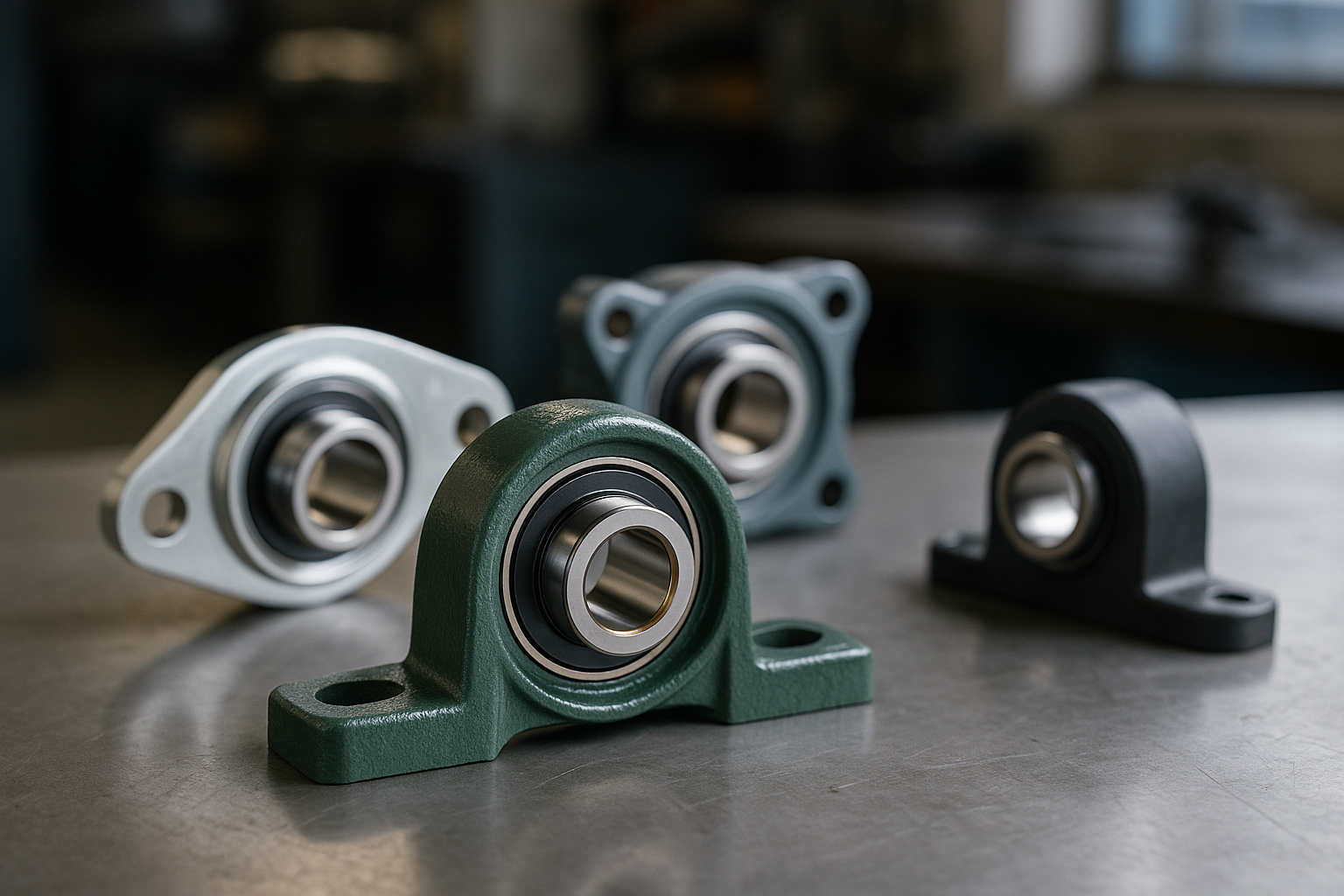
A screw conveyor in a feed mill goes through three housed units a year on the same position. Each replacement is a like-for-like of whatever the last one was, bought on price because it keeps failing anyway, and the circular logic is never broken. Somewhere in that loop is a specification decision that was made once, probably by whoever built the conveyor, and has never been revisited. Pillow block bearing units are the most commonly specified and least deliberately chosen component in general industry, precisely because they are cheap, available everywhere, and dimensionally interchangeable across a wide range of quality levels. That interchangeability is exactly what allows a poor choice to persist: the wrong unit fits perfectly and fails quietly, and the replacement inherits the same mistake.
What a housed unit is really for
A housed bearing unit exists to let a shaft be supported on an ordinary fabricated or machined structure without anybody having to produce a precision bore. That is the entire value proposition, and it explains every design feature. The insert has a spherical outside diameter that seats in a matching spherical seat in the housing, so the bearing can swivel and accommodate the angular misalignment that inevitably exists between two mounting surfaces bolted to a piece of fabricated steelwork. The bore is usually a clearance or light transition fit rather than an interference fit, with the shaft gripped by grub screws, an eccentric collar or a tapered sleeve, so that ordinary commercial drawn shaft can be used without grinding. The result is a component that can be installed by a fitter with a spanner rather than a machinist with a press, which is why they appear in their thousands on conveyors, fans, agitators and agricultural equipment. The trade-off is that every one of those conveniences is also a compromise on load capacity, speed and precision.
Cast iron, pressed steel and composite
Housing material is the first real decision. Grey cast iron is the default for good reason: it is rigid, it damps vibration well, it machines to a consistent spherical seat, and it has enough section to survive being over-tightened by an enthusiastic fitter. Its weaknesses are brittleness under impact and corrosion in wet environments. Pressed steel housings are lighter, cheaper and far more tolerant of impact, but they are flexible, which means the spherical seat deflects under load and the unit cannot support the loads a cast housing of the same bore can. They belong on light-duty, low-load positions and are frequently found carrying loads they were never meant for. Composite and thermoplastic housings solve the corrosion problem outright and are the sensible answer in washdown and chemically aggressive environments, at the cost of temperature capability and stiffness. Ductile iron and cast steel exist above grey iron for heavy shock duty, and on a crusher discharge or a heavy screen they are worth the premium, for the reasons set out in our piece on sizing for shock loads.
The insert: grub screw, eccentric collar or adapter sleeve
How the insert grips the shaft matters more than almost any other single choice, and the three common methods have clearly different behaviour. Two grub screws at 120 degrees are the cheapest and by far the most common, and they work adequately where rotation is unidirectional and loads are moderate, but they grip at two points only, they mark the shaft, and they loosen under vibration or reversing duty. An eccentric locking collar grips around a larger arc and resists loosening better in one direction of rotation, but it locks in one direction only, so fitting one for a reversing drive is a mistake that produces intermittent slipping. An adapter sleeve is the best of the three by a wide margin: it grips concentrically around the full circumference, it does not mark the shaft, it tolerates reversing duty, and it allows a proper interference fit on ordinary shaft. It costs more and takes longer to fit, and it needs to be driven up correctly rather than simply tightened, with the removal technique covered in our note on freeing a locked adaptor sleeve.
Self-alignment is a mounting tolerance, not a misalignment cure
The spherical seat in a housed unit is designed to absorb static angular misalignment arising from mounting surfaces that are not perfectly coplanar — typically a couple of degrees at most, and in many designs less. It is a one-time accommodation taken up during installation, not a running joint. If the shaft flexes under load, or the structure moves, or the two housings are misaligned enough that the seat is working continuously, the spherical interface wears and the unit develops play that presents exactly like a failed bearing. This is the single most common reason a position eats housed units: the structure is not stiff enough, or the two supports are not in line, and the bearing is being asked to articulate on every revolution. Diagnosing it is straightforward — a worn spherical seat shows a polished band and often fretting debris, while the bearing insert itself may be in good condition — and the fix is structural rather than a better bearing. Fitting a more expensive unit into a misaligned installation simply buys a slightly longer interval before the same failure.
Sealing is what actually decides service life
In the environments where housed units live — grain, feed, aggregate, soil, washdown — contamination rather than fatigue ends the great majority of them, so the sealing arrangement is the specification detail most worth paying for. A basic pressed steel shield keeps out coarse material and nothing else. A contact lip seal handles dust and light splash. A triple-lip or labyrinth arrangement, often combined with a flinger, is what is required where fine abrasive dust or high-pressure washdown is present, and the difference in service life between the cheapest and the best sealing option on the same nominal bearing can easily be a factor of five. The relubrication path interacts with this: a well-sealed unit that is greased regularly purges contaminant out through the seal, which is the intended behaviour, whereas an under-greased unit lets contaminant travel the other way. Where a position runs in a genuinely hostile environment, specifying the sealing tier deliberately is a far better use of money than upgrading the housing material.
Flange, take-up and the mounting geometry question
The pillow block is only one of the family, and choosing the right geometry avoids a good deal of fabrication. A two-bolt or four-bolt flange unit mounts on a vertical face rather than a horizontal one and is the natural choice where a shaft passes through a bulkhead or a machine frame. A take-up unit runs in a slotted frame so the shaft can be moved axially along the slot, which is what conveyor belt tensioning requires, and using a plain pillow block with slotted holes instead is a common improvisation that works badly because there is no controlled adjustment. Cartridge and piloted flange units locate positively in a machined recess and are used where concentricity matters. The practical advice is to choose the geometry from how the shaft actually needs to be supported and adjusted, not from what the stores happens to hold, because the wrong geometry generates a fabrication job on every installation. A stocked range of bearing inserts for housings covers most combinations without needing the complete assembly in every variant.
Relubrication, or the case for a sealed insert
Most housed units arrive with a grease nipple and an expectation of periodic relubrication, and in a plant with a functioning lubrication route that is the right arrangement, because purging grease is what keeps contamination out. In a plant where the route does not reliably happen — which is most plants, for the positions that are awkward to reach — a sealed-for-life insert on a replacement schedule is more honest and usually cheaper over time than a greaseable unit that gets greased twice in five years. The decision should be made explicitly and marked at the machine, because the worst outcome is a sealed unit that somebody greases anyway, forcing the seal lip open and admitting the contamination it was there to exclude. Where units are on a lubrication route, the interval needs correcting for the heavy contamination and often low speed typical of these positions, which usually shortens it considerably against the chart figure, as set out in our piece on relubrication intervals for real duty.
Breaking the three-units-a-year cycle takes one deliberate hour rather than a better part number. Measure the alignment between the two supports and the deflection of the structure under load, because if either is out of tolerance nothing bought will fix it. Establish whether the failures are contamination or fatigue by looking at what comes out — grey paste and pitted raceways mean sealing, spalling on the load zone means the unit is undersized, play in the spherical seat means alignment. Then specify against the answer: sealing tier for contamination, a larger bore or a heavier housing for load, structural correction for alignment, and an adapter sleeve insert wherever duty reverses or vibrates. The dimensional interchangeability that let the wrong unit persist for years is the same property that makes the right one a straight swap once you know which it is, and the shaft fit logic behind that choice is set out in our piece on shaft and housing fits.
Same position eating housed units? Our team supports European plants and OEMs with housing material, sealing tier and locking method selection, plus inserts stocked separately from complete assemblies. Book a free consultation.