
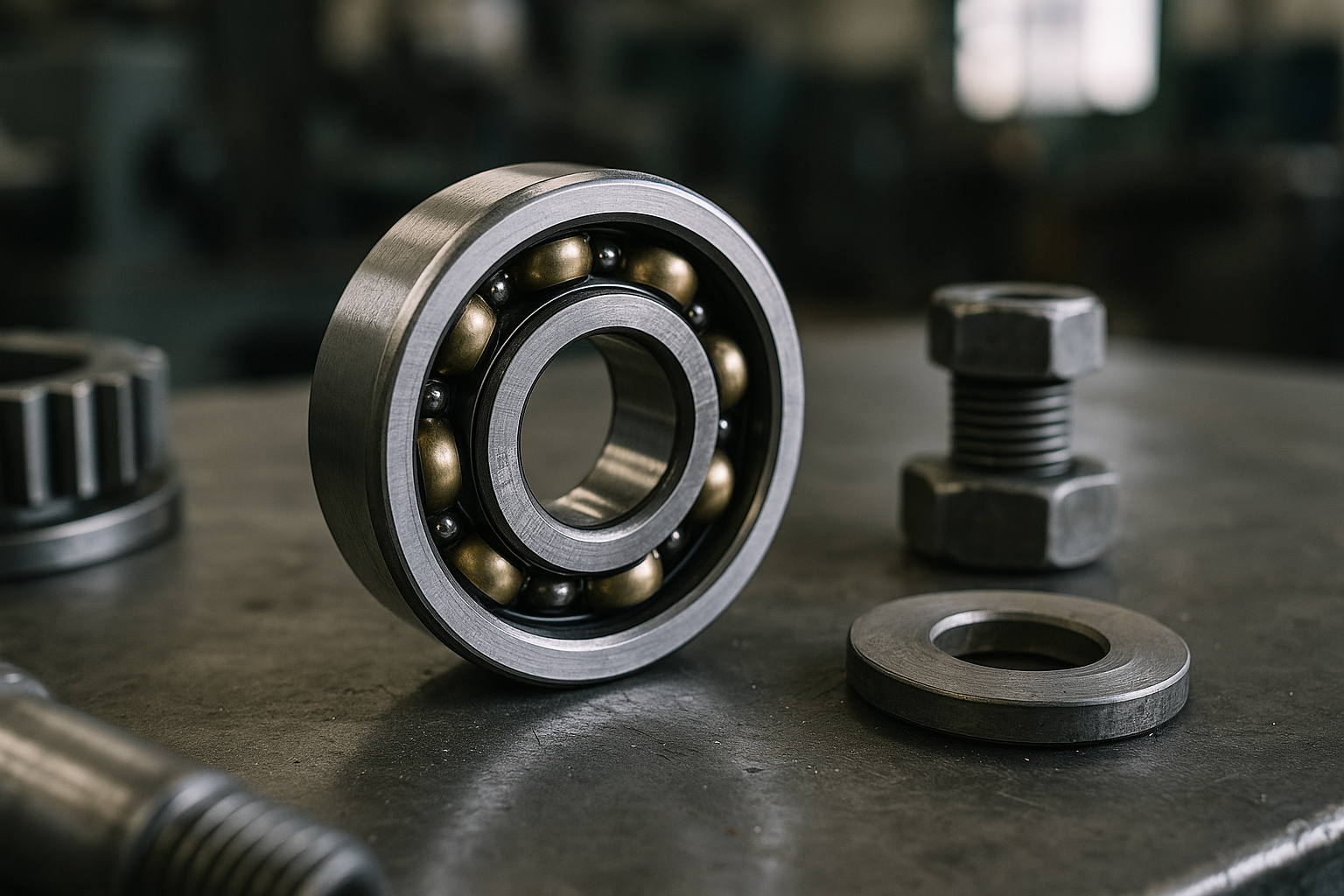
An experienced fitter walks the length of a plant and stops at a pump he has no reason to stop at. He puts a screwdriver handle against the bearing housing, listens for four seconds, and says it will need doing at the next shutdown. Three weeks later the bearing comes out with a spall the size of a grain of rice on the outer ring, exactly as predicted. Nothing mystical happened. Bearing noise diagnosis is a legitimate technique with a physical basis, and while it will never replace a spectrum analyser for trending or for quantifying severity, it is faster than any instrument, it costs nothing, and it works in the places where nobody has installed a monitoring point. Most importantly it is teachable, because each characteristic sound corresponds to a specific mechanism, and once the mechanisms are understood the sounds become readable rather than intuitive.
Why the ear is still a legitimate instrument
Human hearing is extraordinarily good at pattern recognition in exactly the range where bearing defects announce themselves. It detects periodicity buried in noise far better than it detects absolute amplitude, it notices a change in a familiar sound immediately, and it covers a frequency range that spans most bearing defect harmonics. What it cannot do is quantify, trend, or distinguish between two sources at similar frequencies, which is precisely what instrumented monitoring is for. The two techniques are complements rather than rivals: listening tells you which of four hundred machines deserves a measurement, and the measurement tells you how long you have. A mechanic’s stethoscope or a long screwdriver handle pressed against the housing conducts structure-borne sound directly to the ear and cuts out most airborne plant noise, and it should be applied to the bearing housing itself rather than to a guard or a cover, which will ring with everything in the vicinity.
Rumble and growl: the load zone talking
A low-frequency rumble or growl, continuous and slightly irregular, is the commonest and least specific bearing sound, and it indicates general surface degradation across the load zone rather than a single defect. Raceway roughness from contamination, the matt frosted surface left by electrical erosion, and the early stages of widespread fatigue all produce it. Because the sound arises from many small events rather than one repeating impact, it has no clear periodicity and tends to be described as a texture rather than a rhythm. It usually appears gradually over weeks, which is why it is so often normalised: the machine has always sounded like that, as far as anyone currently working there can remember. A useful discipline is to listen to a new or recently replaced bearing on the same machine type and use it as the reference, because the contrast is immediately obvious where the absolute sound is not. Where the rumble is accompanied by darkened grease with a fine metallic glitter, contamination or electrical damage is the likely mechanism, and the latter is covered in our piece on shaft currents and fluting.
A regular click and the arithmetic behind it
A distinct, repeating click or tick is the most diagnostically valuable sound a bearing makes, because it means a discrete defect is being struck at a calculable rate. Every time a rolling element passes over a spall on the outer ring raceway, it generates an impact, and those impacts occur at a frequency determined by the bearing geometry and the shaft speed. The important consequence for a listener is that the rate tells you where the defect is. An outer ring defect produces a steady click at a fixed rate with constant amplitude, because the defect sits in the load zone continuously. An inner ring defect produces a click at a higher rate whose amplitude rises and falls once per shaft revolution, because the defect passes in and out of the load zone as the shaft turns — that amplitude modulation is audible as a pulsing quality and is close to conclusive. A rolling element defect produces a less regular sound at a lower rate, often described as intermittent, because the damaged element strikes both raceways alternately and sometimes sits out of the load zone. Counting the rate roughly against shaft speed is often enough to place the defect before any instrument comes out.
Squeal, chirp and the lubrication signature
High-pitched sounds almost always mean the lubricant film has failed somewhere. A continuous squeal or whine, often at a frequency high enough to be unpleasant, typically indicates a bearing running with insufficient grease or with grease that has hardened and is no longer feeding oil to the contact. An intermittent chirp or birdsong sound, coming and going over seconds or minutes, is characteristic of a cage that is being excited into resonance, which happens with the wrong grease consistency, too much grease, or a bearing running with almost no load. Very light load is an underappreciated cause: a bearing needs a minimum load to make the rolling elements roll rather than skid, and a lightly loaded high-speed bearing will skid, scuff and squeal. The useful test is that lubrication-related noise usually changes immediately when grease is added, while defect-related noise does not change at all, and that single observation separates the two categories in about a minute. What it does not tell you is whether adding grease was the right long-term answer, which depends on the interval calculation set out in our note on relubrication intervals for real duty.
Noise that changes with speed, load or temperature
How a sound responds to a change in operating condition is often more informative than the sound itself. Bearing defect frequencies scale directly with shaft speed, so a defect click will change rate proportionally when the machine is slowed, whereas an electrical hum stays fixed at line frequency and a resonance stays fixed at the structure’s natural frequency. Noise that appears only under load points to a defect in the load zone or to insufficient stiffness in the mounting. Noise that appears only cold and disappears as the machine warms usually indicates excessive internal clearance or a lubricant too viscous at start-up. Noise that appears only when hot and worsens over the run points the other way, toward preload building up as components expand, which is the classic signature of an over-tight fit or a trapped shaft between two located bearings. Running the machine through its speed range while listening, where the drive allows it, extracts more diagnostic information in five minutes than a static measurement will.
Noise that is not the bearing at all
Before condemning a bearing it is worth ruling out the impostors, because replacing a good bearing teaches everyone the wrong lesson. Electromagnetic noise from a motor is a steady hum at twice line frequency that stops instantly when power is removed, while a bearing continues to make noise during coast-down. Gear mesh noise is a tone at the mesh frequency, much higher than most bearing frequencies, and characteristically pure. Cavitation in a pump sounds like gravel passing through the casing and is a suction-side problem, not a bearing one. A rubbing seal produces a squeal that can be indistinguishable from a lubrication problem but does not respond to greasing the bearing. Coupling problems, loose foundation bolts and belt drive noise all transmit into the bearing housing and are best isolated by listening at several points on the machine and finding where the sound is loudest. A quick coast-down test settles most of this: kill the power and listen as the machine slows, since anything electrical stops immediately and anything mechanical persists and changes pitch.
Turning a sound into a defect frequency
Once a suspicious sound is found, converting the observation into a measurement is straightforward and worth doing on anything important. The bearing defect frequencies — outer race, inner race, rolling element and cage — are calculated from the number of rolling elements, the pitch and element diameters, the contact angle and the shaft speed, and manufacturers publish them or provide calculators for standard references. An envelope or demodulated spectrum from a portable analyser will show peaks at those frequencies long before anything appears in a conventional velocity spectrum, which is what gives vibration monitoring its lead time over listening. The practical workflow is to listen on the round, flag the machines that sound wrong, and measure only those, which keeps the instrumented programme to a manageable size. Setting up that measurement round is less work than most people assume, as described in our piece on building a vibration monitoring route in an afternoon.
When to stop listening and take the machine off line
The judgement that matters is how long a noisy bearing has left, and sound alone answers it poorly, which is the honest limitation of the technique. A few indicators justify immediate action regardless of the diagnosis: a sudden change in character over hours rather than weeks, noise accompanied by a rising temperature trend, audible noise combined with visible grease discolouration or metal particles, and any sound that can be heard over normal plant noise without a stethoscope. A slowly developing rumble on a non-critical machine with a spare can reasonably be scheduled. A newly appeared regular click on a machine with no redundancy, on the other hand, should be treated as a short fuse, because the progression from a detectable spall to a cage failure can be a matter of days once the debris starts circulating. When the bearing does come out, photographing it properly before anything is cleaned preserves the evidence, and the method for that is set out in our note on photographing a failed bearing. Recording the sound description alongside the eventual finding is what turns individual experience into a plant asset, which is the point of the failure master log.
The reason this skill is worth deliberately teaching rather than leaving to accumulate is that it decays with staff turnover and takes years to rebuild by osmosis. A structured version — listen at the housing with a stethoscope, classify the sound into rumble, click, squeal or none, test the response to a speed change and to added grease, and record the result — can be taught in an afternoon and gives a new technician most of the diagnostic value that a twenty-year veteran carries in their head. It will not tell you how many weeks are left, and it should not be asked to. What it will do is point the instrumented programme at the right forty machines out of four hundred, which is the part of condition monitoring that no amount of sensor coverage solves on its own. The bearings that fail unexpectedly are almost never silent beforehand; they are simply unlistened to.
Found one that sounds wrong? Our team supports European plants and maintenance teams with replacement references, clearance class advice and availability when a diagnosis turns into an urgent order. Book a free consultation.