
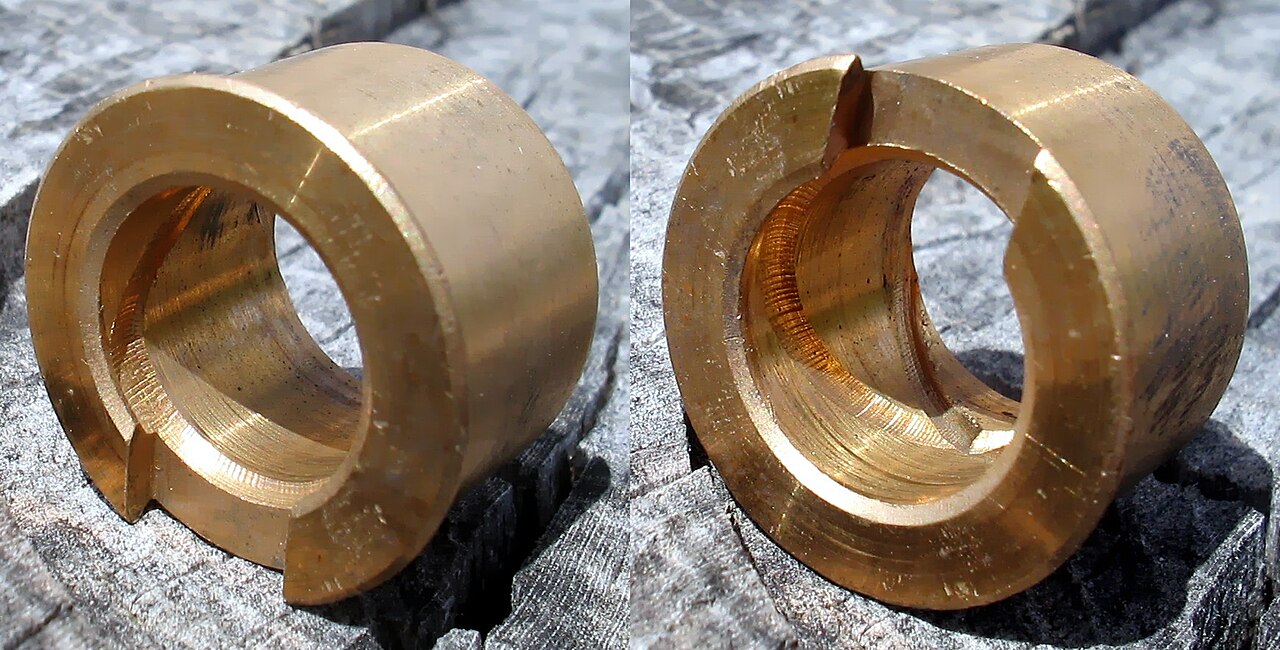
The loader arm on a recycling yard came into the workshop with a pivot that had worn oval in a single season, and the question on the bench was whether to fit the same type again: choosing between bronze vs composite bushings looks like a catalogue exercise, but the worn part told a clearer story. The original was a thin-walled PTFE composite bush, ideal for clean, dry, low-speed oscillation, and it had spent months grinding against sand and impact loads that no sliding layer a few tenths of a millimetre thick can survive. A solid cast bronze bush with a grease groove would have shrugged off the same duty. The reverse mistake is just as common, with a greased bronze bush fitted where nobody will ever lubricate it. Picking the right plain bearing means looking at three things together: the load and how it is applied, the sliding speed, and the maintenance the machine will realistically receive over its life.
PV, specific load and sliding speed
Every plain bearing material is rated with three limits that must be checked separately and then together. The specific load p is the radial force divided by the projected area, bore diameter times bush length, expressed in N/mm² or MPa. The sliding speed v is the surface speed of the shaft in metres per second. The product PV, in MPa·m/s, approximates the frictional heat generated per unit area, and heat is what eventually kills a plain bearing by softening the sliding layer, breaking down oil or accelerating wear. A bush can fail on any of the three: too much load crushes or extrudes the lining, too much speed overheats it even at light load, and a moderate combination of both can exceed the PV limit. Catalogue values for continuous rotation are lower than those for oscillation, because oscillating motion lets the contact zone cool and spreads wear. Static load, the force carried without movement, is a separate rating and usually far higher, which matters for pivots that sit loaded for hours and move only occasionally.
Sintered bronze: self-lubricating for light, fast duty
Oil-impregnated sintered bronze bushes are made by pressing and sintering bronze powder into a porous structure, then vacuum-filling the pores with oil, which typically occupies a significant share of the volume. When the shaft turns, friction warms the bush, oil expands out of the pores and forms a film, and when the shaft stops the oil is drawn back by capillary action. That makes sintered bronze the natural choice for continuous rotation at comparatively high sliding speeds and light loads: small electric motors, fans, office and household machinery, light conveyors. The limitations follow from the same structure. The porous material is weaker than cast bronze, so specific loads are modest and shock loading cracks it. Temperature is limited mainly by the impregnating oil, and once that oil is lost through overheating or washed out, wear accelerates quickly. Reaming the bore after pressing closes the pores, so these bushes are sized to reach their final bore through the press fit in an H7 housing.
Solid cast bronze: the heavy-duty workhorse
Solid bronze bushes, cast or centrifugally cast from tin bronze or leaded gunmetal, sit at the opposite end of the scale. They carry high static and shock loads, tolerate a degree of misalignment by bedding in, and cope with dirt surprisingly well because the relatively soft bronze can embed small hard particles instead of letting them score the shaft. The price for that robustness is lubrication: a solid bronze bush must be greased through a nipple and a lubrication groove, at intervals that match the duty, and run dry it will gall and seize. Sliding speeds are low, which suits pivots, linkages, construction and agricultural equipment, cranes and slow heavy shafts. A typical example is the SKF PBM 405060 M1G1 solid bronze bush, with a 40 mm bore, 50 mm outside diameter and 60 mm length, a wall thick enough to absorb impact and allow re-boring if the housing is worn. The broader plain bushes range includes sizes from small linkage pins upwards.
Between the two extremes sits the wrapped bronze bush, sold in our PRM range. It is rolled from tin bronze strip into a thin-walled cylinder, and the inner surface carries a pattern of diamond-shaped indentations that act as lubrication pockets. Once filled with grease at assembly, those pockets release lubricant gradually, so relubrication intervals stretch considerably compared with a plain bore, and the bush can survive short periods of marginal lubrication. The thin wall saves radial space and weight, which explains why wrapped bronze is common in hydraulic cylinder eyes, agricultural implements, hinges and lifting gear. It shares the dirt tolerance of solid bronze to a reasonable degree, but not its ability to take heavy shock or to be re-machined, because there is very little material to remove. As with any thin-walled bush, the final bore is formed by the housing interference, so housing bore accuracy directly determines running clearance.
PTFE composite: dry running and low friction
The PTFE composite bush, in the PCM..E family, is a three-layer construction: a steel backing for strength, a porous sintered bronze interlayer, and a running surface of PTFE with fillers impregnated into the bronze pores. In service a thin transfer film of PTFE forms on the shaft, giving low and stable friction without any lubricant, and with very little difference between static and dynamic friction, so there is no stick-slip. Specific load capacity at low speed is very high, static ratings run into the low hundreds of N/mm², and the material works over a wide temperature range. That makes PTFE composite bushings excellent for slow oscillating pivots, steering linkages, valves, food and packaging machines and places where grease would contaminate the product. Their weak points are edge loading, because the sliding layer is only fractions of a millimetre thick and a tilted shaft concentrates the load at the bush ends, and abrasive dirt, which rapidly wears through the layer exactly as on the recycling yard loader.
POM composite and the role of initial grease
The POM composite, sold as PCM..M, uses the same steel and sintered bronze backing but replaces the PTFE overlay with an acetal resin layer carrying lubrication pockets. It is designed to be greased on assembly, and that first charge of grease often lasts a long time because the pockets hold it in the contact zone. Compared with PTFE composites, POM types tolerate dirt and edge loading somewhat better and are well suited to marginally lubricated applications in agricultural and construction machinery, but they do not run dry and their upper temperature limit is markedly lower than that of PTFE. Thrust washers from the same family solve the axial side of a pivot: the SKF PCMW 325401.5/M composite thrust washer, 32 mm bore, 54 mm outside diameter and 1.5 mm thick, pairs with a radial bush to carry the shoulder load that otherwise scuffs housing faces. Filament wound bushings, glass fibre and resin with a sliding liner, extend the composite idea to very high loads and corrosive environments.
Housing fit, shaft hardness and surface finish
The material choice only works if the mating parts are right. Thin-walled bushes, whether wrapped bronze or composite, are pressed into a housing bored to H7, and the interference compresses the bush so that the bore closes to its intended size; reaming or honing a PTFE composite after fitting removes the sliding layer and should be avoided. The shaft is typically ground to f7 or h8, giving a running clearance that allows for thermal expansion. Shaft hardness and finish matter more than many fitters expect. For composites and wrapped bronze, a hardened shaft with a fine ground finish, roughly Ra 0.2 to 0.4 µm, extends life considerably, while a soft or rough shaft wears the sliding layer quickly. Solid bronze is more forgiving but still benefits from a hardened pin. For greased bushes, our article on grease compatibility mistakes is worth reading before switching products, because mixing thickeners can soften grease and empty a lubrication groove in weeks.
Choosing by maintenance reality
When the engineering data leaves several candidates, the maintenance regime usually decides. If a machine has an established greasing route and operates in dirt, solid or wrapped bronze is the robust choice, and the interval can be planned with the same logic we describe for relubrication intervals based on real duty cycle. If the point is inaccessible, must stay clean or will never see a grease gun, a PTFE composite is the right answer, provided the pivot is shielded from abrasive particles and the shaft is aligned to avoid edge loads. For continuous light rotation, sintered bronze remains hard to beat on cost. The market for composite materials keeps developing, as our report on the Technymon Fritex composite bearings expansion shows, and SKF offers bronze and composite families in matching dimensions, which makes a like-for-like swap straightforward once the duty has been analysed properly.
The loader pivot from the opening went back into service with a solid bronze bush, a grease nipple and a hardened pin, and the yard added it to the weekly greasing round. That outcome sums up the trade-offs. Sintered bronze serves light loads and higher speeds with built-in oil. Solid cast bronze takes heavy, shock and dirty duty, but only with regular grease. Wrapped bronze saves space and stretches intervals through its lubrication pockets. PTFE composite runs dry with low friction at high load and low speed, yet dislikes dirt and edge loading. POM composite needs that first charge of grease but forgives marginal conditions. Check specific load, sliding speed and PV against the catalogue limits, respect the housing fit and shaft finish, and then let the maintenance the machine will actually receive settle the remaining choice.
Unsure whether a bronze or composite bush suits your pivot? Our team supports maintenance engineers in checking load, speed and PV limits and finding dimensionally interchangeable plain bearings. Book a free consultation.
Image credits: “Boccola Minarelli AM345” by A7N8X (CC BY-SA 4.0), via Wikimedia Commons.