
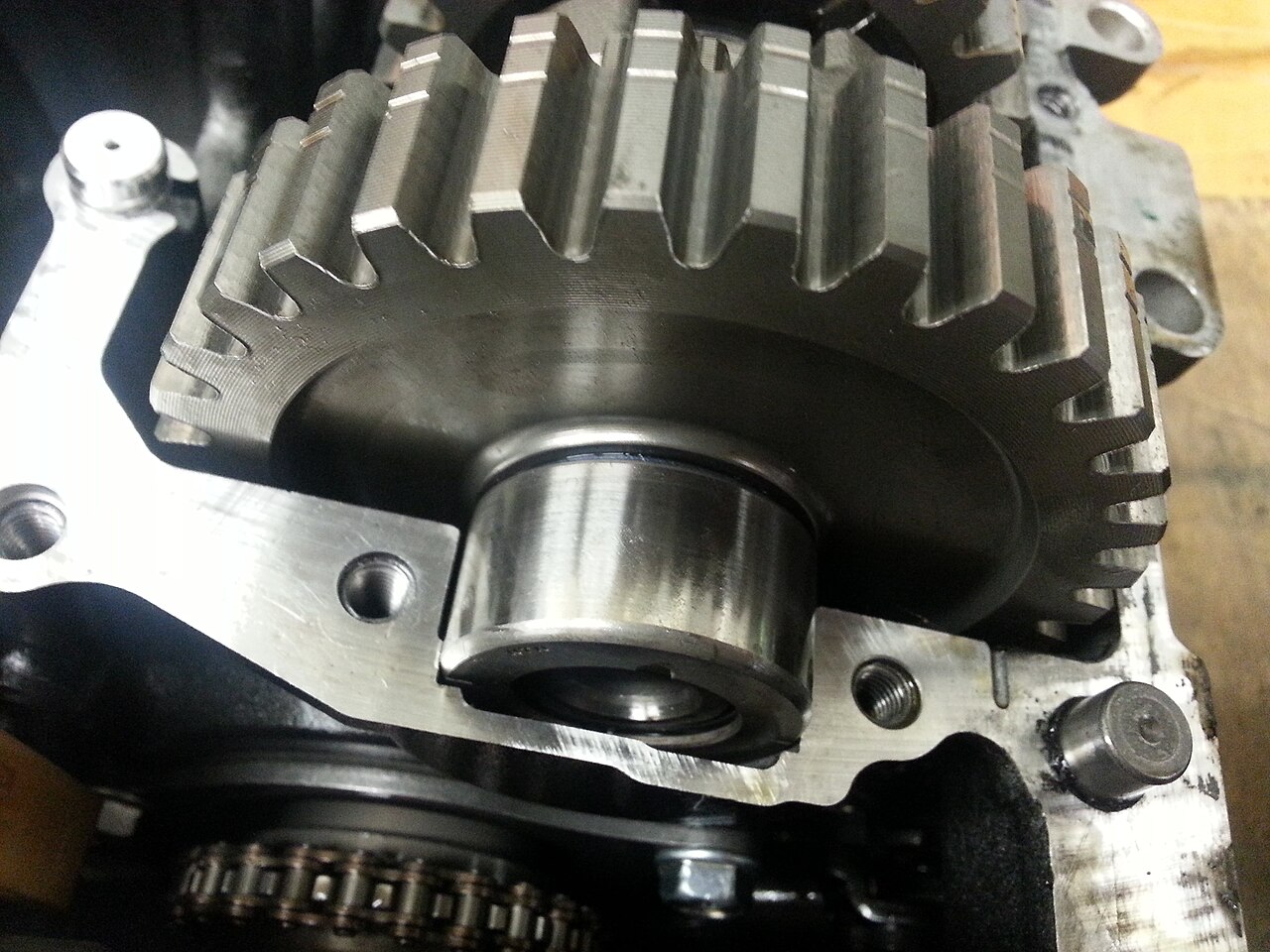
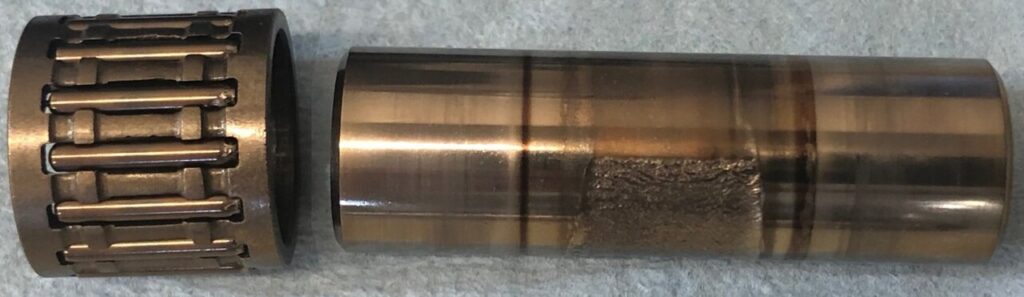
The planetary reduction gear from a slewing drive lay in pieces on the workshop bench, and the fitter counted the loose needle rollers from one planet gear onto a clean cloth: twenty-two needles, two of them noticeably brighter than the rest, most of them blued at the ends, and a pin with a polished track that had started to flake. Nobody had stocked the original bearing because there was no bearing in the usual sense, only a planet gear bore, a hardened pin and a set of needles running between them. Repairing it meant answering questions that a boxed bearing normally answers for you: what hardness and finish the raceways need, which tolerance grade of needle to order, how much end play to leave and how to hold everything in place during assembly. This kind of custom arrangement is everywhere in gearboxes, pumps and joints, and understanding it turns a confusing pile of small parts into a predictable, long-lived bearing position.
Why designers skip the outer ring and the cage
A needle roller arrangement without rings gives the highest load capacity for the smallest radial space of any rolling bearing. When needles run directly between a shaft and a housing bore, every millimetre normally taken by rings is available for the rolling elements, and a full complement of needles, packed with no cage, places as many load-carrying contacts as possible around the circumference. That is why a planet gear can carry a large tooth load on a pin only slightly smaller than the gear root, and why universal joint crosses and rocker arms use the same trick. The trade-offs are equally clear. Without a cage the needles touch each other, sliding at the contact points with opposite surface velocities, so friction is higher and the permitted speed lower than for a caged needle roller bearing. Full-complement sets also depend completely on the quality of the surfaces around them, because the shaft and the bore have become the bearing raceways and inherit every requirement that a ring manufacturer would normally take care of.
Raceway hardness and surface finish
A surface that carries rolling contact must be hard enough to resist the subsurface stresses of Hertzian contact. The standard target for raceways, whether on a shaft, a pin or a housing bore, is 58 to 64 HRC, achieved by through-hardening a bearing steel or by case-hardening or induction-hardening a suitable steel to an adequate case depth. If the hardness falls below that range the load capacity drops sharply, and catalogue ratings for needle rollers are usually quoted with a reduction factor for softer raceways. The raceway must be ground to a fine finish, typically better than Ra 0.2 µm, with good roundness and cylindricity, and free of grinding burn. A track that is wavy or slightly tapered concentrates load on part of each needle length, which leads to the edge flaking seen on the slewing drive pin. Where the housing is the outer raceway, as in a planet gear bore, the gear must be hardened and the bore ground after heat treatment, not just turned.
When the shaft cannot be a raceway: inner rings
Often the shaft simply cannot be hardened and ground. It may be a soft carbon steel, a stainless shaft for corrosion resistance, a long part that would distort in heat treatment, or a refurbished component where regrinding is impossible. That is where needle roller inner rings come in. These hardened, ground sleeves of the IR series are pressed onto the shaft and provide the raceway that the needles or the bearing need. The designation gives the dimensions directly: the IR20X25X38,5 inner ring has a 20 mm bore, a 25 mm raceway diameter and a width of 38.5 mm. The ring is generally wider than the needle set it supports, so axial movement of the shaft does not run the needles off the edge of the hardened surface. Some executions carry a lubrication hole, and many are ground with a slight allowance so that the final raceway diameter can be matched to the clearance required.
Inner rings also solve the most common pairing problem in needle bearing work: combining a ring with a bearing that has no inner ring of its own. Drawn cups, machined needle roller bearings without inner rings and combined radial and thrust units all assume a hardened raceway on the shaft. The NADELLA RAXNZ 525, a combined needle roller bearing, is one example of a unit designed to run directly on a prepared shaft. Where the shaft is soft, an inner ring whose raceway diameter matches the bearing’s specified under-roller diameter provides that surface. The fit of the inner ring on the shaft follows the usual logic of rotating load, normally a light interference, and the clearance in the finished bearing depends on the combination of ring raceway tolerance and the bearing’s inner envelope. Check both catalogue values before ordering, because pairing a bearing with a ring of the wrong raceway diameter is the commonest mistake at the counter.
Needle tolerance grades and why sets must match
Needle rollers are manufactured to very tight diameter tolerances and then sorted into narrow gauge classes, each covering only a couple of microns. The tolerance grade, written as G2 or similar under ISO 3096, defines the permitted variation, and the gauge or sorting class identifies which band of diameters a given batch falls into. The rule that follows is absolute: every needle in one bearing position must come from the same gauge class, and preferably from the same package. If needles of different diameter are mixed, the larger ones carry most of the load, the smaller ones barely touch, and the effective capacity collapses, which explains the failure on the slewing drive, where two replacement needles had been added from a different batch. The end shape matters too. Rounded and flat ends behave differently against thrust washers. When ordering loose needle rollers, specify diameter, length, end form, grade and gauge class, and always replace the complete set.
End play, circumferential gap and axial guidance
A full complement of needles needs two small but essential clearances. Around the circumference, the needles must not fill the space completely: a small total gap between the first and the last needle prevents them from jamming against each other when they skew slightly under load or expand thermally, and the bearing manufacturer’s guidance sets it as a fraction of the needle diameter. Too large a gap lets needles tilt and skew, too small a gap risks jamming. Axially, the needles must be guided by shoulders, hardened thrust washers or snap rings, with an end play of a few tenths of a millimetre so they can roll freely without wandering. In planet gears with long bores, two rows of needles separated by a spacer ring are common, because a single long needle is more sensitive to misalignment and skewing. Thrust surfaces need the same hardness as the raceway, or the end play grows until the set skews.
Assembly with grease and installation sleeves
Getting twenty-odd loose needles into a bore and onto a pin without dropping one is the practical heart of the job. The classic method is to coat the bore with a stiff grease compatible with the operating lubricant, place the needles one by one against the grease film until the ring is complete, and then insert the pin carefully so the needles stay in position. For series work or awkward positions, an installation sleeve is better: a dummy shaft slightly smaller than the real pin holds the needles in the bore, and when the actual pin is pushed in from the other side it displaces the sleeve without letting a needle fall. Count the needles before and after assembly, because a missing needle in a full complement shifts load onto its neighbours. Our test on an INA needle bearing that stopped rotating smoothly shows how quickly debris and poor lubrication degrade these tightly packed sets, and the same lessons apply to loose arrangements.
Where custom needle arrangements earn their keep
The applications share one feature: high load in a radial space too small for a conventional bearing. Planet gears in industrial and mobile gearboxes are the textbook case, often with two needle rows per gear. Gear pumps use needle support for the gear shafts where plain bushes would be too large or too sensitive to start-up conditions. Rocker arms, cam levers and universal joint crosses run oscillating motion on full complements, which suits needles well because the short stroke prevents a single needle from carrying load continuously. Specialist manufacturers such as NADELLA and INA supply needles, inner rings, drawn cups and combined units in matching dimensions, so a design can mix loose needles in one position with a complete bearing in the next. Our profile of NADELLA as a needle roller specialist explains why that depth of range matters when a single gearbox needs several needle sizes and grades.
The slewing drive went back together with a new hardened pin ground to the original finish, a complete set of needles from a single gauge class, fresh thrust washers and the end play checked with a feeler gauge, assembled on a film of grease and counted twice. That sequence captures everything a custom needle arrangement needs. The raceways must be hardened to 58 to 64 HRC and finely ground, or replaced by an inner ring when the shaft cannot be treated. The needles must share one grade and gauge class and be replaced as a set. The arrangement needs a small circumferential gap, a few tenths of end play and hard axial guidance. Get those right and loose needles deliver more load capacity in less space than any other rolling bearing, at a fraction of the cost of a special bearing.
Rebuilding a planet gear or pivot with loose needles? Our team supports workshops in matching needle grades, inner rings and combined needle bearings to existing shafts and housings. Book a free consultation.
Image credits: “Honda CBR600RR teardown 2015-10-19 13.38.09” by Spheroidite (CC BY-SA 4.0); “Worn out needle bearing piston pin” by Simiprof (CC0), via Wikimedia Commons.