
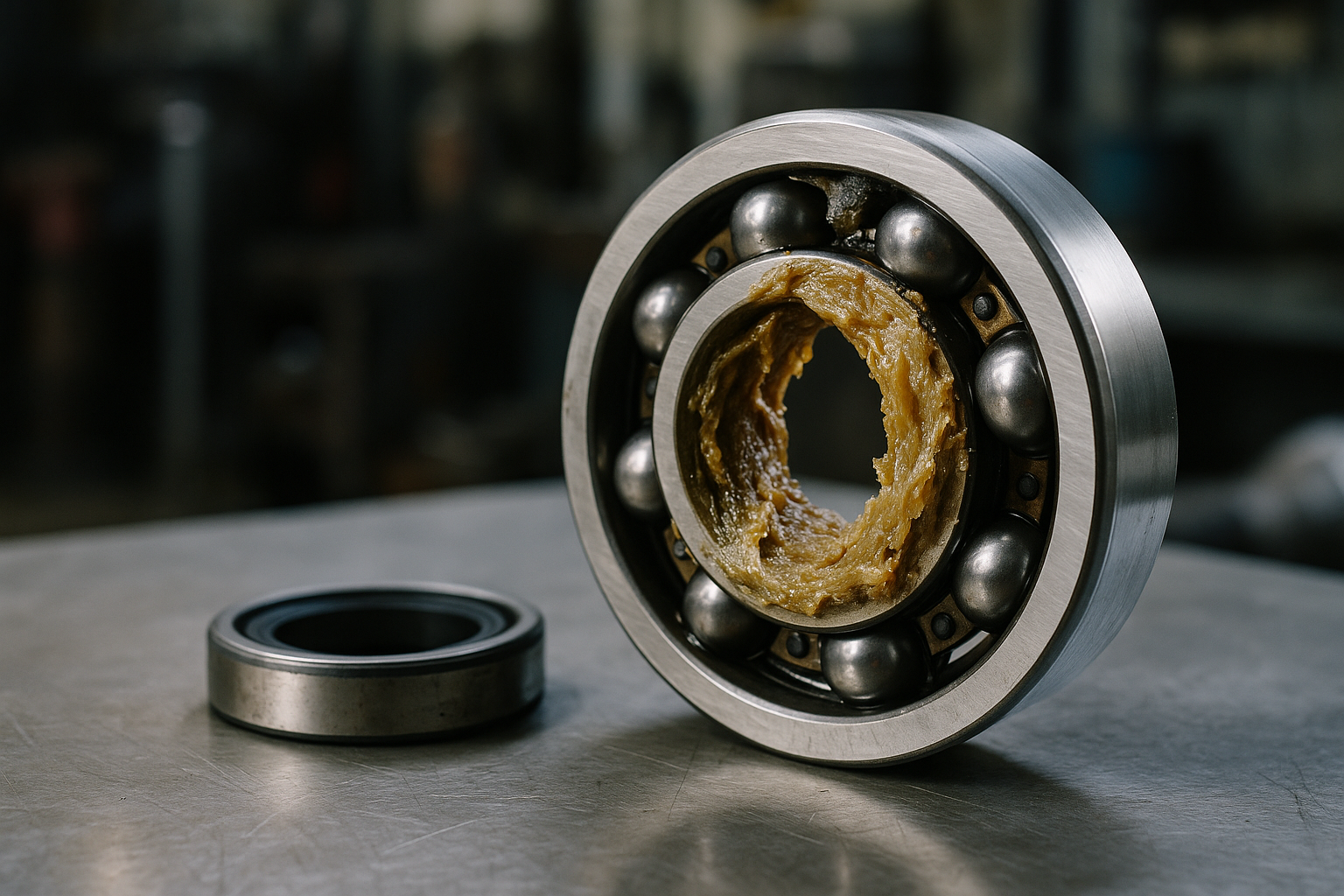
The call usually comes six weeks after somebody topped up a bearing with whatever was on the shelf. The machine is running hot, nobody can explain why, and the maintenance log shows nothing unusual. Grease compatibility failures are among the most avoidable causes of bearing damage in European industry and among the hardest to diagnose after the fact, because the evidence looks like every other lubrication failure until somebody opens the housing and finds a substance that is neither of the two greases that went in.
What actually happens when two greases meet
Grease is base oil held in a thickener matrix, with an additive package doing specific jobs. Mix two greases with incompatible thickener chemistries and the matrix can break down, releasing the oil and leaving a soap that neither carries load nor stays where it is needed. The bearing then runs on whatever oil has not drained away, which is not enough and not for long. Lithium and calcium sulfonate are a classic incompatible pair; polyurea with lithium is another. The reaction is not always immediate, which is why the failure appears weeks later with no obvious trigger.
The German paper mill that lost five roll positions
A mill received a delivery of calcium sulfonate grease in packaging that led the stores to shelve it alongside the lithium complex they had always used. Roll bearings were topped up from it during routine service. Temperatures began climbing within a month, and over the following quarter five roll positions required emergency replacement. The bearing cost was a fraction of the loss; the production interruption was the expensive part. Nothing about the maintenance procedure had changed, and nobody had thought to check what was in the new drums because the label said grease.
The food plant where both products were correct
An Italian bottling operation switched H1 food-grade grease suppliers on price. Both products were properly certified for incidental food contact, both were entirely fit for purpose, and the thickener chemistries were different. Over the following six months the plant replaced more than thirty bearings across the line before the connection was made. The lesson that stuck was that shared certification tells you nothing about compatibility — H1 describes what the grease may touch, not what it may be mixed with. Food-grade positions carry their own specification demands, which we covered in our piece on food-grade insert bearings under wash-down duty.
The steel plant that got the base oil right and the additives wrong
A Polish operation upgraded from mineral to synthetic PAO grease on high-temperature positions without purging first. The base oils were compatible, which is what the engineer checked. The corrosion inhibitor packages were not, and under the operating temperatures they reacted to produce a residue that etched the raceways. Bearings developed corrosion pitting within three months. Compatibility is a property of the whole formulation, not of the base oil alone, and the additive chemistry is the part that supplier charts exist to cover.
The three rules that prevent all of this
Consult the compatibility chart before any change of product, including a change of supplier for a nominally identical specification — every major manufacturer publishes one and they take a minute to read. Purge completely rather than topping up when the specification changes, either by cleaning during disassembly or by flushing fresh grease through until what emerges is clean. And dedicate grease guns to single specifications, labelled clearly, because shared guns transfer incompatible product between positions as reliably as any mistake in the stores. None of this is difficult; it is simply a discipline that has to be maintained rather than assumed.
Consolidation is the right goal and the biggest risk
Reducing a plant from ten grease specifications to three is genuinely worth doing — less inventory, fewer mistakes, simpler training. It also means deliberately introducing new grease into positions that contain something else, which is exactly the condition these failures need. Treat every consolidation step as a full-purge operation with a documented compatibility check, and phase it across the plant rather than doing everything in a fortnight. Choosing the right specifications to consolidate onto is a separate exercise, and our selection decision tree across twelve industrial scenarios works through the logic. Where the choice is between grease and oil entirely, that comparison sits in our note on mid-speed shaft lubrication.
Recognising it when it has already happened
Open the housing and look at the grease. Unusual colour, a separated oily layer over a hardened residue, or a texture that matches neither original product indicates a reaction has taken place. Elevated running temperature without a load or alignment explanation points the same way, particularly if it began some weeks after a service. When you find it, replace the bearing — the common sizes sit across the deep groove and spherical roller ranges — clean the housing thoroughly rather than wiping it, and refill with a single known specification. Then find out how the wrong product reached that position, because if the stores or the gun is the cause it will happen again on the next machine.
Consolidating lubricant specifications across a site? Our team supports European maintenance operations on compatibility, purging procedure and grease selection. Book a free consultation.