
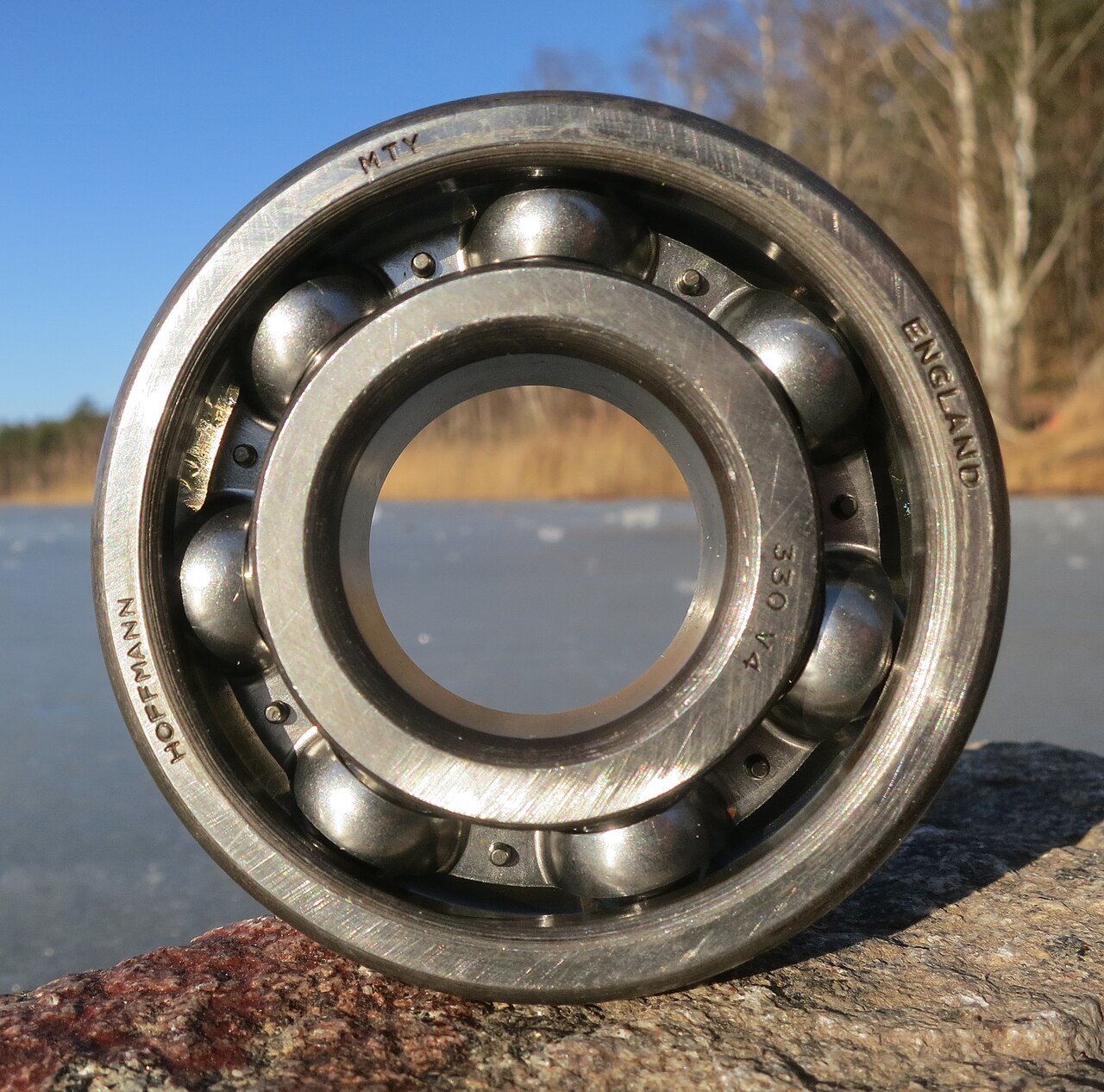
The gearbox came out of a British-built paper converting line with its original drawing still taped inside the guard, and every bearing in it was stamped RHP with an imperial size, which is exactly the moment a maintenance engineer starts hunting for an RHP bearings cross reference that will survive contact with the shaft. Legacy British plant is full of these parts. They were specified when inch shafts were normal in UK engineering, they often outlast two or three generations of motors, and they confuse younger fitters who have only ever ordered metric ISO sizes. The good news is that RHP remains an active brand with a clear lineage, and many of the old ranges are still produced or have well-understood equivalents. The less good news is that some cross-references found in old notebooks or online tables are wrong in subtle ways. This article sets out what the ranges are, how to read them and where RHP still belongs in a modern maintenance programme.
A short lineage from three British makers to one brand
RHP stands for Ransome Hoffmann Pollard, the company formed when three established British bearing manufacturers, Ransome & Marles, Hoffmann and Pollard, were brought together in the late 1960s. Each contributed its own product heritage, and the combined business became a major domestic supplier to British industry for the following decades, from machine tools and textile machinery to agricultural equipment and electric motors. In 1990 RHP was acquired by NSK, and the brand has since operated within the NSK group, keeping its name on specific ranges, notably housed units and certain precision and imperial products. For the counter technician this history has a practical side. An old RHP part may correspond to a range that is still made under the RHP name, to an NSK equivalent, or to a dimension that only survives through cross-reference. Knowing which of the three applies avoids long searches and wrong substitutions, and the RHP brand page shows what is currently sourced under the name.
Reading the imperial ranges LJ, MJ, LJT and MJT
The imperial ranges are where most legacy enquiries land. LJ denotes a light-section single-row deep groove ball bearing with inch dimensions, and MJ its medium-section counterpart, with the number giving the bore in inches, so an LJ1 has a one-inch bore and an LJ1.1/4 a bore of one and a quarter inches. Add a T and the part becomes an angular contact bearing in a comparable envelope: LJT and MJT bearings carry a combined radial and single-direction axial load and are normally mounted in pairs or opposed to another bearing. The RHP LJT2 illustrates the scheme clearly, with a 2-inch (50.8 mm) bore, a 4-inch (101.6 mm) outside diameter and a 20.6 mm width. Fitters sometimes replace an LJT with an LJ of the same size because it slides straight in, and the bearing then fails under thrust it was never designed to carry. Checking for the T is the first discipline of any imperial cross-reference.
LS, ALS and the alternative names in old records
Older maintenance records and drawings frequently use LS and ALS designations rather than LJ and LJT, and part of the cross-reference job is recognising that these describe related imperial families rather than wholly different bearings. The LS designation belongs to an older imperial deep groove scheme, with AC added for an angular contact version, while the ALS prefix is commonly used for imperial angular contact bearings. The product listing for the LJT2 shows how a single part can carry three references at once, LJT2, LS15AC and ALS16, and the numbers do not share any common logic, so one cannot be derived from another. The pitfall is that such tables were compiled by different manufacturers and distributors over decades, and they do not always agree on width, contact angle or internal design. The safe practice is to treat any legacy reference as a starting point and confirm the boundary dimensions in inches and millimetres, the bearing type and, for angular contact parts, the mounting arrangement before ordering. A five-minute measurement prevents most wrong picks.
Self-Lube housed units and insert bearings
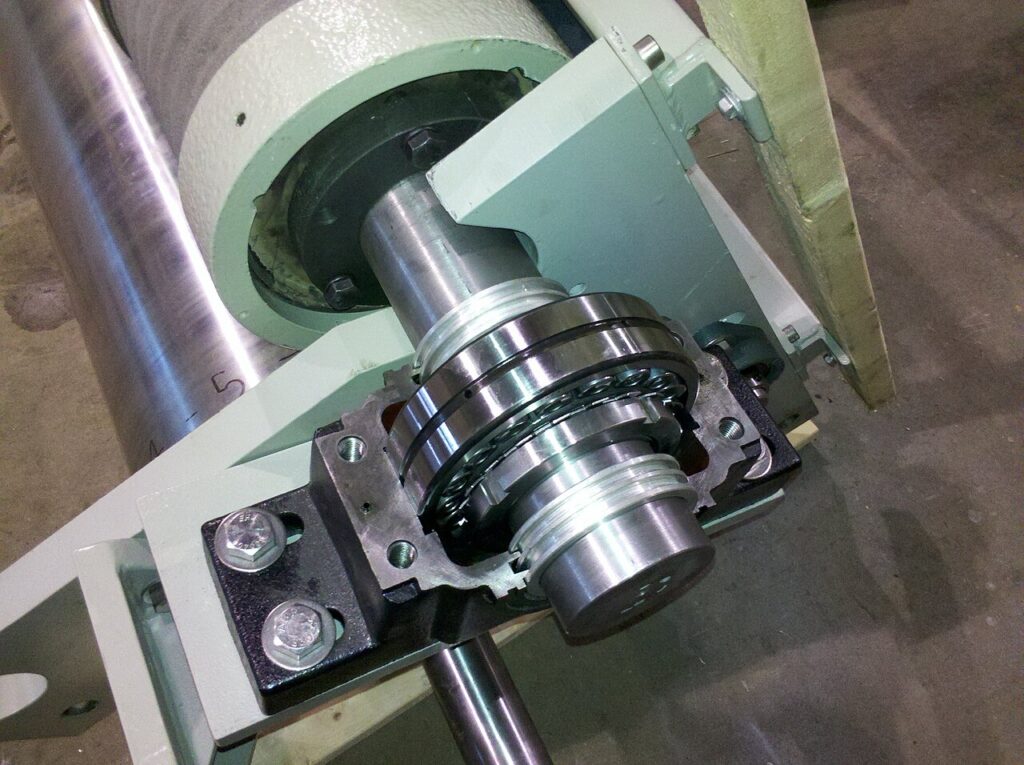
Outside the imperial ball bearing ranges, RHP’s strongest modern identity is in housed units, marketed under the Self-Lube name. These combine an insert bearing with a spherical outside diameter and a cast-iron or pressed-steel housing, allowing the insert to self-align in the housing seat and absorb initial misalignment between shaft and frame. Inserts are typically fixed by grub screws or an eccentric locking collar, and many units are supplied pre-greased with provision for relubrication. Because the series grew up serving British and Commonwealth markets, imperial bore inserts remain an important part of the offer alongside metric bores, which makes RHP a natural first stop when a conveyor or agricultural machine has a 1-3/16 or 1-7/16 inch shaft. The broader comparison of cast and pressed-steel insert housing units covers the mechanical trade-offs, and the same logic applies here: check the locking method and lubrication arrangement before treating two units as interchangeable.
Where RHP still fits in agricultural and conveyor work
Agricultural machinery is the sector where RHP references survive most visibly on European counters. Balers, drills, combines and grain-handling conveyors built in the United Kingdom, or built for markets that inherited British specifications, often carry imperial shafts and insert bearings with RHP numbers in their parts books. When a farmer brings in a worn unit at the start of the season, the realistic options are a direct RHP replacement, an equivalent insert from another major maker with matching bore and locking, or a metric conversion that requires machining the shaft, which is rarely acceptable during harvest. Insert bearings follow fairly well-shared dimension conventions, as the discussion of insert bearings as the agricultural aftermarket standard explains, so interchange is usually achievable. The care point is the housing: centre height, bolt spacing and lubrication fitting position must match the frame, and an imperial unit replaced by a nominally similar metric housing can shift the shaft line by a few millimetres.
Metric parts and precision with the 16009 C3 example
Not every RHP enquiry is imperial. The brand also appears on metric deep groove bearings, including thin-section types such as the RHP 16009 C3, a 45 x 75 x 10 mm bearing from the 160 extra-light series. That series shares its bore and outside diameter with the 6009 but uses a 10 mm width instead of 16 mm, saving axial space in gearboxes, fans and compact drives where the radial load is moderate. The C3 suffix indicates radial internal clearance greater than normal, chosen when interference fits or temperature differences between the rings would otherwise reduce operating clearance too far. For metric parts like this, cross-referencing is straightforward because ISO fixes both the boundary dimensions and the clearance classes, and equivalent deep groove ball bearings from other premium makers will fit. RHP’s historic reputation for precision, built partly on machine-tool and instrument work, remains relevant wherever a legacy drawing calls for a specific tolerance class.
Building a cross-reference file that survives staff changes
The most valuable thing a plant with legacy British equipment can do is turn tacit knowledge into a written cross-reference file. Many sites rely on one senior fitter who knows that the drive end of a particular fan takes an MJT rather than an MJ, or that a conveyor tail shaft is one and a quarter inches rather than 32 mm. When that person retires, the knowledge leaves with them. A practical file records the machine, position, original RHP reference, measured dimensions in both units, bearing type, clearance, seal or shield arrangement and any confirmed equivalent, together with a photograph of the old ring markings. The identification methods described in quick bearing identification without catalogues fit neatly into that routine. The effort is a few hours per machine, and the payoff is that every future breakdown starts from verified data rather than guesswork based on a worn, half-legible ring pulled out under time pressure.
RHP therefore occupies a narrower but durable place in a modern bearing basket. It is the reference brand for imperial deep groove and angular contact bearings in British-designed equipment, a respected maker of self-aligning housed units with both inch and metric bores, and a metric supplier whose parts cross cleanly to other premium names. Its NSK ownership means sourcing is backed by a large group, while its own name continues on the ranges that customers still ask for by habit and by drawing. The engineer facing an old gearbox, a farm conveyor or a machine tool with RHP stamped on every ring should not assume the parts are obsolete, nor that any similar-looking bearing will do. Read the designation, check for the angular contact T, measure in both units and confirm the housing details, and legacy British plant can keep running for many more years on correctly specified replacements.
Holding an RHP reference you cannot match? Our team supports maintenance engineers and buyers with imperial and legacy RHP cross-references, from LJ and LJT ball bearings to Self-Lube housed units. Book a free consultation.
Image credits: “1970 or earlier ball bearing 330 V4 MTY Hoffmann Manufacturing Company England” by R. Henrik Nilsson (CC BY 4.0); “Pillow block NSK SAFD522” by SamuelFreli (CC BY-SA 3.0), via Wikimedia Commons.