
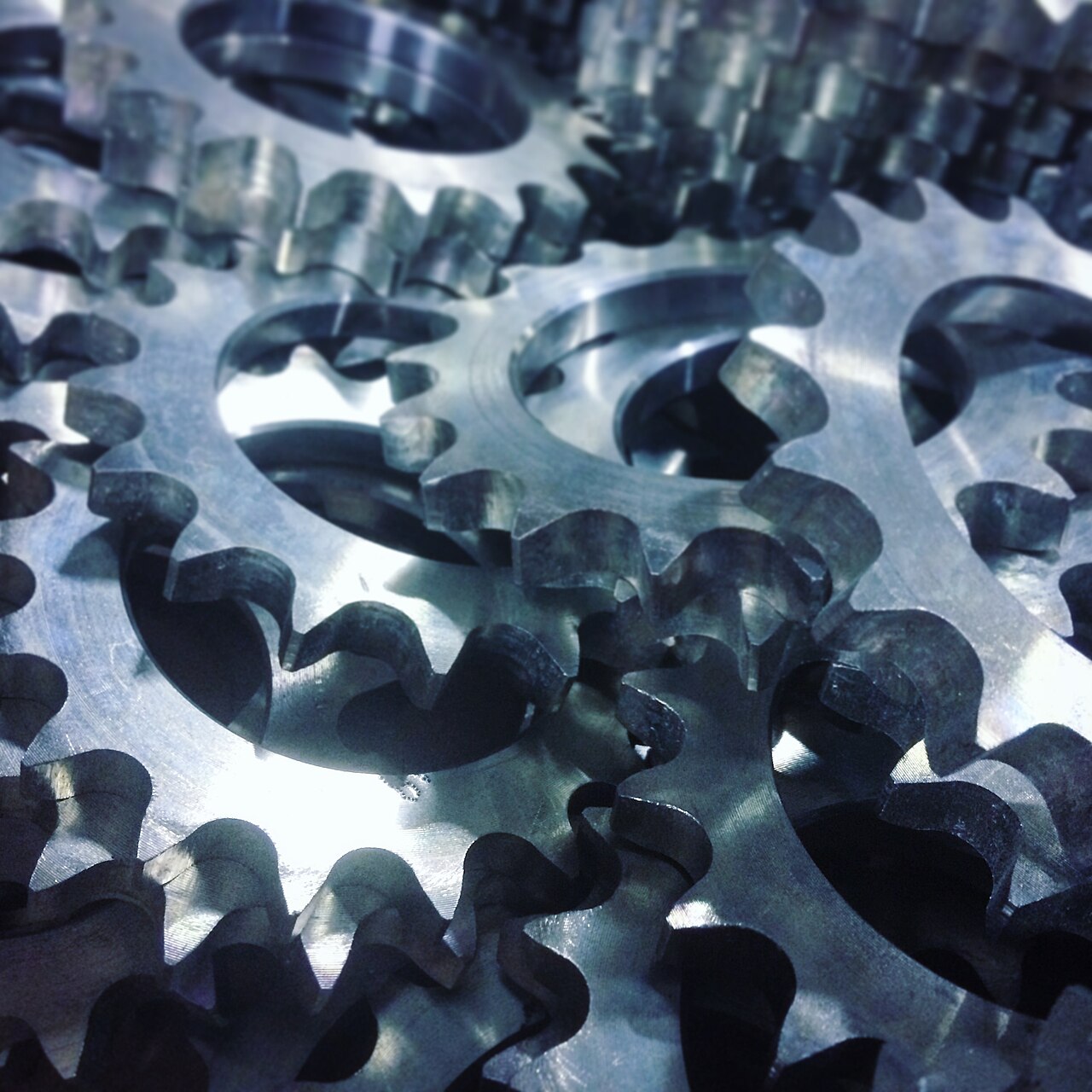
The fitter on a bottling line had the guard off a stalled accumulation conveyor and a hooked drive sprocket in his hand, and his question to the parts counter was whether the replacement could be one of the stock simplex, duplex and triplex sprockets listed under a different code from the worn original. The old part was marked only with a tooth count and a pitch in inches, the chain was a single strand of half-inch pitch, and the drive had been given a larger motor a year earlier. That combination is typical. A sprocket order is never just about the tooth count, because the chain pitch, the inner width between the plates, the number of strands, the bore arrangement and the duty all have to agree. The good news is that ISO 606 makes most of this predictable, and a few rules let a technician go from a worn sample or a chain designation to the right sprocket or platewheel with confidence, without guessing from a faded stamp.
ISO 606 B-series pitches and what the codes mean
In European plants the default roller chain is the ISO 606 B-series, derived from British practice, and its designations encode the pitch in sixteenths of an inch. 06B has a pitch of 3/8 inch (9.525 mm), 08B of 1/2 inch (12.7 mm), 10B of 5/8 inch (15.875 mm), 12B of 3/4 inch (19.05 mm) and 16B of 1 inch (25.4 mm). The suffix after the hyphen gives the number of strands: 08B-1 is simplex, 08B-2 duplex and 08B-3 triplex. Shop listings often add the inner width in inches, so a simplex sprocket 08B-1 1/2″ x 5/16″ Z100 is a single-strand wheel for half-inch pitch chain with a nominal 5/16-inch inner width and 100 teeth. The A-series, derived from ANSI chain, shares the nominal pitches but uses different roller diameters and, in several sizes, different widths, so an 08A sprocket and an 08B chain engage poorly even though both are half-inch pitch. Always confirm the series before ordering, ideally by measuring the roller diameter on the old chain.
Inner width, tooth width and transverse pitch
The chain dimension that the sprocket tooth must respect is the inner width, the clear space between the inner plates. For B-series chain it is about 5.72 mm for 06B, 7.75 mm for 08B, 9.65 mm for 10B, 11.68 mm for 12B and 17.02 mm for 16B, and the tooth is machined somewhat narrower so that the chain tracks without binding. Multi-strand sprockets add a second dimension, the transverse pitch, which is the centre-to-centre spacing between strands: about 10.24 mm for 06B, 13.92 mm for 08B, 16.59 mm for 10B and 19.46 mm for 12B. A duplex sprocket cut for one transverse pitch will not carry a duplex chain built to another, and running a simplex chain on one row of a duplex sprocket works but loads the wheel off-centre and wastes the material. The practical check on a worn sample is simple: measure the tooth width across the flanks and the spacing between tooth rows with callipers, and compare the readings with the series table before trusting any marking on the hub.
Tooth count, speed and wear distribution
Tooth count governs smoothness as much as ratio. As a chain wraps a sprocket it forms a polygon rather than a circle, so the chain speed and the effective radius fluctuate once per tooth, and the fewer the teeth, the larger that fluctuation and the harder each roller strikes as it seats. For drives at moderate to high speed, 17 teeth is widely treated as the practical minimum on the small sprocket, with 19 to 25 preferred where noise and life matter; counts below about 12 belong only to slow drives. Large wheels have their own limit. The pitch diameter grows with tooth count according to d = p / sin(180°/z), so an 08B wheel with 100 teeth reaches about 404 mm, and a worn chain rides higher on the teeth of a large wheel than on a small one. Combining an odd tooth count with an even number of chain links spreads contact so that each roller meets every tooth over time, rather than the same pairs repeatedly, which evens out wear across both sprocket and chain.
Pilot bore, taper bush or platewheel
The tooth geometry is standardised; the way the sprocket is fixed to the shaft is the real choice. Pilot bore sprockets have a hub and a small rough bore, intended to be bored to the shaft, keyed and secured with a set screw, and they suit permanent installations because any bore within the hub limits can be machined. Our simplex pilot bore sprockets make up the broadest stock because they cover almost any shaft. Sprockets for taper lock bushes accept a standard bush, so one wheel fits a range of shafts and comes off without a puller, which matters on drives that are changed or re-ratioed often. Platewheels are flat toothed plates without a hub, supplied for the user to weld to a hub, bolt to a flange or mount on a drum. A simple platewheel 6 x 2.8 Z114, for 6 mm pitch chain with a 2.8 mm inner width, has a pitch diameter of roughly 218 mm. The simple platewheels range follows the same pitch logic as the hubbed sprockets.
When to add strands and when to go up in pitch
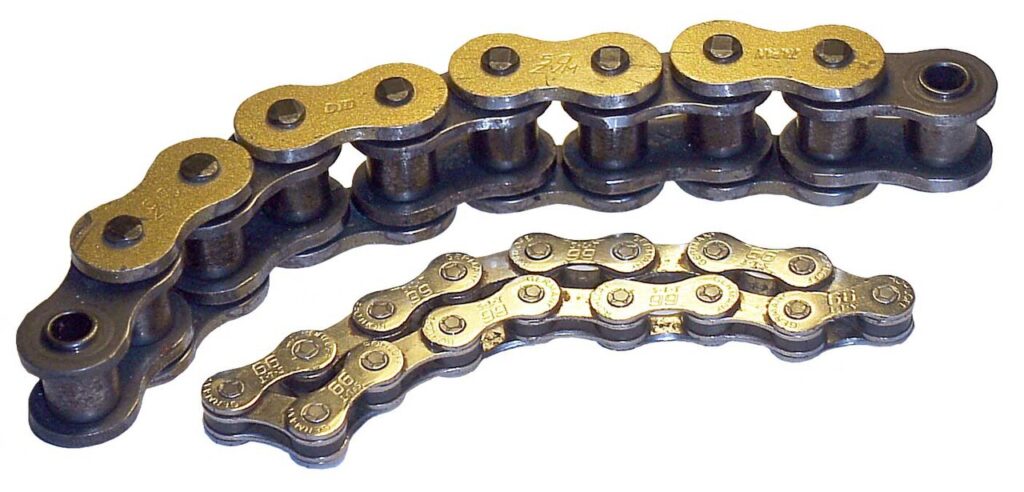
When a simplex drive is overloaded there are two ways out: more strands at the same pitch, or a larger pitch. Standard practice applies multi-strand factors to the simplex power rating, commonly about 1.7 for duplex and 2.5 for triplex, because load sharing between strands is never perfect. Staying at the same pitch keeps the sprocket diameter and the polygonal effect unchanged, which is the better route at higher speeds and where the diameter is limited by the machine frame. Going up one pitch increases capacity per strand but makes each roller impact heavier and lowers the permissible speed, so it suits slow, heavily loaded drives where space is available. Duplex and triplex chains are less forgiving of misalignment and shaft deflection, because the strand furthest from the bearing carries more than its share. In the bottling-line case, moving from 08B-1 to 08B-2 meant changing both sprockets and the chain together, and checking the extra shaft overhang.
Alignment, wrap angle and centre distance
A correctly selected sprocket still fails early if the drive geometry is wrong. The small sprocket should have at least 120 degrees of chain wrap, which in practice means keeping a single-stage ratio to around 6:1 or 7:1 and a reasonably generous centre distance, typically 30 to 50 chain pitches. Shafts must be parallel and the sprocket faces in the same plane; a straightedge across both faces is the minimum check, and measuring the offset at both ends of the span reveals angular error that a single reading misses. Misaligned drives show polished wear on one side of the teeth and on the inner faces of the link plates, and on multi-strand chains they overload the outer row first. Slack matters too: on horizontal drives a midspan sag of roughly 2 to 3 percent of the centre distance is a common target, with less on vertical or reversing drives where a loose chain can jump teeth. The tensioner or idler, where fitted, should sit on the slack side, never on the tight span carrying the load.
Matching chain and sprocket wear
Sprockets and chain wear as a pair, and fitting a new chain on hooked teeth, or a new sprocket under a stretched chain, shortens the life of the new part sharply. Elongation is measured over a known number of pitches under light tension; a replacement limit of around 3 percent is common for general drives, and many chain makers recommend a lower limit on drives with large wheels, often given as 200 divided by the number of teeth on the largest sprocket, read as a percentage. On a 100-tooth wheel that gives 2 percent, because a stretched chain climbs the teeth of a large wheel sooner. For half-inch drives, a precision chain such as the SEDIS RECORD ISO simplex chain, pitch 12.70 keeps elongation low through accurate pin and bush fits, and our article on SEDIS industrial chain selection and maintenance covers lubrication and inspection intervals in more detail for plants planning a full drive refurbishment.
Choosing between simplex, duplex and triplex is therefore a sequence rather than a guess. Confirm the chain series and pitch, measure inner width and transverse pitch, set the tooth counts for speed and ratio, decide how the wheel will be fixed to the shaft, and only then compare one strand at a larger pitch with two or three strands at the same pitch, applying the published multi-strand factors. Align the drive, set the slack, and replace chain and sprockets together when the elongation limit is reached. If the drive is being redesigned from scratch, it is worth asking whether chain is the right technology at all, and our comparison of chain and belt conveyor drives by maintenance cost sets out where each wins. For the chain itself, the SEDIS range covers ISO B-series simplex, duplex and triplex sizes to match the sprockets discussed here, in both standard and stainless versions.
Not sure whether your drive needs a duplex sprocket or a larger pitch? Our team supports chain and sprocket selection, from identifying a worn sample to sizing multi-strand drives. Book a free consultation.
Image credits: “Sprocket” by SimonWaldherr (CC BY-SA 4.0); “Kettenvergleich” by Ralf Roletschek (CC BY-SA 3.0), via Wikimedia Commons.