
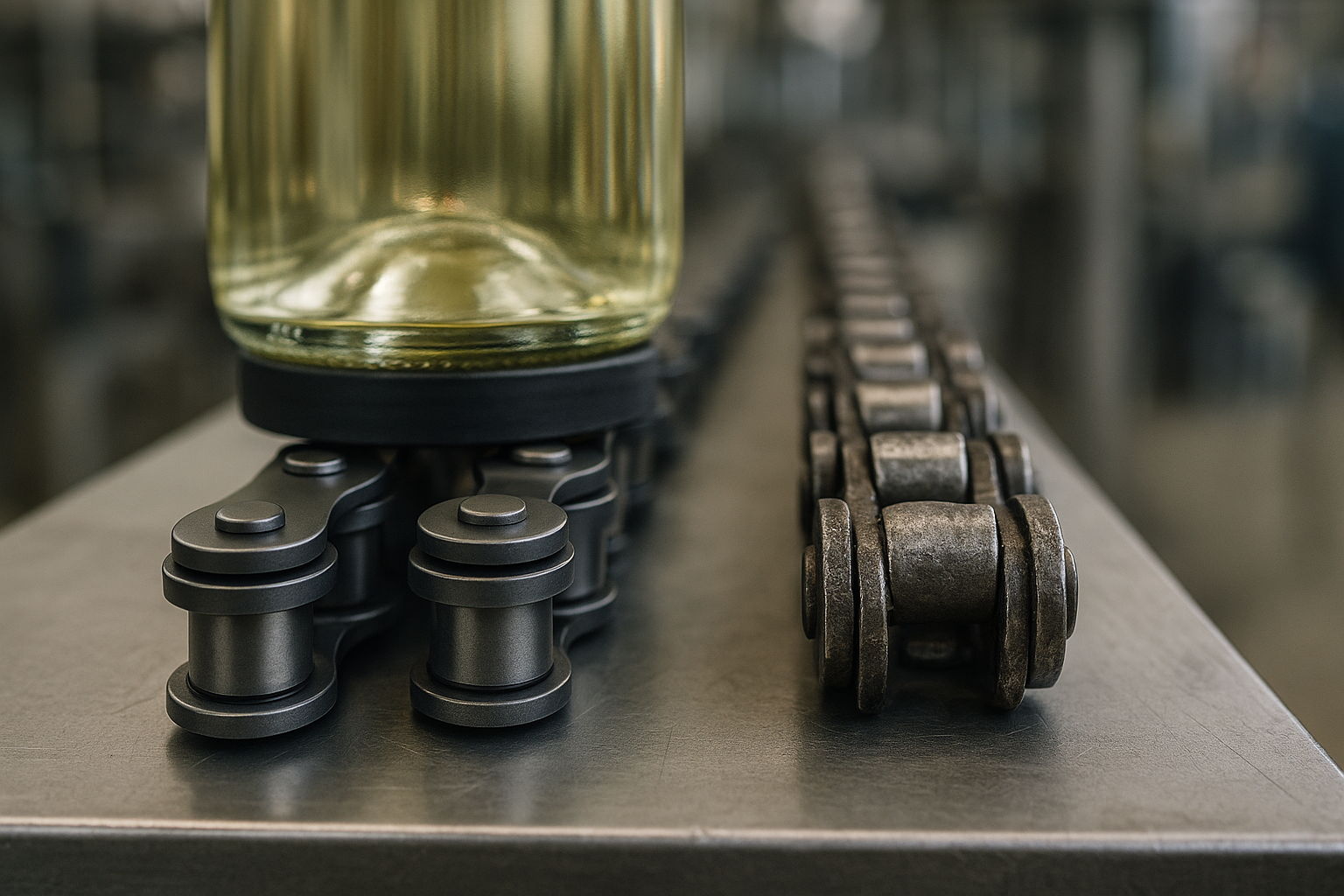
Every plant engineer who has run a bottling line chain to failure knows the argument by heart. Procurement sees two quotes for the same ISO pitch — one from SEDIS, one from an unbranded import at roughly half the price — and asks the obvious question: it is the same pitch, the same plate thickness on paper, the same ISO designation, so why are we paying double? The honest answer is that the datasheet is where the two chains look identical and the wash-down bay is where they stop looking identical. What follows is the operational picture from European bottling and filling lines, where the cost of being wrong is measured in lost production shifts rather than in the purchase order.
Why the datasheet hides the difference
An ISO 606 designation fixes pitch, roller diameter, plate height and minimum tensile strength. It says nothing about how the pin is hardened, how the bush is finished, how much lubricant the assembly retains after the first month, or how consistently the pitch holds as the chain elongates. Two chains can both honestly claim ISO 08B-1 and behave completely differently after 4,000 hours in a humid environment. The generic chain typically meets minimum tensile strength on a new sample and then elongates faster because the pin-bush pair was finished to a looser tolerance and case-hardened to a shallower depth. On a bottling line that elongation is not an abstract number: it is the moment the chain starts skipping on the sprocket, the bottle spacing drifts, and the filler head starts rejecting. Procurement bought to the specification and the line still stopped, which is why the specification alone is a poor purchasing instrument for this particular application.
What the wash-down cycle actually does to a chain
Bottling lines are cleaned aggressively and frequently. Caustic solutions, hot water, sometimes peracetic acid, applied several times a day, and directed exactly at the places where the chain is most exposed. Each cycle strips lubricant out of the pin-bush interface and drives moisture in. A chain that retains its lubricant film through the cycle keeps its wear rate flat. A chain that loses the film runs metal on metal for the first minutes of every restart, and those minutes accumulate into the elongation curve that eventually takes the line down. This is the single mechanism that separates a premium chain from a cheap one in food and beverage service, and it is invisible on the purchase order. Our own field notes on this are collected in the 24-month SEDIS ALPHA wear-rate study on bottling lines, which tracks the elongation curves rather than the anecdotes.
Running the numbers honestly
Take a 5-metre chain run on a filler infeed, replaced during planned maintenance. The premium chain costs perhaps 180 euro more per run. Against that, count what a replacement actually costs you: two maintenance hours, the sprocket inspection that goes with it, and — the number that dominates everything else — the production time. A mid-size European bottling line producing 20,000 bottles an hour does not lose money on the chain, it loses money on the four hours of stopped filling. If the generic chain drives one extra unplanned replacement per year, the premium chain has already paid for itself several times over on that single line. The calculation inverts on low-utilisation equipment: a chain on a palletiser that runs two shifts a week, in a dry area, with easy access, is a perfectly reasonable place to buy the cheaper option. The mistake is applying one answer to the whole plant.
Where the generic chain is the right call
It is worth being specific about this, because blanket premium specification is its own form of waste. Dry-area conveyors, intermittent-duty transfers, secondary packaging equipment, anything with comfortable access and a forgiving stop cost — these are positions where a standard chain from the power transmission range does the job for years without drama. A plant that specifies premium everywhere is subsidising positions that were never going to fail expensively. Segment the plant by wash-down exposure, duty cycle and stop cost, and buy accordingly. Most European bottling plants find that somewhere between a quarter and a third of their chain positions genuinely justify the premium tier, and the rest do not.
The qualification test that settles the argument internally
Supplier claims and industry averages rarely convince a sceptical maintenance manager, and they should not have to. Run a parallel trial instead. Pick two comparable positions on the same line — same duty, same wash-down exposure, same sprocket condition — fit the premium chain on one and the incumbent generic on the other, and measure elongation with a chain wear gauge at fixed intervals for six to twelve months. Log the measurements rather than the impressions. At the end you have plant-specific data that answers the question for your water chemistry, your cleaning regime and your operating hours, which is the only version of the answer that matters. The trial also tends to end the recurring procurement argument permanently, because the numbers come from your own line rather than from a supplier brochure.
Specification details worth getting right
Once the tier decision is made, a few choices still move the needle. Stainless variants such as the SEDIS RECORD INOX P.12.701z earn their place where the cleaning chemistry attacks carbon steel directly, though they trade some tensile capacity for the corrosion resistance. Reinforced series like the SEDIS ALPHA ASA reinforced P.15,875 suit positions carrying real load rather than just moving product. And the sprocket matters as much as the chain: fitting a new premium chain onto worn sprockets from the simplex sprocket range destroys the new chain quickly and produces exactly the disappointing result that convinces a plant the premium tier “does not work here”. Replace both or measure the sprocket before deciding.
Maintenance discipline decides whether you get what you paid for
A premium chain in a plant with no lubrication schedule delivers roughly the same service life as a generic one, and the money is simply gone. The extended service life is available only if the lubrication interval is respected, if elongation is measured rather than guessed, and if replacement happens at the wear threshold instead of at failure. Plants that get this right treat chain replacement as a planned event with a known date; plants that do not are always replacing chains at two in the morning. The underlying discipline is the same one that governs bearing service intervals, and if you want the general framework, our guidance on extending transmission component life covers the monitoring approach that applies equally to chain drives.
The short version for a plant engineer
Premium chain pays back on wet, continuous, high-stop-cost positions and wastes money everywhere else. The decision is per position, not per plant. Prove it on your own line with a parallel trial rather than arguing from brochures, replace sprockets alongside chains, and hold the lubrication schedule — because without that last piece you are paying premium prices for generic service life.
Need help segmenting your chain positions by tier? Our team supports European food and beverage plants with transmission component programmes. Book a free consultation.