
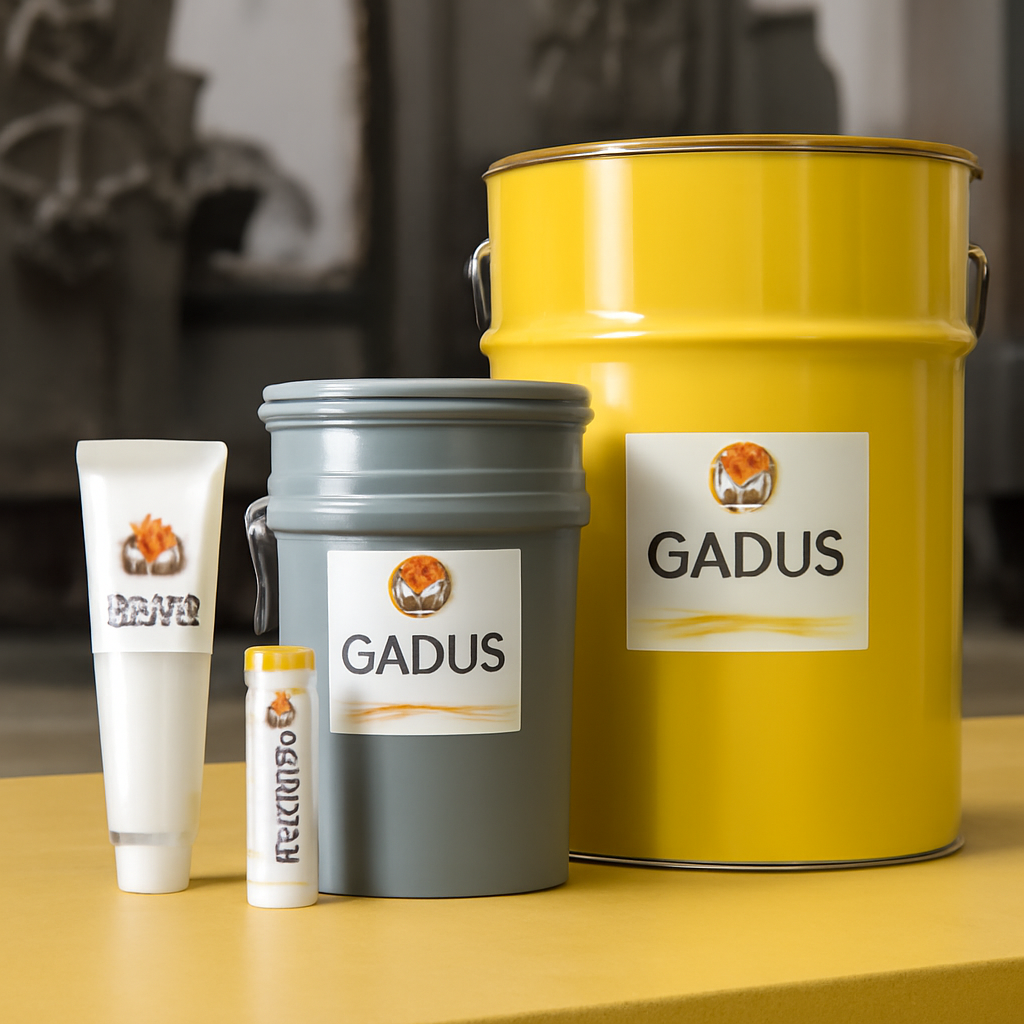
Shell Gadus is one of the most widely-specified industrial grease ranges in European industrial maintenance. Shell’s global lubrication portfolio combines decades of formulation expertise with broad distribution and consistent quality across batches. The Gadus range covers virtually every industrial bearing lubrication scenario from general-purpose lithium grease through specialty high-temperature, water-resistant, and food-grade variants. This guide walks through the practical selection across the Shell Gadus range for European industrial applications.
1. The Shell Gadus naming convention
Shell Gadus designations follow a structured naming system that encodes performance characteristics. Typical format: Gadus S2 V220 2. Decoded:
- S: synthetic (S) or mineral base oil.
- 2: performance tier (1, 2, 3, 5, indicating capability level).
- V: viscosity grade indicator.
- 220: base oil viscosity at 40 °C (ISO VG).
- 2: NLGI grade (consistency).
Understanding the naming system makes selection across the range systematic rather than guesswork.
2. The Gadus S2 range: general industrial workhorse
Gadus S2 covers the bulk of general industrial bearing lubrication:
- Gadus S2 V100: ISO VG 100 base oil, NLGI 2. General-purpose lithium grease for moderate-speed bearings.
- Gadus S2 V220: ISO VG 220 base oil, NLGI 2. Heavier-duty applications, gearbox bearings, higher loads.
- Gadus S2 V460: ISO VG 460. Very heavy industrial duty, low-speed high-load bearings.
For most European industrial motor and pump applications, Gadus S2 V100 NLGI 2 is the default specification.
3. The Gadus S3 range: enhanced performance
Gadus S3 incorporates enhanced additive packages for demanding industrial applications:
- Gadus S3 V220 C: enhanced calcium sulphonate complex, water resistance, marine and wet industrial applications.
- Gadus S3 V460 D: heavy-duty with EP additives, gear applications.
- Gadus S3 T100: high-temperature variant for applications up to 150 °C continuous.
4. The Gadus S5 range: synthetic premium
Gadus S5 uses fully synthetic base oils for the most demanding applications:
- Gadus S5 V100 2: synthetic high-temperature, polyurea thickener. Up to 160 °C continuous. Electric motor specialty.
- Gadus S5 V220 P: synthetic premium with extended drain intervals.
- Gadus S5 T460: extreme high-temperature applications.
5. Specialty Gadus variants
5.1 Food-grade range
NSF H1 registered greases for food contact applications. Shell Gadus S5 FG 220, FG 460 for food and beverage processing.
5.2 Marine range
Specifically formulated for salt-water and salt-spray resistance. Calcium sulphonate base with marine-specific additives.
5.3 Mining and heavy industrial
Shock-load tolerance, EP performance, contamination resistance. Specific Gadus variants for mining gearboxes and crushers.
6. Application-specific selection
6.1 Electric motors
Standard motors below 30 kW: Gadus S2 V100. High-power motors above 75 kW: Gadus S5 V100 (synthetic, lower friction, longer service life). Inverter-driven motors with insulated bearings: Gadus S5 V100 or specific motor bearing grease (Shell Gadus S5 EM).
6.2 Pump bearings
General industrial pumps: Gadus S2 V220. Pumps with water exposure: Gadus S3 V220 C (calcium sulphonate water resistance).
6.3 Fan and blower bearings
Industrial fans: Gadus S2 V100 or V220 depending on load. High-temperature exhaust fans: Gadus S5 T100.
6.4 Conveyor bearings
Standard conveyor pulleys: Gadus S2 V220. Mining and aggregate conveyors: Gadus S3 V460 D with EP additives.
6.5 Gearbox bearings
Industrial gearboxes: typically gear oil rather than grease; for grease applications, Gadus S2 V460 or S3 V460 D.
6.6 Wind turbine bearings
Specialty wind-grade grease beyond general Gadus range; Shell offers specific wind turbine main bearing greases.
6.7 Steel mill bearings
Hot strip mill back-up roll bearings: Gadus S3 V460 with calcium sulphonate. Hot rolling applications: specialty high-temperature variants.
7. Re-lubrication intervals with Shell Gadus
Re-lubrication intervals depend on grease specification, application duty, and operating temperature. Shell’s LubeMatch online calculator computes recommended intervals from application parameters. General guidelines:
- Sealed motor bearings with factory-fill Gadus: 5,000-20,000 hours typical.
- Re-greasable pump bearings: 1,000-4,000 hours.
- High-temperature applications: halve standard intervals for every 15 °C above reference.
- Contaminated environments: significantly shorter intervals.
8. Compatibility considerations
Shell Gadus greases use specific thickener chemistry that requires compatibility verification when transitioning from other brands. Specific compatibility notes:
- Standard Gadus S2 (lithium-complex): compatible with most lithium-complex greases.
- Gadus S3 V C (calcium sulphonate): may have compatibility constraints with certain lithium grades.
- Gadus S5 V (polyurea): NOT compatible with lithium-based greases. Full purge required during transitions.
- Always verify compatibility before mixing in re-lubrication operations.
9. The Shell distribution network in Europe
Shell Lubricants distributes through specialty industrial lubricant distributors plus general industrial distribution. Standard Gadus ranges are widely available across European industrial markets. Specialty variants may require specific distributor channels or direct supply for volume customers.
10. Cost-benefit considerations
Shell Gadus pricing positions in the mid-premium range across the industrial grease market. Compared to budget lithium greases, Gadus delivers measurable service life advantages that pay back the modest premium. Compared to specialty premium brands (Klüber, Mobil specialty), Gadus offers comparable performance on most applications at lower cost. For specific specialty applications (very high temperature, extreme environments), specialty premium alternatives may justify their premium.
11. Integration with bearing supplier specifications
Major bearing manufacturers (SKF, Schaeffler, NSK, NTN, TIMKEN) qualify Shell Gadus across multiple applications. Bearing OEM specifications often reference Shell Gadus variants by name in factory-fill and re-lubrication recommendations. This integration simplifies procurement: bearing supplier specifies the application, distributor provides the qualified grease.
12. The 2026 Shell Gadus roadmap
Shell continues investment in the Gadus range with focus on:
- Synthetic premium expansion for high-power motor applications.
- Food-grade range expansion as European food processing regulatory environment evolves.
- EV-specific lubrication for traction motor and reducer bearing applications.
- Sustainable formulation development reducing environmental impact.
- Smart lubrication system integration for predictive re-lubrication.
13. Procurement guidance for European industrial customers
- Standardise on Gadus S2 V100 or V220 for the vast majority of general industrial bearing lubrication.
- Upgrade to Gadus S5 V100 for high-power motor bearings to capture service life benefits.
- Use Gadus S3 V C variants for water-exposure applications.
- Document specifications in equipment master data for consistency.
- Use Shell LubeMatch calculator for re-lubrication interval specification.
- Verify compatibility when transitioning between grease types.
Conclusion
Shell Gadus represents one of the most comprehensive and widely-supported industrial grease ranges in European industrial maintenance. The structured naming convention, broad application coverage, mid-premium positioning, and integration with bearing OEM specifications make Gadus a sensible default specification for the vast majority of European industrial bearing lubrication. Selective premium upgrades (Gadus S5, food-grade, specialty variants) capture additional value on specific high-value applications.
Industry context
Shell Gadus sits inside a European industrial-grease market that in 2026 is roughly split between four majors — Shell, Total, ExxonMobil (Mobilith) and Fuchs — plus a long tail of specialty formulators. Gadus’s positioning is broadest-in-class: no other major grease line covers the full temperature and NLGI range with the same distribution depth across European industrial regions. For maintenance managers, that translates into two practical advantages: standardisation risk is low (a Gadus code specified today is very likely to still be available in five years), and cross-brand substitution is well documented in Shell’s technical bulletins. The trade-off is that Gadus is rarely the cheapest option in any single niche — specialty formulators typically beat it on price at the extremes of temperature or contamination resistance. For most bearing lubrication scenarios inside a European industrial plant, the standardisation dividend outweighs the specialty savings.
Selection criteria for buyers
Selecting the right Gadus reference for a given bearing application comes down to four criteria applied in order. First, NLGI grade selection based on speed factor (n·dm), where NLGI 2 is the general-industrial default and NLGI 3 or higher belongs on slow, heavily loaded or vertical-shaft applications. Second, base-oil viscosity match to the bearing’s operating temperature and load — Shell publishes speed-viscosity curves that map cleanly to standard rolling-bearing calculations. Third, additive package alignment: EP additives for high loads, corrosion inhibitors for humid environments, PTFE or polymer boosters for shock loads. Fourth, service life expectation matched to regrease interval — this is the criterion buyers most often skip, but it drives total lubrication cost far more than unit grease price. When all four criteria point to the same Gadus code, procurement is straightforward; when they conflict, the decision framework should be documented rather than left to individual maintenance judgement.
Long-term reliability factors
Long-term bearing reliability with Gadus grease depends less on the grease itself and more on the surrounding practice. In our field experience across European industrial customers, three practice factors dominate the reliability outcome: regrease-interval discipline, contamination control at the fill point, and consistent lubricant identification on the asset. Regrease intervals that drift by 25% or more from the calculated target are one of the top three causes of premature bearing failure, and they show up regardless of grease brand. Contamination control means clean nozzles, capped fittings and single-brand storage — a Gadus reservoir cross-contaminated with a lithium-complex grease from a different supplier is a common but underdiagnosed failure precursor. Consistent asset-level identification (colour-coded caps, printed lubrication routes) prevents the accidental substitution that shows up months later as an unexpected bearing overhaul. Get these three right, and the Gadus range delivers the reliability its data sheets promise.
Related guides on Eurobearing
- Guide to Choosing Lubricants
- Lubricant Selection Decision Tree
- High-Temperature Lubrication Best Practices
- Grease vs Oil Lubrication
- Bearing Re-Lubrication Intervals
Need help with bearing selection? Our team supports you with cross-references and lead-times.