
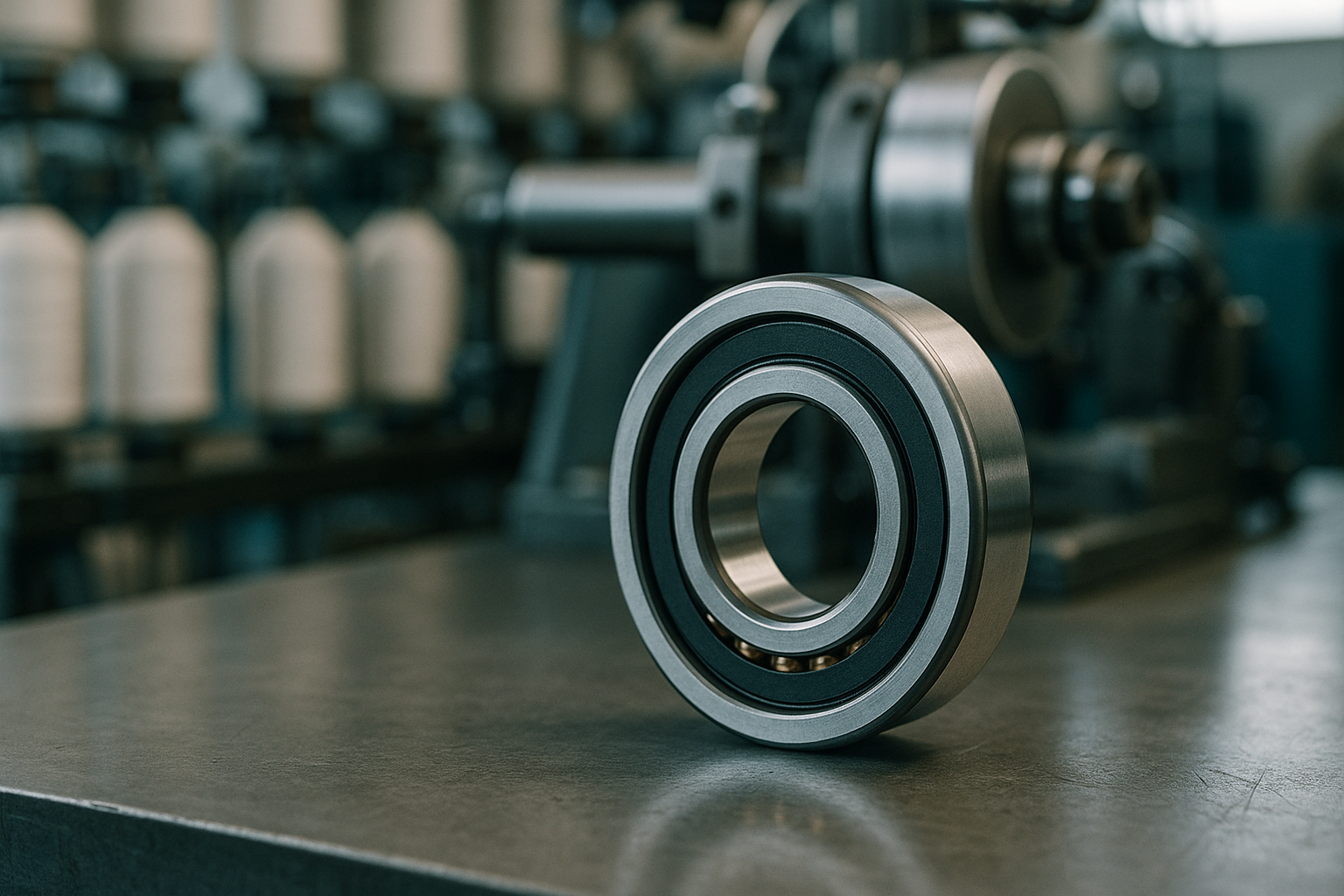
Walk a spinning floor in Prato or Biella with the machines running and the first thing you notice is not the noise but its texture. A well-maintained mill produces a steady hum; a mill with three failing bearings produces a hum with edges on it, and the operators hear the difference long before the condition monitoring system flags anything. This is the quietly demanding world that textile machinery high-speed bearings live in — speeds that reach twelve thousand revolutions and beyond, continuous campaigns that run for days without a stop, lint that finds every gap in a seal, and an acoustic requirement that no general industrial specification bothers to address.
Speed alone is not what makes the application hard
Plenty of industrial positions run fast. What distinguishes textile machinery is the combination of sustained high speed with continuous duty and a contamination environment that never lets up. A spindle bearing on a twister accumulates more revolutions in a fortnight than a general conveyor bearing sees in a year, and it does so while fine fibre dust settles into every available crevice. Heat has no quiet period in which to dissipate, because there is no quiet period. The consequence is that specifications which look adequate on a datasheet — correct bore, adequate load rating, sensible speed limit — still fail early here, because the datasheet describes a duty cycle the textile mill does not have. Selecting on catalogue speed rating alone is the single most common error in this sector.
The acoustic requirement is commercial, not cosmetic
Noise matters in a mill for two reasons that have nothing to do with comfort. The first is that operators use sound as a diagnostic instrument, and a floor with a high baseline of bearing noise destroys their ability to hear the one machine that is starting to go. The second is that modern textile equipment increasingly carries acoustic monitoring for automated fault detection, and those systems are calibrated against a background they expect to stay stable. Bearings that emit more than their share of noise raise the floor for everything else and degrade both diagnostic channels at once. This is why precision grades and cage selection matter more here than the raw load calculation suggests, and why an apparently equivalent bearing at a lower price can end up costing a mill its early-warning capability.
Cage material decides most of the acoustic outcome
Polymer cages run quieter than steel or brass because the material damps rather than transmits, and on textile positions operating within their temperature envelope they are usually the correct choice for that reason alone. They also tolerate marginal lubrication better than metal cages, which matters on positions where the lubrication interval is stretched by access difficulty. The constraint is temperature: above roughly 120 degrees the polymer degrades and the advantage becomes a liability, so positions near drying sections or heated rollers need metal cages regardless of the acoustic cost. The full trade-off across all three cage materials is worked through in our guide to cage material choices in modern bearings, which applies directly to this selection.
Lint is a sealing problem before it is a bearing problem
Cotton and synthetic fibre dust behaves differently from the mineral contamination most seal designs are tested against. It is light, it is fibrous, and it migrates along surfaces rather than settling, which means it finds seal lips that would comfortably exclude sand. Once inside, it packs rather than circulates, absorbing lubricant and holding moisture against the raceway. Heavy-duty contact seals with lint-management geometry handle this; standard shields do not, and a mill that specifies shields on exposed positions will be replacing those bearings on a schedule set by contamination rather than by fatigue. Where the environment is genuinely severe, the calculation that matters is described in our notes on preventing bearing contamination in high-intensity production.
Where the premium tier earns its money and where it does not
Precision-grade bearings from the premium ranges deliver the tolerance consistency and surface finish that produce both the acoustic performance and the extended service life textile applications want, and on primary spindle positions running continuous campaigns they repay the forty to sixty percent premium comfortably through fewer interventions. On secondary positions — winding frames running single shifts, ancillary drives, anything with easy access and forgiving stop cost — that premium buys very little. Italian mills that segment their positions this way generally find that somewhere around a third of their bearing population justifies the precision tier. Specifying it everywhere is a common and expensive habit; specifying it nowhere is worse, because it shows up as noise on the floor within a year.
Service life expectations worth holding suppliers to
On primary textile machinery positions, premium specifications should be delivering eighteen to thirty-six months of continuous service, and standard specifications eight to eighteen. If your mill is replacing bearings materially faster than that, the cause is usually contamination through a compromised seal or a lubrication interval that no longer matches the actual duty, not the bearing itself. Establishing these numbers as a baseline turns vague dissatisfaction into a specific conversation with a supplier, and it also gives the maintenance team a threshold at which to investigate rather than simply reorder. The relevant specifications across ball and roller types are stocked within the angular contact range and the broader deep groove ball bearing category, in both standard and precision grades.
What Italian mills expect from a supplier beyond the box
The mills that run well have long relationships with distributors who understand the machinery rather than just the part numbers, and they expect application engineering support when a position starts misbehaving, failure analysis when something fails unexpectedly, and honest guidance on when the cheaper option is genuinely fine. Brands with established textile application engineering — SKF, NSK and KOYO all maintain specific ranges for this sector — provide that support through distribution, and the distributors who pass it on capture the relationship. Those who compete only on the quoted price of a catalogue item tend to win the order and lose the account.
The short version for a mill engineer
Specify precision grade and polymer cages on primary high-speed positions, heavy-duty contact seals everywhere lint can reach, and metal cages wherever the temperature exceeds the polymer envelope. Hold your standard-tier positions to a standard-tier budget. Track service life against the eighteen-to-thirty-six month baseline and investigate deviations rather than absorbing them. The acoustic environment you get from doing this consistently is not just quieter — it is diagnostic, which is the part that saves you the unplanned stop.
Need help specifying bearings for textile machinery positions? Our team supports Italian and European mills on precision grades, sealing and service life programmes. Book a free consultation.